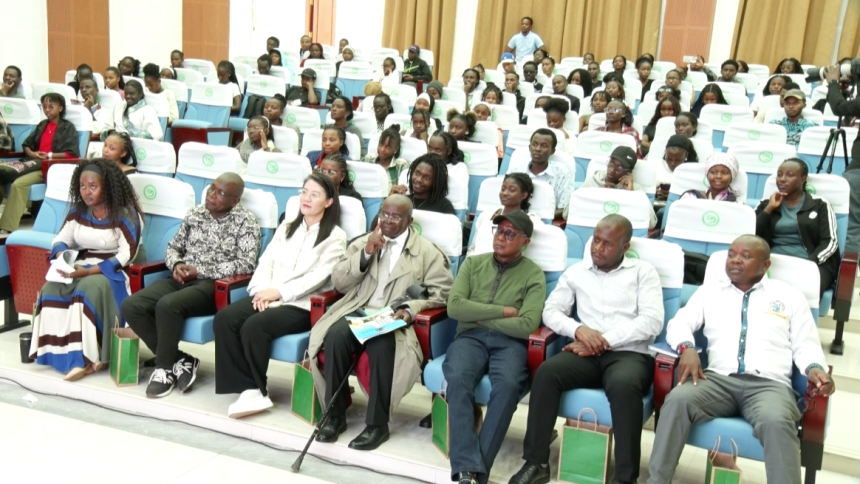
Classical poetry is emerging as a powerful symbol of shared values and people-to-people engagement as China and Kenya increasingly turn to culture, literature, and academic exchange to enhance their bilateral relations.
This was the central message during a celebration of Classical Chinese Poetry held at the Confucius Institute of the University of Nairobi, where scholars, students, literary experts, and cultural enthusiasts gathered under the theme “Harmony Between Humanity and Nature.”

The event focused on promoting cultural exchange through a shared appreciation of literary traditions while highlighting the growing importance of educational and cultural diplomacy in Kenya-China relations.
Speaking at the event, University of Nairobi Vice Chancellor Margaret Hutchinson described poetry as a bridge of wisdom that carries cultural memory and human aspirations across generations and continents.
She noted that the theme invited participants to rediscover “the timeless dialogue between heaven, humanity, mountains, and water,” adding that such imagery reflects how societies across civilisations understand the world and humanity’s place within it.
“This year, 2026, holds special significance. It marks the China-Africa Year of People-to-People Exchanges, as well as the 70th anniversary of the establishment of diplomatic relations between China and African countries,” she said.
Hutchinson highlighted that the partnership between China and African countries has expanded beyond development cooperation into deeper cultural understanding and mutual appreciation.
She praised the role played by the Confucius Institute at the University of Nairobi in advancing language learning, academic collaboration, and cultural exchange programmes that continue to connect Kenyan and Chinese communities.
The Vice Chancellor also noted the institute’s recent performance in the 25th Chinese Bridge Chinese Proficiency Competition, Kenya Division Finals, stating that the achievement reflects the growing interest in Chinese language and culture among Kenyan students.
The Director of the Confucius Institute at the University of Nairobi, Wang Shangxue, stated that poetry and literature remain central to ongoing China-Africa civilizational dialogue initiatives.
She explained that Chinese poetry, with a history spanning more than 3,000 years, forms a major pillar of China’s traditional culture and is distinguished by brevity, emotional depth, and musicality.
“Chinese poets believe that words end, but meaning never ends. They leave blank spaces for the reader’s heart,” she said.
Wang traced the origins of Chinese poetry to The Book of Songs, known as Shijing, and noted that Chinese poetry flourished during the Tang Dynasty, producing renowned poets such as Li Bai and Du Fu.
“In the Tang Dynasty, around 1,300 years ago, Chinese poetry reached its golden age. Every educated person in the Tang Dynasty could write poetry,” she
explained. She remarked that classical Chinese poetry uses natural imagery to communicate human emotion and philosophical reflection, particularly regarding the relationship between humanity and nature.
“In only a few words, they create deep meaning and wide imagination. Poetry connects nature and humans, past and present,” she said.
Dr Mercy Kathina, a lecturer and comparative literature scholar, drew connections between Chinese literary traditions and Kenyan oral poetry, arguing that both cultures use poetry to preserve memory, express social realities, and transmit values across generations.
Kathina noted that Chinese poetry is deeply influenced by Confucian philosophy, emphasising harmony, morality, and coexistence between humanity and nature.
She contrasted the subtle imagery used in Chinese poetry with the more direct and confrontational tone often found in Kenyan poetry, citing Okot p’Bitek and his work Song of Lawino as an example of African poetry’s direct critique of colonial influence and cultural change.
“Poetry mirrors society. Literature reflects what is happening in society and never exists in abstraction,” she said.
Dr. Kathina added that both Chinese and Kenyan traditions use poetry as a tool for preserving communal identity and passing cultural values from one generation to another.
On his part, Kenya Literature Bureau representative Joel Okinde emphasised the growing collaboration between Kenyan literary institutions and Chinese partners in expanding access to translated literary works.
He stated that the Kenya Literature Bureau had already worked with the Chinese Embassy to translate The Governance of China into Kiswahili and English, with plans to distribute the books to libraries across the country.
Okinde also revealed plans to translate more Chinese poems for younger learners as Mandarin language education continues to expand in Kenyan schools.
“We want our students to take the language to the next level,” he said.
Calls for continued literary and academic exchanges between Kenya and China resonated throughout the event, with participants describing poetry as a universal language capable of fostering dialogue, empathy, and mutual understanding across cultures.
Speakers noted that the celebration demonstrated how cultural diplomacy is becoming an increasingly important pillar of Kenya-China relations, complementing economic and infrastructure cooperation with deeper human and intellectual engagement.