China’s record-breaking Shenzhou-21 astronauts have made their first public appearance since returning from the nation’s longest-ever crewed space mission. They offered new insights into their 210-day journey, which combined pioneering scientific research with an unprecedented in-orbit emergency rescue operation.
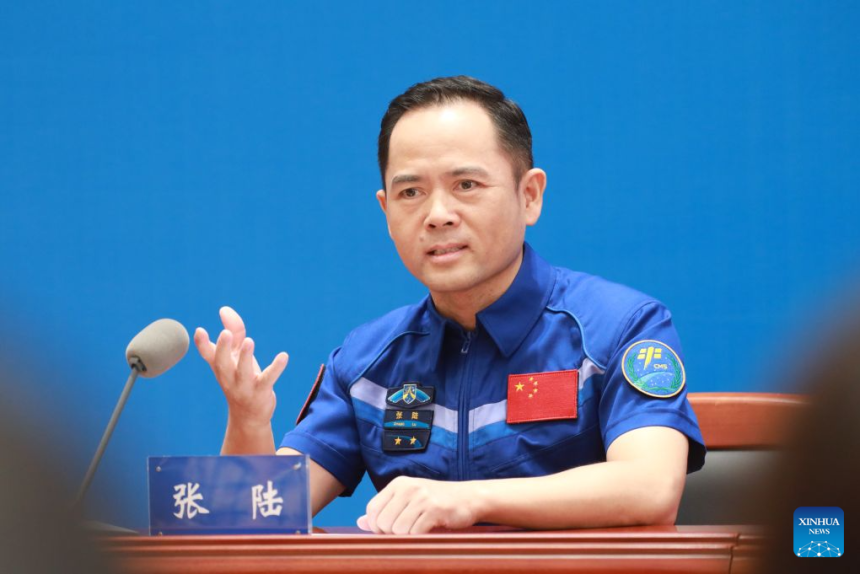
Mission commander Zhang Lu, alongside astronauts Wu Fei and Zhang Hongzhang, met journalists in Beijing on Wednesday, following months of post-flight rehabilitation after their return to Earth in May.

Officials said all three astronauts are in excellent physical and psychological condition, with their muscle strength, endurance, and cardiovascular fitness largely restored to pre-flight levels. The crew has now entered the final phase of medical observation before resuming regular astronaut training.
The Shenzhou-21 mission, which ran from 31 October 2025 to 29 May 2026, established a new record for the longest single spaceflight by Chinese astronauts, lasting 210 consecutive days aboard China’s space station.
During their time in orbit, the crew conducted three spacewalks, completed a wide range of scientific experiments, and participated in what became the first in-orbit emergency rescue operation in the history of China’s human space programme.
“The emergency response system of China’s manned space programme withstood a real-world test during our stay,” Zhang said. “From responding to a spacecraft impact by space debris and adjusting our orbital schedule, to switching return vehicles and executing an emergency launch, the entire system worked seamlessly to ensure our safety.”
Zhang further stated that the experience reinforced his confidence in China’s space programme, citing its technical precision, calm decision-making, and strong teamwork during one of the mission’s most challenging moments.
The mission also cemented Zhang’s place in China’s space history. Having completed seven spacewalks across the Shenzhou-15 and Shenzhou-21 missions, he is now the country’s most experienced astronaut in extravehicular operations.
For Wu Fei, the mission marked the culmination of years of engineering work on Earth. Having previously helped develop the Tianhe core module and the Wentian laboratory module, he found operating systems he had once tested on the ground made working in orbit both familiar and rewarding.
“All the experience accumulated from my ground work translated into the confidence and composure I needed for precise operations and sound judgments in space,” Wu explained.
Payload specialist Zhang Hongzhang highlighted a series of scientific milestones achieved during the mission. These included China’s first successful aeroponic cultivation of cherry tomatoes and wheat in orbit, the first closed-loop breeding of mice in space, and the validation of advanced technologies designed to improve spectral efficiency and water-fertiliser utilisation for future space agriculture.
Beyond scientific research, the crew cultivated more than ten varieties of crops, including wheat, tomatoes, sunflowers, sweet potatoes, and mint. The experiments not only advanced China’s in-orbit food production capabilities but also helped improve the astronauts’ living environment during the six-month mission.
The achievements of Shenzhou-21 underscore China’s continuing expansion of its human spaceflight programme as the country advances long-duration missions, space station research, and preparations for future deep-space exploration.