Shortage of adequate sanitation facilities in parts of Turkana County, including Kakuma and Kalobeyei, has long forced residents to rely on unsafe alternatives, threatening public health in one of Kenya’s most densely populated arid regions and refugee-hosting areas.
A new private-sector partnership now seeks to change the situation through a market-based model that expands access to climate-resilient toilets while creating local jobs and a circular waste economy.

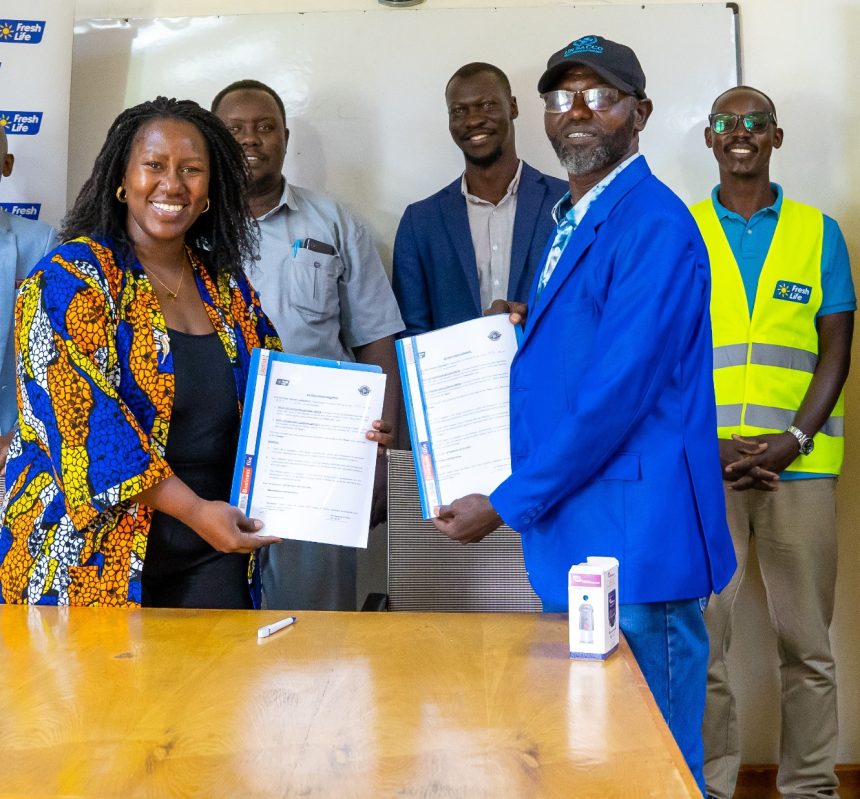
Fresh Life Sanitation Services Ltd and Atoo Kakuma Usafi Company Ltd have signed a long-term Distributorship Agreement to expand access to Urine Diversion Dry Toilets (UDDTs) across Turkana County, including Kakuma Refugee Camp, Kalobeyei Integrated Settlement, and surrounding host communities.
The arrangement, facilitated by Swisscontact under its Climate Proofing WASH Services programme, positions Atoo Kakuma as a non-exclusive distributor of Fresh Life’s water-efficient sanitation technology.
The model is designed to operate beyond donor-funded cycles by anchoring service delivery in local enterprise and commercial viability.
The initiative aligns with Kenya’s broader refugee inclusion and self-reliance agenda under the Shirika Plan, which promotes private-sector participation in essential services within refugee-hosting regions.
Swisscontact Team Lead Jimmy Delyon said the partnership demonstrates that sanitation delivery can shift from short-term humanitarian interventions to sustainable local business systems capable of addressing public health and dignity at scale.
“What began as an ambition to introduce a private-sector-led sanitation model in Kakuma has now evolved into a proof point that sustainable, market-driven solutions can work in fragile and refugee-hosting contexts,” said Delyon.
“This agreement demonstrates that sanitation can move beyond short-term humanitarian delivery to become a viable local business that addresses public health, dignity, and economic inclusion at scale,” he added.
Turkana West has for years grappled with a severe sanitation gap, with limited public facilities serving large populations, contributing to open defecation risks and disease exposure.
The new model now seeks to expand pay-per-use sanitation units in high-density areas while building a structured local operator network to manage waste collection and service delivery.
Atoo Kakuma Usafi Company CEO Moses Eyaran said the partnership marks a turning point for the organisation, which began as a small community youth initiative before evolving into a structured sanitation enterprise.
He noted that technical support under the programme has strengthened logistics, coordination, and waste management capacity, enabling the company to scale operations sustainably.
“We began at a very small scale, and through Swisscontact’s support, our potential was recognised and strengthened, opening the door to a commercial partnership with Fresh Life that validates local enterprise in refugee-hosting contexts,” he said.
Since the rollout of the Climate Proofing WASH initiative, 57 urine diversion dry toilets have been installed in Kakuma town.
The programme has also created multiple income streams, engaging 37 local entrepreneurs in installation and servicing roles, while 45 young people are employed in briquette production and marketing activities. More than 200 women supply biomass used in the production chain, linking sanitation services to household-level earnings.
Waste collected from the toilets is transported by Kalobeyei Water and Sanitation Company to Sanivation Ltd, where it is processed into eco-friendly briquettes, forming a closed-loop system that converts sanitation waste into usable energy products.
According to Water Mission and Plan International Kenya, which are among the implementing partners supporting the broader programme alongside APAD, the approach demonstrates how sanitation infrastructure can be adapted for arid and off-grid environments without relying on conventional sewer systems.
Fresh Life Head of Strategy Angela Nzioki said the model offers a replicable pathway for other underserved regions, noting that many parts of the country lack sewer connectivity and require decentralised sanitation systems anchored in local operators.