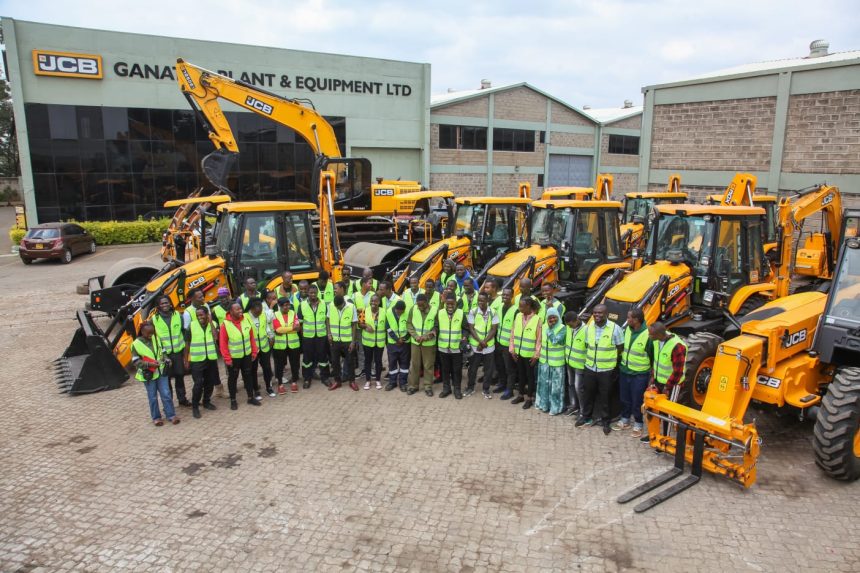
Ganatra Plant and Equipment Training Institute (GPTI) has announced plans to expand its training programmes across East Africa. The initiative, marking the institute’s tenth anniversary, aims to certify 5,000 heavy plant operators by 2029.
A recent graduation ceremony celebrated students from Kenya, Uganda, the Democratic Republic of Congo, and South Sudan.

Since its establishment in 2015, GPTI has trained over 1,500 operators, mechanics, and instructors, serving the construction and heavy equipment sectors in Kenya and neighbouring countries.
The institute’s comprehensive training methodology includes classroom instruction, simulator-based learning, workshop practice, and supervised field experience. A European-imported simulator is used for operator training on wheeled and tracked excavators and wheel loaders.
General Manager Suhhel Yakub explained the simulator’s benefits: “Every trainee’s first hours on a real machine are the most expensive and the most dangerous hours of the entire course. The simulator lets a student make those mistakes in software instead of on twenty tonnes of hydraulics. They arrive at the machine past the fear, and that changes everything: for the operator, for the equipment, and for everyone else on that site.”
The announcement comes as demand for certified heavy plant operators grows alongside increased construction activity in Kenya and the wider region. Industry stakeholders frequently cite shortages of qualified operators as a hindrance to project delivery, equipment maintenance, and workplace safety.
The institute says practical training is resource-intensive, requiring access to machinery, workshops, and dedicated training grounds. To enhance accessibility, Ganatra has introduced modular training programmes, allowing trainees to enrol in individual machine courses or shorter schedules.
“A student who can only spare two weeks is still a student,” said GPTI Administrator Maggie Kamau.
“We built the modules so that time stops being the thing that disqualifies you. We arrange the hours around the student.”Kamau emphasised that all trainees follow a consistent instructional sequence.
“We do not start with the machine. We start with the classroom, then the simulator, then the workshop. By the time a student climbs into a live excavator, the expensive mistakes are already behind them,” she said
Yakub said the curriculum also covers safety procedures, machine knowledge, and operating principles.
He stated, “We work according to the student’s plan and hours. But there is more to this than operations. There is safety. That is why you learn the fundamentals of safety procedures, machine knowledge, and operating principles.”
He also highlighted an increase in female participation in heavy equipment training, noting, “This proves that skills and dedication have no gender boundaries. Anyone with the passion, commitment and the right training can succeed.”
During the anniversary ceremony, graduates shared their experiences. Alumna Shanice Amakhula remarked that the milestone reflected the training’s profound impact:
“It is about recognising the growth, the achievements, the challenges overcome, and the many lives that have been changed through the knowledge and skills gained here.” said Shanice
Stephen Ndung’u, who progressed from trainee to operator and mechanic after joining in 2024, credited access to workshop facilities for strengthening his practical skills.
Mukasa Lawrence, a heavy mechanics student from Kampala, found that practical exposure to equipment reinforced classroom learning.
“Every concept in heavy mechanics, hydraulics, fluid mechanics, we now touch with our own hands,” he said.
The institute offers courses in heavy plant operation, plant mechanics, driver training, and instructor development. Its operator programme integrates classroom learning, simulator training, workshop instruction, and supervised practical experience on construction sites.