As the second and last term of Antonio Guterres comes to a close in December 2026, the race for the next United Nations (UN) Secretary-General has gained momentum turning to who will steer the world’s premier multilateral body in 2027.
Since the United Nations was founded in 1945, all the nine Secretaries-General that have served the organisation have been men.

While the office has been held by leaders from Europe, Asia, Africa and Latin America and the Caribbean, no woman has ever served as the UN’s top diplomat.
The contest now intensifies with one question taking centre stage, ‘Is the world ready for a female UN Secretary-General?’
There is also growing international support for electing the first female UN Secretary-General.
When the race for the next SG officially opened on November 25, 2025, the President of the UN General Assembly, Annalena Baerbock, and the President of the Security Council for November 2025, Michael Imran Kanu, sent a letter to Member States. In their letter , they called for a process guided by transparency, inclusivity and integrity while also urging member states to consider women candidates.
Similarly, the “1 for 8 Billion” campaign has intensified calls for a transparent, inclusive and merit-based selection process while urging Member States to nominate qualified women.
Candidates for UN Secretary General position
There are several high profile candidates that have entered the race so far with female candidates dominating the line up.
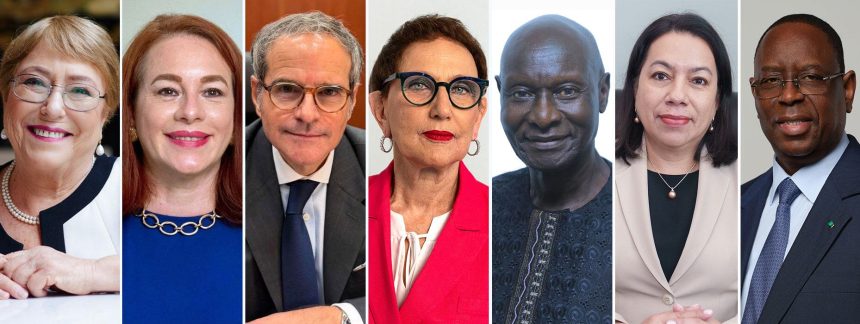
Out of the seven candidates nominated for the position, four are female.
They include: Former President of Chile and former UN High Commissioner for Human Rights, Michelle Bachelet of Chile, Secretary-General of UN Trade and Development (UNCTAD), Rebeca Grynspan of Costa Rica, former Minister of Foreign Affairs and former President of the UN General Assembly, María Fernanda Espinosa of Ecuador, Permanent Representative of Guyana to the UN and former Foreign Minister, Carolyn Rodrigues-Birkett of Guyana.
The three male candidates are Director General of the International Atomic Energy Agency (IAEA), Rafael Grossi of Argentina, former President of Senegal, nominated by Burundi, Macky Sall of Senegal as well as former UN Under-Secretary-General and Special Representative for Children and Armed Conflict, nominated in July 2026, Olara Otunnu of Uganda.
The strong presence of women has given fresh momentum to calls for the UN to break with its eight- decade-old tradition of male leadership.
Proponents of a female Secretary-General argue that the UN’s commitment to gender equality should be reflected in its highest office. However, critics point out that the final decision will ultimately depend not on public opinion but on the complex geopolitical negotiations within the Security Council.
Regional rotation
The position of UN Secretary-General has traditionally reflected an informal principle of regional rotation, although there is no formal rule requiring it. The office is rotated among the regional groups of the UN with each region getting two or three consecutive terms.
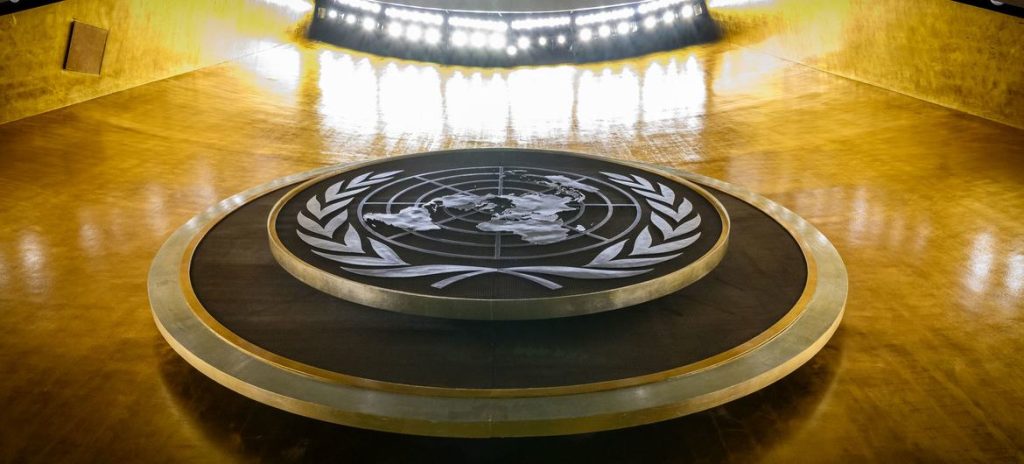
UN Photo/Loey Felipe The UN crest is pictured in the General Assembly hall.
In its 80 years of existence, regional distribution of Secretary-Generals has been four from Europe, two from Asia two from Africa and one from Latin America and the Caribbean while North America and Oceania have had no representation.
However, according to Dr. Graham Amakanji Oluteyo, an academic, lecturer and Senior Research Analyst specialising in Peace, Security and International Relations, regional representation should not be considered in isolation.
Speaking in an interview with KBC Digital, Dr. Oluteyo says the effectiveness of the Secretary-General cannot be separated from the international political system in which the UN operates, noting that regional rotation should serve the core mandate of the UN, rather that simply satisfying the geographic consideration.
“International relations is largely about power, and basically the functioning of the UN is determined to a great deal by the major powers,” Dr. Oluteyo noted adding that, “Regional rotation should not simply be about ensuring that every region feels represented; it should be about advancing peace and security.”
Women leaders
The growing number of women occupying the highest leadership positions across the United Nations system has further strengthened the case for the appointment of the organization’s first female Secretary-General.
Today, several key UN agencies are headed by women; Sima Sami Bahous heading UN Women, Catherine Russell for United Nations Children’s Fund (UNICEF) while Cindy McCain leads World Food Programme (WFP).
Others include, Audrey Azoulay who heads the United Nations Educational, Scientific and Cultural Organization (UNESCO) as well as Rebeca Grynspan of who is also a candidate for Secretary-General, serves as Secretary-General of the United Nations Conference on Trade and Development (UNCTAD).
Meanwhile, Winnie Byanyima of (Uganda) is the Executive Director, Joint United Nations Programme on HIV/AIDS (UNAIDS). and also serves as a United Nations Under-Secretary-General.
To add to the list, recently, Monica Juma of Kenya was appointed by Antonio Guterres to head United Nations Office on Drugs and Crime (UNODC) as Executive Director as well as Director-General of the United Nations Office at Vienna (UNOV).
In addition, the President of the UN General Assembly, Annalena Baerbock of Germany, is also a woman, underscoring the increasing presence of female leadership at the highest levels of the United Nations and Amina Mohammed, the Deputy Secretary-General of the United Nations.
According to proponents, this then weakens the argument of whether there is a lack of qualified female leadership within the UN system. They note that from the statistics this goes to show that women are indeed qualified to hold the office of the Secretary General of the United Nations.
However Dr. Oluteyo argues that the debate should go beyond gender and examine where power actually lies within the UN system.
“Whether the UN is spearheaded by a male or a female Secretary-General, the bigger question is the balance of power and the cooperation of the major powers, particularly within the Security Council.” Dr. Oluteyo noted.
Adding that: “A female Secretary-General would undoubtedly represent a historic breakthrough for gender equality and could strengthen the UN’s credibility on its own commitments to women’s leadership. However, the office-holder would still operate within an institution where the five permanent members of the Security Council; China, France, Russia, the United Kingdom and the United States retain veto power,” he added.
To become the UN Secretary-General, a candidate must be officially nominated by a UN member state, self-nomination is not permitted, additionally, a candidate must secure at least 9 votes out of 15 in the UN Security Council without receiving a veto from any of the five permanent members (China, France, Russia, the UK, and the USA).
Finally, the Security Council’s chosen nominee is then sent to the 193 member UN General Assembly for a final formal appointment vote.
The effectiveness of the Secretary-General will ultimately depend on the cooperation of members of the Security Council, particularly the five permanent members.
The selection process began in April 2026 with the General Assembly dialogues featuring six of the seven candidates who had been nominated at the time. Olara Otunnu of Uganda, joined the race later, following his nomination on July 24, 2026.
The 15-member Security Council held its first straw poll on July 30, 2026, as it began narrowing the field of candidates.
A General Assembly dialogue with the latest candidate, Otunnu is scheduled for Aug 19, 2026 while a second Security Council straw poll is planned for Aug 21, 2026.
The process places the Security Council at the heart of the contest.
According to Dr. Oluteyo, the next Secretary-General will inherit an increasingly complex international system that is characterised by competing centers of power saying he/she must be able to navigate them.
“The world is increasingly shifting towards multipolarity, with several centres of power, and the next Secretary-General must be able to navigate these competing interests,” Dr. Oluteyo argued.
Oluteyo describes an ideal candidate for the position of UN SG as one who will maintain relationships across geopolitical divides.
“The UN Secretary-General must be friendly to the East, the West, the North and the South, while responding to Africa’s call for greater representation,” he added.
The tenth Secretary-General will follow in the steps of: António Guterres (Portugal), who took office in January 2017, Ban Ki-moon (Republic of Korea), 2007 to 2016, Kofi Annan (Ghana), 1997 to 2006, Boutros Boutros-Ghali (Egypt), 1992 to 1996, Javier Pérez de Cuéllar (Peru), 1982 to1991, Kurt Waldheim (Austria), 1972 to 1981, U Thant (Burma, now Myanmar), 1961 to 1971, Dag Hammarskjöld (Sweden), 1953 to1961 and Trygve Lie (Norway), 1946 to 1952.
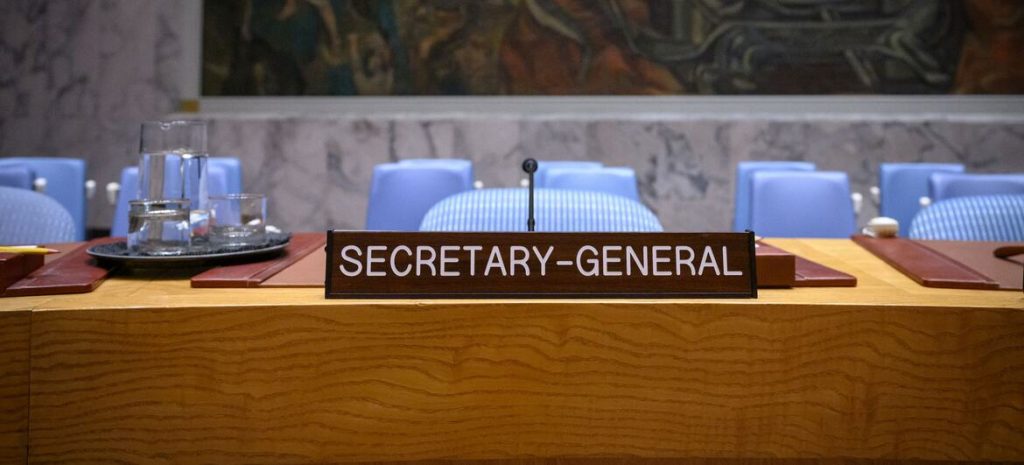
UN Photo/Loey Felipe The UN Secretary-General regularly addresses the Security Council. (pictured)
Security Council
The Security Council is one of the six main organs of the United Nations established under the UN Charter. Its primary responsibility is maintaining international peace and security.
The Council has 15 Members (5 permanent and 10 non-permanent members). Each Member has one vote. Under the Charter, all Member States are obligated to comply with Council decisions.
UN General Assembly
The UN General Assembly (UNGA) is the main policy-making organ of the Organization. Comprising all Member States, it provides a unique forum for multilateral discussion of the full spectrum of international issues covered by the Charter of the United Nations. Each of the 193 Member States of the United Nations has an equal vote.
The UNGA also makes key decisions for the UN, including: Appointing the Secretary-General on the recommendation of the Security Council, electing the non-permanent members of the Security Council and approving the UN budget.