Kenya Broadcasting Corporation is urging the Kenya Meteorological Service Authority to effectively utilize its wide network of radio, television and digital platforms to reach the last mile in the delivery of weather forecasts.
The Controller of Television Programs at KBC Monica Juma said media is about impacting the lives and livelihoods with the information that is passed to the public, hence the intersection between the role of the media in delivering news and action based forecasting.

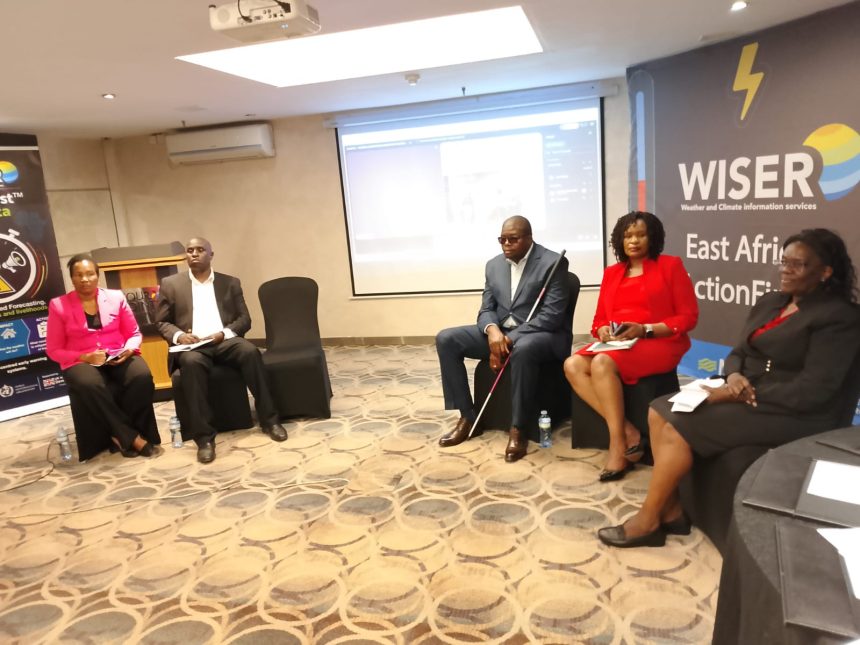
“I believe media is about impacting the lives of whoever is watching, or listening, because if it not going to impact your life then there is no need of having on air,” said Juma when she represented the KBC Managing Director and Chief Executive Officer Agnes Kalekye at the National Sensitization Workshop on Action-Based Forecasting (ABF) and Institutional Coordination for Early Action in Kenya.
Juma noted that, the evolution forecasting from threshold forecasts, to impact based forecast now to Action Based Forecasts will enrich the delivery of weather forecast information to the public. “Remember the days of Ngwata Francis, when he said it was going to rain, it was definitely going to rain. But we stopped at the rain. If he said it was going to be sunny, it was going to shine. And it stopped at shining,” she said adding that with the improved forecasting through Action Based Forecasting shifts weather prediction from merely describing physical events to anticipating specific human and economic consequences will enrich the news being delivered to the public.
She urged the Kenya Meteorological Service Authority to make use of the national broadcaster’s two television stations, KBC Channel1 and Y254 and radio stations including Radio Taifa which broadcasts in Kiswahili and KBC English Service which broadcasts in English and over 23 vernacular FM stations, a Podcast Magazine and KBC Digital to reach the last mile in delivery of Action Based Weather Forecasts.
“So all of this, when we speak, the language ought to be one in which we are sensitising the public, in which we are empowering the public, in which the information that we are disseminating is one that can be able to influence, one that can be able to change, and one that can be able to impact their lives,” said Ms. Juma and added, “Our responsibility as a national broadcaster is first to the people. Message that is for the people, by the people, that can be able to influence and make them make the right decisions.”
The Acting Director of Kenya Meteorological Service Authority Edward Muriuki said Action Based Forecasting is filling the gap in which early warning systems only focused primarily on describing the expected weather, by advocating for co-production of early warning information among all stakeholders in the Disaster Risk Management (DRM) value chain including the community.
“Impact Based Forecasting translates weather forecasts into likely societal impacts by combining meteorological information with data on exposure and vulnerability, while Action Based Forecasting links these anticipated impacts to early actions that can be implemented before a hazard escalates into a disaster,” said Muriuki in a speech read for him by Deputy Director for Public Weather Services Mary Kilavi.
The Acting Director further noted that Action Based Forecasting has the potential to transform disaster risk management in Kenya by enabling government agencies, humanitarian organizations, emergency responders, county governments, and communities to move from reactive emergency response to proactive risk management.
Muriuki said while there is fear and anxiety among the public on possible above average rainfall during the October-November-December (OND) 2026 season due to the prevailing El Nino conditions and a possible Positive Indian Ocean Dipole, “the rain has the potential to support agriculture, replenish water resources and improve hydropower generation hence the need to plan for its positive utilization.”