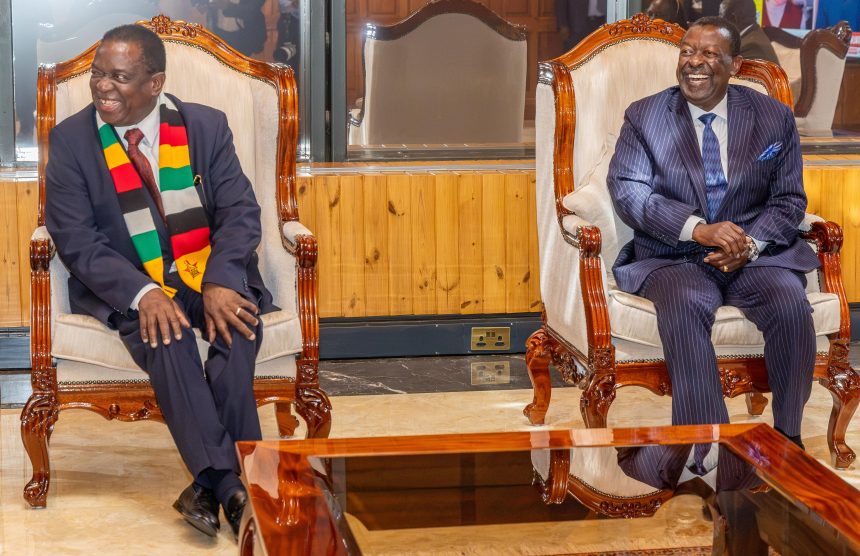
Kenya and Slovenia have committed to strengthening their bilateral partnership, with renewed focus on trade, investment, technology transfer, healthcare, climate action and skilled labour mobility.
The commitment emerged during bilateral talks between Prime Cabinet Secretary and Cabinet Secretary for Foreign and Diaspora Affairs, Musalia Mudavadi, and Slovenia’s Minister of Foreign and European Affairs, Tone Kajzer, who is on an official visit to Kenya.
The discussions reviewed the two countries’ longstanding diplomatic relations and explored practical ways of translating their cordial ties into tangible economic and development opportunities.
Dr. Mudavadi recalled the successful State Visit to Kenya by Slovenian President Dr. Nataša Pirc Musar from May 31 to June 2, 2025, noting that sustained high-level engagements were essential in advancing bilateral cooperation.
Both countries reaffirmed their commitment to implementing the Memorandum of Understanding on Political Consultations signed during the State Visit, including convening its inaugural session.
On trade and investment, the PCS identified considerable opportunities to expand commercial relations and address the existing trade imbalance.
Kenya imported goods worth Ksh.388million (USD 2.986 million) from Slovenia in 2025, against exports valued at Ksh .14 million (USD 110,000).
Mudavadi emphasised the need to expand market access for Kenyan products into Slovenia, particularly value-added agricultural produce.
He also welcomed the growing presence of Slovenian companies in Kenya, including CTC Group, Geocodis, Roto Group, Tevel and Waboost, whose investments span affordable housing, digital solutions, manufacturing, industrial safety and water treatment technologies.
He encouraged more Slovenian enterprises to explore investment opportunities in Kenya’s Special Economic Zones and Export Processing Zones, positioning the country as a strategic manufacturing, logistics and innovation hub for the East African region and the wider African Continental Free Trade Area.
The two countries also explored cooperation in digital transformation, with Kenya seeking to benefit from Slovenia’s experience in artificial intelligence, cybersecurity and e-government.
Climate action and environmental sustainability featured prominently in the discussions, with Kenya appreciating Slovenia’s support for the Aqua Twin satellite-driven river basin management project implemented between 2023 and 2025.
The initiative strengthened Kenya’s capacity in satellite Earth observation, digital twin modelling, drought monitoring and climate planning. It complements the Conduit Climate Intelligence Hub in advancing environmental management.
The two sides further identified opportunities to strengthen cooperation in agriculture and apiculture, drawing on Slovenia’s expertise in sustainable beekeeping.
Building on existing initiatives in Homa Bay and Mandera counties, the partnership seeks to expand beekeeping and rangeland restoration programmes to Wajir, Marsabit and other counties, creating additional livelihood opportunities for women and young people while supporting food security and environmental conservation.
In education, the discussions focused on partnerships between academic and research institutions, particularly in Science, Technology, Engineering and Mathematics, joint research, academic exchanges and skills development.
Healthcare cooperation also emerged as a key pillar, particularly in addressing antimicrobial resistance, a growing global public health challenge.
Mudavadi welcomed the successful Slovenia-Kenya Phage Summit held at Kenyatta National Hospital on October 6, 2026, which brought together Kenyan clinicians, regulators and researchers alongside Slovenian experts.
The discussions explored appropriate regulatory and compassionate-use frameworks for phage-based treatments targeting drug-resistant infections.
The two countries also considered an early-stage EUR 4 million co-investment proposal for regional biomanufacturing capacity, comprising proposed contributions of EUR 2 million each from Kenya and JAFRAL.
A 90-day feasibility process is underway to assess site selection, governance and regional health demand before any binding commitments are made, with Kenyan regulatory oversight and patient safety remaining central considerations.
On labour mobility, Kenya expressed interest in exploring structured cooperation with Slovenia in healthcare, information and communications technology and hospitality, where complementary labour-market needs could create opportunities for skilled professionals.
The two sides also reaffirmed their commitment to peace, security and effective multilateralism, acknowledging the importance of dialogue, conflict prevention and peaceful resolution of disputes.
Kenya appreciated Slovenia’s constructive engagement during its 2024–2025 tenure on the United Nations Security Council and its support for international peace initiatives, including efforts to restore stability in Haiti, where Kenya led the Multinational Security Support Mission.
Both countries committed to strengthening coordination within the United Nations and other multilateral institutions on climate action, biodiversity protection, sustainable development and environmental governance.
PCS reaffirmed Kenya’s commitment to deepening relations with Slovenia through sustained political dialogue, expanded economic cooperation and stronger people-to-people connections.
He expressed appreciation to Minister Kajzer and the Government of Slovenia for their continued friendship and constructive engagement, expressing confidence that the discussions would translate into mutually beneficial outcomes for both countries.