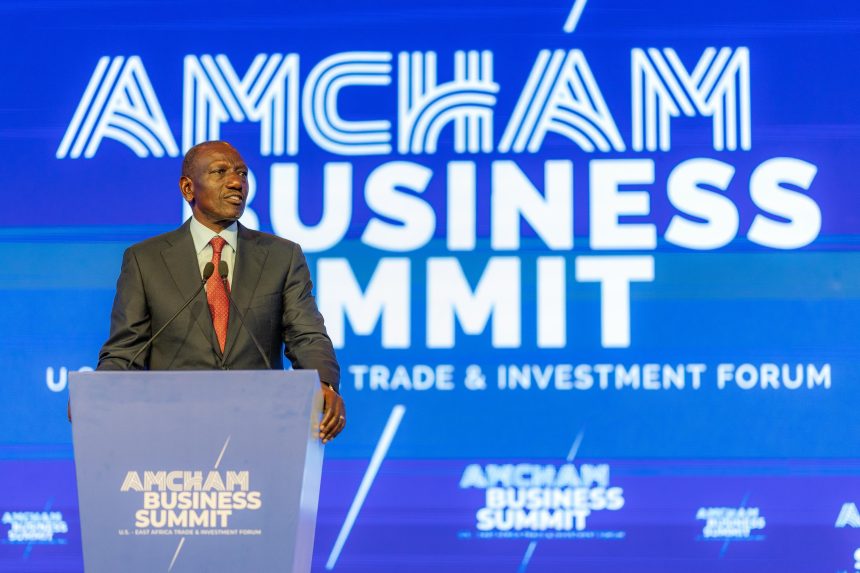
Major investment reforms have positioned Kenya as a strategic hub for Africa’s 1.4 billion people, President William Ruto has said.
The President said Kenya has deliberately moved from policy to implementation in its efforts to improve the business environment, strengthen investor confidence and attract capital.

He made the remarks when he addressed the fifth American Chamber of Commerce (AmCham) Business Summit in Nairobi on Wednesday.
The summit, whose theme is “Advancing Mutual Prosperity Through Trade and Investment”, brought together investors and delegates from more than 30 countries.
President Ruto pointed out that more than 50 business-enabling reforms have been undertaken over the past three years, many directly responding to concerns raised by investors.
Recalling commitments he made at the 2023 AmCham Summit, the President explained that the Government has delivered on several of the pledges.
“I said we would remove VAT on exported services. We did. I said verified tax refunds would be paid within six months or become available for offset. That is now law,” he said.
He added: “I said we would end the premature taxation of shares allocated to start-up employees. We did. And I said we would remove 30 per cent local equity requirement deterring major technology firms. We removed it.”
He noted that other reforms include reduced local ownership requirements for pension scheme administrators and the harmonisation of corporate income tax at 30 per cent for foreign companies that are fully established in Kenya.
The President said the reforms are already producing results, with American companies committing more than $600 million (Ksh78 billion) in new projects since the last AmCham Summit.
These include Oracle, which selected Kenya for its first public cloud region in Africa while Coca-Cola has committed $175 million (Ksh22.7 billion).
Mars Wrigley inaugurated a $103 million (Ksh13.3 billion) production line at Athi River while SC Johnson is establishing a new manufacturing plant to serve the African market.
President Ruto said Ford Motor Company is exploring opportunities in Kenya, linking its founding philosophy of affordable production to the Government’s Bottom-Up Economic Transformation Agenda and its focus on creating jobs and expanding economic opportunities.
The President said Africa continues to receive a disproportionately small share of global foreign direct investment.
He also pointed out that the United Nations Conference on Trade and Development’s ‘World Investment Report 2026’ shows that global foreign direct investment stands at about $1.6 trillion while Africa attracts about $70 billion or 4.3 per cent.
“Africa must claim a larger share, and Kenya intends to lead that effort,” President Ruto said.
He said Kenya’s foreign direct investment has more than doubled, rising from $1.5 billion in 2022 to a record $3.2 billion over the past three years. He attributed the growth to rising investor confidence in Kenya’s renewable energy resources, digital economy and manufacturing potential.
Present were Cabinet Secretaries Lee Kinyanjui (Investment, Trade and Industry) Aden Duale (Heath), United States Assistant Secretary of State for African Affairs Frank Garcia, United States Charge d’Affaires Susan Burns, AmCham Kenya Board President Angela Ng’ang’a and Mastercard Senior Vice-President for Eastern Europe, Middle East and Africa, Middle East and Africa Azzam Alameddin.
The President announced new incentives targeting special economic zones, pharmaceutical manufacturing, public-private partnerships, electric mobility and agricultural value addition.
He also announced the introduction of advance pricing agreements aimed at reducing disputes and providing greater certainty to investors.
On regulatory barriers at the counties, President Ruto urged the Council of Governors to fully implement the County Licensing (Uniform Procedures) Act, 2024.
“An investor should not encounter a different country every time a truck crosses a county boundary,” he said, calling for harmonised procedures, digitised applications and the elimination of duplicate charges.
The President also announced two major pieces of legislation intended to reduce the regulatory burden on businesses.
The proposed Paperwork Reduction Bill, modelled on the US system, will require public agencies to justify, simplify or eliminate compliance requirements imposed on businesses.
The Food and Feed Safety Coordination Bill will seek to streamline the current system involving multiple agencies and enable Kenyan agricultural products to access international markets, including the United States, more efficiently.
Meanwhile, the Investment and Export Promotion Bill, 2026, currently before Parliament, will provide safeguards against unlawful expropriation, guarantee the repatriation of capital, profits and dividends and establish a specialised Investment Tribunal and a Presidential Dialogue Forum.
The reforms will be supported by a digitised Investment – One Stop Centre – through which investors will be able to submit applications, track their progress and receive approvals from a single platform.
“Predictability is the product Kenya is selling. Capital does not move because a President issues a directive. It moves when the rules are clear, licences are issued on time, verified refunds are paid promptly, contracts are respected, and agreed terms do not change halfway through an investment,” President Ruto said.
The Government, he explained, had established a Green Investment Fund with $40 million in seed capital, with a target of mobilising an additional $200 million for green enterprises.
Nearly 100 Special Economic Zone enterprises licensed over the past four years have created 22,000 industrial jobs while 118 Export Processing Zone companies have generated more than 32,000 jobs.
Four new public EPZs in Busia, Kirinyaga, Nakuru and Eldoret are expected to become operational by December 2026.
The President outlined several emerging investment opportunities, including expansion of electricity generation capacity to 10,000 megawatts within seven years, with opportunities in geothermal, battery storage and green hydrogen.
He also identified responsible processing of critical minerals, including rare earth, titanium, graphite and lithium, as well as agro-processing, pharmaceutical manufacturing and medical diagnostics as key areas for investment.
In the creative economy, President Ruto highlighted the proposed $120 million 15,000-seat Zaria Arena at Railway City and Kenya’s ambition to host the Grammy Awards.
He said the objective is not simply to host a high-profile event, but to attract studios, record labels and global platforms and consequently establish Kenya as a permanent centre of African creative production.
The President also highlighted the longstanding Kenya-US health partnership, noting that the United States has invested more than $7 billion in Kenya over the past 25 years.
He pointed to the new five-year $2.5 billion Health Cooperation Framework signed in December 2025, which includes a $850 million commitment by Kenya.
“We do not seek to remain a recipient. We intend to be a capable and dependable partner,” he said.
He underscored Africa’s readiness to work with international partners on the basis of mutual benefit, saying the continent wants partnerships that are neither extractive nor exploitative.
“We want agreements based on a solid foundation of investment for mutual benefit,” he said.
The President stated that Africa is seeking to create a stronger nexus between its assets, minerals and human capital, on the one hand, and investment, technology and skills on the other.
CS Kinyanjui said Kenya and the US enjoy a high degree of economic integration that local companies could leverage to access American markets.
Garcia, the Assistant Secretary of State for African Affairs, emphasised the joint security role Kenya and the United States have played over the years, describing it as critical to economic growth.
“Serious economic growth cannot happen without security,” he said.
Garcia noted that Kenya and the US have an opportunity to become economic leaders globally, and stressed that American companies were looking for trade and investment opportunities that delivered win-win outcomes for both countries.
“We are not here to extract; that is not partnership. We invest in communities, train workers and build mining that respects communities,” he said.
He commended Kenya for embarking on the journey of establishing a vision beyond 2030, describing it as a “brilliant strategy”. He commended President Ruto for being action-oriented and “getting deals across the finish line”.
Ng’ang’a said American investors want Kenya to make it easier to invest and do business.
She pointed out that a harmonised economic zone framework would provide the necessary clarity, alongside targeted incentives.
Through AmCham, she said, American companies contribute to job creation and skills transfer.
“We know Kenya has talent, an enterprising culture and the ability to do business at scale,” she said.