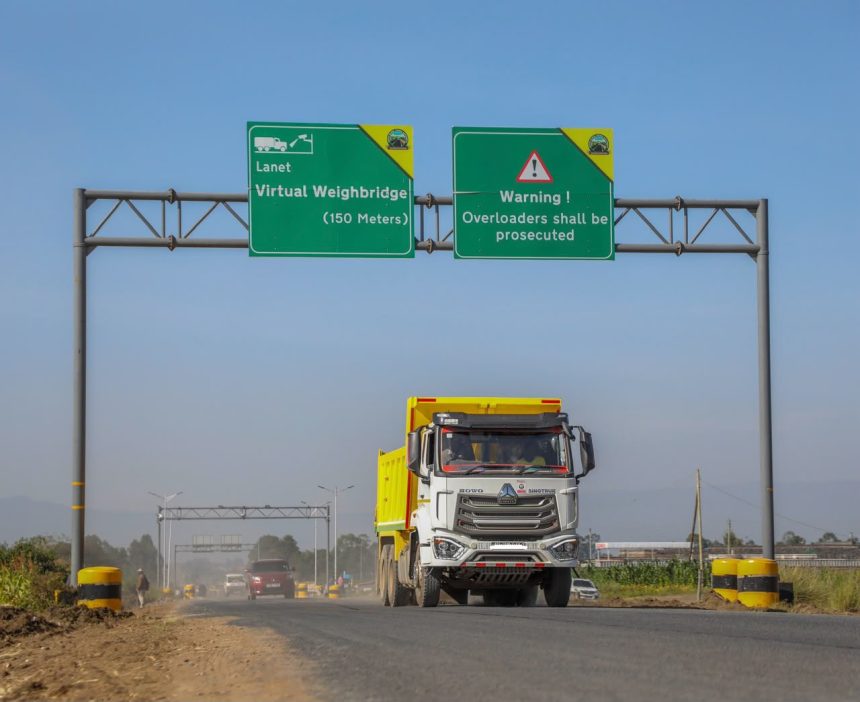
The use of technology to monitor heavy commercial vehicles is helping the Kenya Rural Roads Authority (KeRRA) curb overloading and protect the country’s road network from premature damage.
KeRRA Director of Road Asset Management Dr Engineer Peter Gichohi revealed the authority’s four virtual weighbridges have processed about 2.5 million vehicles since they became operational, with 2 million found to be compliant with axle-load regulations.

The figures represent an 80 per cent compliance rate, which Gichohi said demonstrates the impact of technology in strengthening axle-load control while providing reliable evidence for enforcement.
“Since we started the operations with virtual weighbridges, around 2.5 million vehicles have gone through those virtual weighbridges, of which 2 million have been found to be compliant,” he said.
Gichohi said the technology has also created a deterrent effect, with some truck operators reporting themselves to police after discovering that they had been flagged for overloading.
“We have seen some cases where overloading trackers take themselves to the police station when they find out that they are being sought, and I think that has discouraged many of these trackers from overloading,” he said.
The virtual weighbridges are strategically located at Mwareni along the Mariakani-Bamba Road in Kilifi County, Ewaso Kedong along the Ngong-Suswa Road in Kajiado County, Lanet along the Lanet-Pipeline Road in Nakuru County and Kamukuywa along the Kamukuywa-Chesamis Road in Bungoma County.
He attributed part of the improvement in compliance to the combination of technology, enforcement and stakeholder sensitisation, noting that KeRRA has also been engaging transporters, local leaders, the Judiciary and the Office of the Director of Public Prosecutions (ODPP) on the consequences of overloading.
“We don’t rely solely on prosecution. We do sensitisation among ourselves, local leaders and transporters themselves on the need to comply,” he said.
Despite the high compliance rate, KeRRA has particularly identified sand harvesting, quarrying and the extraction of construction materials as areas where overloading is common.
Gichohi cited the Ngong-Suswa Road, where trucks transporting sand have frequently been found carrying excessive loads, as well as roads serving areas involved in sand harvesting, ballast production and murram extraction.
“Road damage is caused by many factors, and overloading is one of them. For example, if a 52-tonne truck is overloaded to 70 tonnes, the damage to the road can be about six times greater than that caused by a compliant truck,” he explained
Gichohi urged transporters to continue observing axle-load regulations, saying improved compliance extends the lifespan of roads and ensures that public investment delivers benefits to communities for longer.