
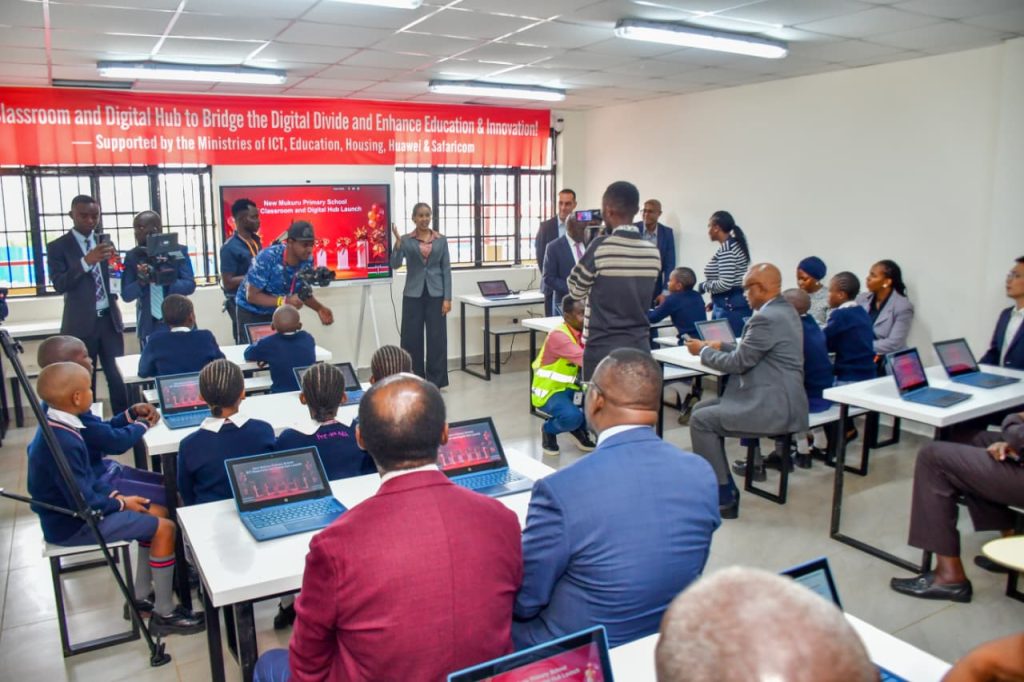
Kenya has marked a major milestone in digital inclusion and education with the official launch of the Mukuru Digital Classroom at New Mukuru Primary School.
The initiative, unveiled as part of the Connected Africa Summit 2026, highlights how integrated digital infrastructure and strong partnerships are transforming learning and community development in underserved areas.

Located within the Mukuru Affordable Housing Complex, the digital classroom is equipped with modern ICT infrastructure including 20 new laptops and is supported by the broader Mukuru ICT Hub.
The initiative is designed to enhance digital literacy, improve learning outcomes, and equip learners with the skills needed to thrive in a rapidly evolving digital economy.
The launch was led by William Kabogo, alongside Eng. John Tanui, with participation from Huawei Kenya, Safaricom, education stakeholders, and community representatives.
Speaking during the launch, Cabinet Secretary William Kabogo emphasized the central role of education in Kenya’s digital transformation:
“Kenya’s digital future begins in the classroom. Through initiatives like the Mukuru Digital Classroom, we are ensuring every learner, regardless of background, has the opportunity to gain the skills needed to thrive in the digital economy.”
Beyond the Classroom: Building a connected and secure community
A recent intervention by Huawei Kenya at the Mukuru ICT Hub demonstrates how end to end digital infrastructure can accelerate inclusive development. The facility has been equipped with fibre to the office connectivity, multiple WiFi 7 access points, CCTV surveillance systems, and a smart classroom screen (IdeaHub), creating an ecosystem that supports learning, safety, and economic activity.
 Affordable fibre packages, priced at nearly half of typical market rates, are also being extended to residents, ensuring that connectivity is not only available but accessible to low income households. For Mukuru families, this means digital opportunity now extends beyond the classroom into homes, businesses, and the wider community.
The impact of this infrastructure is multidimensional. CCTV systems are enhancing security by deterring crime and fostering safer public spaces, which in turn supports small businesses and enables extended economic activity. Within the classroom, the IdeaHub smart screen is transforming teaching and learning into an interactive, digital first experience, enabling multimedia instruction, collaborative learning, and early exposure to critical skills such as coding and digital literacy.
These interventions contribute directly to key development priorities, including quality education, innovation and infrastructure, reduced inequalities, and the creation of sustainable, inclusive communities.
Partner perspectives on digital inclusion
Nyagitari Bosire, Tribe Lead, Fixed Data Products and Proposition at Safaricom, underscored the importance of connectivity:
“Reliable connectivity is the foundation of modern learning. Through strong partnerships, we are helping create connected classrooms that open up quality education opportunities for learners in underserved communities.”
Freshina Morogo, ICT Solutions Manager at Huawei Kenya, highlighted the broader role of technology in bridging inequality:
“Technology can be a powerful equaliser when applied where it is needed most. By supporting smart learning environments, we are helping build digital inclusion and laying a strong foundation for future ready skills from an early age.”
Ruth Ogachi welcomed the initiative as transformative for the school community:
“The Mukuru Digital Classroom represents new possibilities for our learners and teachers. Access to digital tools will enrich learning, improve outcomes, and prepare our students for a fast-changing world.”
More than a classroom, the Mukuru Digital Classroom is a gateway to opportunity, demonstrating how coordinated investments in infrastructure, education, and connectivity can unlock potential at the community level.
As one of the flagship community impact initiatives showcased during the Connected Africa Summit, it stands as a compelling example of how collaboration between government and the private sector can bridge learning gaps, empower underserved communities, and build a future ready generation.