The 31st United Nations Climate Change Conference (COP31) has increasingly been framed as the “Implementation COP”, with a strong focus on translating political and financial commitments into practical action at the scale and pace required to address climate change.
Against this backdrop, Kenya’s approach to forest restoration, anchored in strong government coordination, political leadership and community participation, has received recognition at the global summit in Antalya, Turkey, demonstrating how national commitments can be translated into coordinated action and measurable results on the ground.

Speaking after attending the high-level leaders’ dialogue on Forests and Climate Action: The Contribution of Forests to Addressing Climate Change, Dr. Magrate Kaigongi, a Senior Scientist at the State Department for Forestry, highlighted Kenya’s progress in mobilising national support for forest restoration.
She attributed the progress to the institutionalisation of the 15 Billion Trees by 2032 Programme, which has brought together political leaders, opinion shapers, thought leaders and citizens from different sectors of society behind a shared national goal.
Kaigongi particularly recognised the coordination led by Principal Secretary, State Department for Forestry Gitonga Mugambi, whose leadership has strengthened a whole-of-government approach to forest restoration.
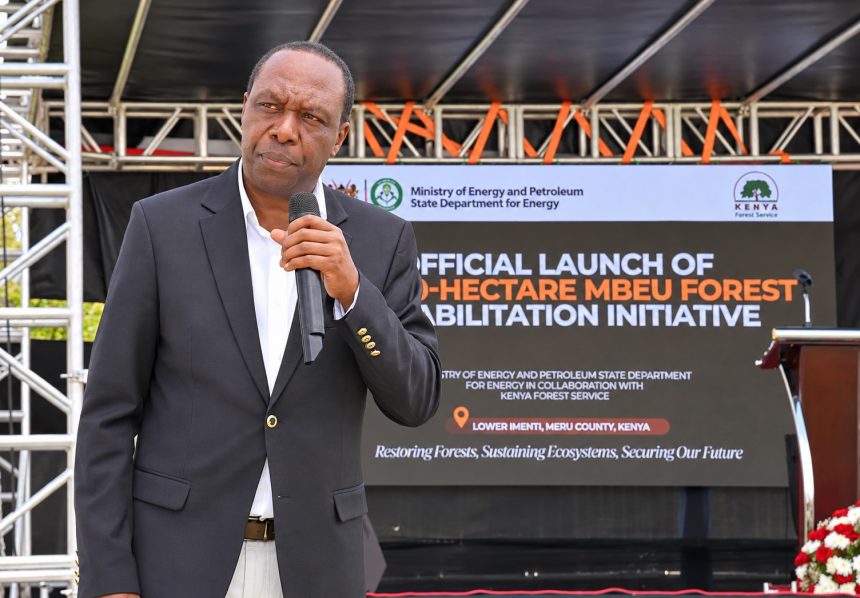
“Through the coordination and mobilisation led by Principal Secretary the State Department for Forestry, Gitonga Mugambi, Kenya is demonstrating how supporting collective leadership can turn forest restoration ambitions into measurable action on the ground. The strategy is inclusive, national and county governments, communities and other stakeholders leading the restoration of designated forests across the country. Examples include Cherangany Hills Ecosystem Restoration for Livelihood Improvement, Sustainability and Harmony, whose patron is the Cabinet Secretary for Interior and National Administration, Onesmus Murkomen; Oloolua Forest in Ngong, adopted by Irrigation Principal Secretary CPA Ephantus Kimotho; the Kaptagat Integrated Conservation and Livelihoods Programme, led by National Treasury Principal Secretary, Dr Chris Kiptoo; the Mau Integrated Conservation and Livelihoods Improvement Programme, championed by Environment and Climate Change Principal Secretary Eng. Festus Ng’eno and Mbeu Forest in Meru, championed by Energy Principal Secretary Eng. Alex Wachira.”
She noted that the initiatives demonstrate how political goodwill, effective coordination and community participation can translate national commitments into measurable action, adding that, “The efforts are complemented by stronger forest protection, integrated fire management, implementation of Reducing Emissions from Deforestation and Forest Degradation (REDD+), and the development of sustainable forest-based livelihoods.”
The leaders’ dialogue brought together Heads of State and other senior leaders to strengthen political support for the 2030 goal of halting and reversing deforestation.
The discussions focused not only on recognising existing progress but also on addressing barriers to implementation and mobilising the investment needed to accelerate forest restoration.
Dr Kaigongi noted that Kenya’s 15 Billion Tree Growing Programme demonstrates the country’s commitment to translating global forest pledges into practical results.
The programme targets 30 per cent national tree cover and the restoration of 10.6 million hectares of degraded landscapes by 2032.
Through the National Landscape and Ecosystem Restoration Programme, Kenya has institutionalised nationwide tree-growing campaigns, strengthened seedling production, expanded community participation and enhanced forest monitoring and sustainable forest management.
Progress at the global level was also recognised, particularly the delivery of the Forest Finance Roadmap developed by the Forest and Climate Leaders Partnership.
The global forest agenda has evolved through successive climate conferences. At COP26, the Glasgow Leaders’ Declaration on Forests and Land Use set the ambition to halt and reverse forest loss and land degradation by 2030.
At COP27, the Forest and Climate Leaders Partnership was established to sustain high-level political collaboration on forests.
At COP30 in Belém, leaders endorsed the Belém Declaration on the launch of the Tropical Forests Forever Facility and the Call to Action on Integrated Fire Management and Wildfire Resilience.