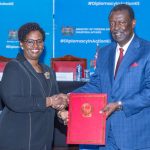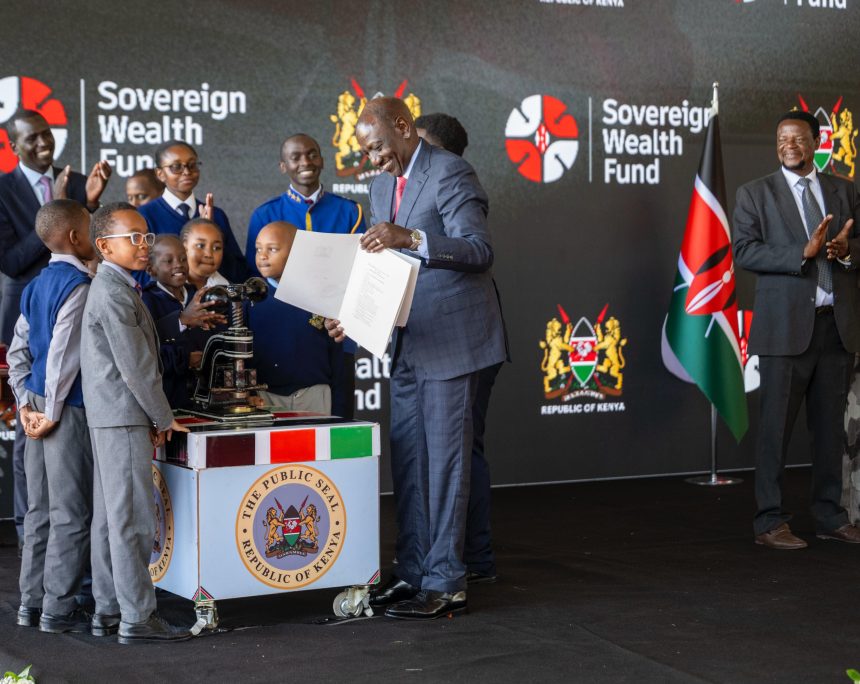
President William Ruto has signed into law the Sovereign Wealth Fund Bill, 2026, establishing a vital investment vehicle that will preserve wealth generated from national resources for future generations.
The President said the new law is a historic milestone that will ensure Kenya’s prosperity endures beyond today.

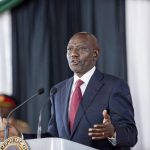
“Today, Kenya changes how it will preserve its wealth. Today, we enshrine in law the institution that will ensure that the prosperity those assets create endures for generations,” the President said during the assent ceremony at State House Nairobi on Wednesday.
The Sovereign Wealth Fund, he noted, will ensure that revenues from petroleum and mineral resources are not entirely consumed at present, but are invested to benefit future generations.
The new law establishes three key windows under the Sovereign Wealth Fund: The Stabilisation Fund will cushion the economy against external shocks, the Strategic Investment Window will finance national development projects and create jobs, while the Future Generations arm, to be known as Urithi Fund, will invest a portion of petroleum and mineral revenues for future citizens.
Under the law, 30 per cent of revenues from petroleum and mineral resources will be channeled into the Urithi Fund, with the remainder supporting economic stability and strategic investments.
Present were Deputy President Kithure Kindiki, National Treasury Cabinet Secretary John Mbadi, National Assembly Speaker Moses Wetang’ula, Orange Democratic Movement Party Leader Oburu Oginga, Head of Public Service Felix Koskei, and National Assembly Majority Leader Kimani Ichung’wa.
Others were Equity Group Chief Executive James Mwangi, Kenya Commercial Bank Group Chief Executive Paul Russo, Britam Chief Executive Tom Gitogo, and CPF Financial Services Group Managing Director Hosea Kili, among other key dignitaries.
The Sovereign Wealth Fund becomes the second major financial institution created under the government’s economic transformation agenda after the establishment of the National Infrastructure Fund in March 2026.
President Ruto said the new law was inspired by successful sovereign wealth funds around the world, including Norway’s Government Pension Fund now valued at about $2.2 trillion (KSh280 trillion) and Botswana’s Pula Fund.
“The lesson from each of these nations is unmistakable. Natural resources create opportunity. Institutions determine destiny,” he said.
The President noted that Kenya has learned important lessons from past exploitation of natural resources, citing the extraction of titanium in Kwale where mineral deposits were exhausted without creating long-term national wealth.
He said the establishment of the fund comes at a crucial time as Kenya prepares to commence commercial oil production in the Lokichar Basin in Turkana and seeks to harness newly confirmed deposits for strategic and industrial minerals across the country.
“Every barrel extracted should become an asset that never runs dry,” President Ruto said.
A nationwide mineral survey, he disclosed, has confirmed Kenya’s vast mineral potential, which could accelerate industrialisation, create jobs and boost exports if managed prudently.
To ensure accountability, the new Act provides for independent professional management of the fund, parliamentary oversight, transparent public reporting and robust auditing mechanisms.
“The Sovereign Wealth Fund will not belong to any Government but to the Republic of Kenya. Every shilling must be accounted for, every decision guided by prudence and every investment measured by the legacy it leaves for future generations,” President Ruto said.
The new law, the President stated, demonstrates Kenya’s commitment to saving, investment and preserving national wealth, ensuring that future generations inherit “not depleted resources but lasting prosperity”.
President Ruto commended the partnership between the Government and the private sector, capital markets, and pension funds in backing mega infrastructure projects such as the Talanta Sport City Stadium, the Bomas International Convention Complex, and the expansion of the Rironi-Mau Summit road.
“I don’t take this partnership for granted,” he said.
The President also highlighted the political stability brought by the Broad-Based Government and the collaboration between Kenya Kwanza and the Orange Democratic Movement (ODM), noting that the partnership is delivering immense benefits to Kenyans.
He commended National Treasury Mbadi for providing the requisite leadership in managing the country’s finances and steering the economy.
The President also commended Parliament for passing the legislation, saying lawmakers have laid the foundation that will outlive the current generation.
Noting the bipartisan approach among MPs, the President pointed out that parliamentary sessions have sometimes extended up to midnight to process critical Bills.
“History will remember you not as the Parliament that debated Kenya’s future, but as the Parliament that legislated it into being,” he said.
President Ruto noted that Parliament has enacted several transformative laws in the past three years, including the Affordable Housing Levy Fund, three Social Health Authority (SHA) funds, the National Infrastructure Fund, and now the Sovereign Wealth Fund.
On public-private partnerships, President Ruto said the Government is actively collaborating with private entities. This model is illustrated in the KSh150 billion upgrade of Jomo Kenyatta International Airport, where the Government will deploy KSh20 billion from the National Infrastructure Fund to crowd in the balance from private investors.
“That is how transformation works, with investors, pension funds, and fund managers come together to implement major infrastructure projects,” he explained.
The President also pointed to the country’s economic turnaround over the past three years, recalling that Kenya was staring at a sovereign debt default in 2023.
He asserted that decisive fiscal actions, driven by robust economic adjustments, successfully averted the financial crisis.
Kenya’s macroeconomic indicators, President Ruto explained, have also recorded significant improvements. National foreign exchange reserves have surged from $5.7 billion in 2022 – the equivalent of two and a half months of imports – to about $17 billion currently, providing, equivalent to seven months of import cover.
“We are almost tripling our reserves and that is extraordinary,” the President noted.
He added that data from the United Nations Conference on Trade and Development’s (UNCTAD) “World Investment Report 2026” shows Kenya’s Foreign Direct Investment (FDI) net inflows jumped from $1.5 billion in 2022 to $3.2 billion last year.
Deputy President Kithure Kindiki pledged to work closely with the President to ensure the private sector plays an expanded role in national development.
“I have taken notes on today’s discussions and I will support you to transform the country. You are doing the heavy lifting to ensure that Kenyans tomorrow will be better off than today,” Prof Kindiki said.
Dr Oginga commended the establishment of the Sovereign Wealth Fund, calling it a highly progressive idea. Citing Botswana as a successful African precedent, he noted that such funds preserve finite resources for future generations.
“With such funds, you go to the capitals of the world to discuss trade and mutually beneficial relations instead of begging. Other people are not obliged to develop your country; we must do it ourselves with our own resources,” he said.
National Assembly Speaker Moses Wetang’ula termed the enactment of the Sovereign Wealth Fund law a major milestone for the 13th Parliament, noting that previous attempts over the years to establish the fund had failed.
Mr Kiili described the new fund as a game-changer but recommended a further amendment to the law to allow private citizens and institutions outside of Government to directly contribute to the fund.
“We should go beyond natural resources and allow Kenyans of goodwill to contribute,” he said.
Mr Mbadi said the fund marks a major milestone in Kenya’s efforts to promote inter-generational equity and place Kenya alongside other nations that have leveraged natural resources revenues to build long-term national wealth.
The Treasury CS said President Ruto will go down in history as Kenya’s foremost reformist leader, pointing to the number of transformative laws and massive infrastructure projects delivered in a short span.
“Initially, we thought the road to Singapore would pass through Canaan only. But now it seems we will also go through Norway as well,” Mr Mbadi said noting that Norway’s world-class sovereign wealth management offers valuable lessons for Kenya.
Equity Group’s Mwangi explained that the fund will be instrumental in crowding in commercial capital by effectively de-risking large-scale public investments.
“In countries such as Singapore, the level of national investment stands at 25 percent of GDP. In Kenya, we are at 18 per cent,” he pointed out, adding that strategic funds will anchor a highly predictable economic growth path.
“We are maturing when we start thinking beyond ourselves,” he added.
Mr Russo of KCB said the fund would spark a powerful multiplier effect across the financial ecosystem due to its strict governance structures and transparency.
“Kenya will therefore be well-positioned to attract significant global investment for various development projects,” Mr Russo stated.