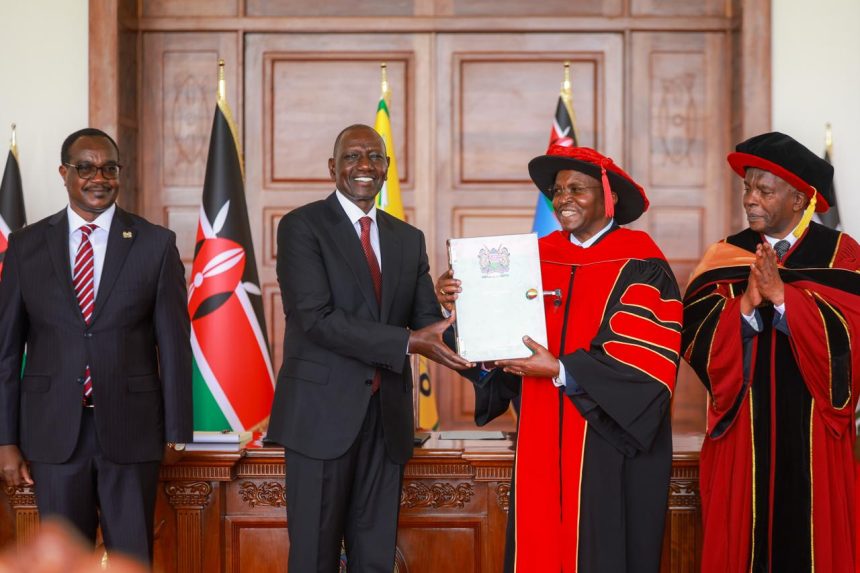
President William Ruto has challenged Kenyan universities to produce graduates capable of addressing society’s most pressing challenges while adapting to a dynamic workplace.
The President said universities and technical training institutions must align their academic programmes with the realities of society and the evolving demands of industry.

The ultimate measure of education, he said, should not be the certificates graduates acquire but their ability to apply knowledge, create opportunities and contribute meaningfully to national development.
President Ruto made the remarks at State House Nairobi on Thursday during the award of charter to International Leadership University (ILU).
“This is the difference between education that produces qualifications and education that builds capability. Knowledge and expertise matter, but their value lies in their application,” the President said.
He added: “A degree should certify more than what a graduate knows. It should demonstrate what that graduate can achieve.”
Kenya, he stated, needs scientists who develop solutions to diseases, farmers who transform agricultural produce into thriving enterprises, engineers who build for future generations and entrepreneurs who create employment.
At the same time, President Ruto pointed out that the changing nature of work, driven by artificial intelligence, automation and digital technologies, makes it urgent for educational institutions to prepare students for a rapidly evolving global economy.
Citing the World Economic Forum’s “Future of Jobs Report 2025”, he noted that 39 per cent of workers’ skills are expected to change or become outdated by 2030.
The President said Kenya must therefore move away from an education system that emphasises rote learning and examinations at the expense of critical thinking, creativity, practical competence and innovation.
“We cannot build a 21st Century economy with an education system that prepares young people to reproduce yesterday’s answers,” he said.
Kenya’s ambition, President Ruto noted, is to build a knowledge-driven, globally competitive economy supported by a modern services sector capable of exporting technology, financial services, professional expertise and innovation alongside traditional agricultural and manufactured products.
He noted that technology has made it possible for professionals based in Kenya to compete internationally, citing opportunities for software engineers, financial analysts, medical specialists, researchers and creative professionals to serve clients and institutions across the world.
However, he cautioned that such opportunities could only be realised if universities equipped graduates with relevant digital skills, including the ability to use computers, access the Internet, analyse data and apply artificial intelligence.
A major priority, the President explained, must be strengthening the connection between universities and industry through practical training, internships and structured partnerships.
He disclosed that the Government is working towards expanding the National Internship Programme to accommodate 50,000 young college and university students from January 2027.
Incentives, including netting off the stipends they pay from their taxes, will also be introduced to encourage private-sector employers to offer internship opportunities.
The President urged universities to proactively identify internship placements for their students, noting that practical exposure is essential in bridging the gap between academic knowledge and workplace competence.
Within 24 hours of Government advertising the 50,000 paid internship opportunities, 150,000 young people have already applied, the President announced.
Additionally, Micro, Small and Medium Enterprises State Department has advertised for a training programme for 600,000 young people – and progressively up to one million – to enable them access business opportunities in the Access to Government Procurement Opportunities. Already, 200,000 applications have been received within 24 hours.
He encouraged young people to register and take advantage of the opportunities, adding that the Government will facilitate free business registration and access to financing.
Meanwhile, the President underscored the importance of equity in education and economic opportunity, stating that fairness must be reflected in Government policy and resource allocation.
“When I said ‘Bottom Up’, it was not a slogan. Now I am saying, ‘Usawa ni Sawa’, it is not a slogan. I mean it. Equity must inform Government policy,” he said.
He cited investments in education as evidence of his commitment to expanding opportunities, noting that in the 2026/27 financial year, the education sector has been allocated KSh784.5 billion, up from KSh527 billion in 2022/23, representing an increase of 49 per cent.
The President also cited the introduction of a student-centred university funding model through which scholarships and loans are allocated according to students’ financial needs.
President Ruto also used the occasion to underscore the importance of leadership grounded in service and measurable results, and not titles or positions.
He cited the example of Mr Peter Tabichi, a mathematics and physics teacher at Keriko Mixed Day Secondary School in Nakuru County, who was named the world’s best teacher in 2019.
The President said despite teaching in a school with only one computer, poor Internet connectivity and a teacher-to-student ratio of 1:58, Mr Tabichi demonstrated exceptional initiative.
“He downloaded learning materials from Internet cafés for offline use and donated 80 per cent of his monthly income to support his students,” he said.
His students, the President added, subsequently won a Royal Society of Chemistry Award for a project that generated electricity from local plants.
When asked what his philosophy was, Mr Tabichi gave a simple answer: “You have to do more and talk less.”
The President said this is the kind of leadership Kenya needs and the values universities should deliberately cultivate.
He challenged ILU to distinguish itself through the quality of leaders it nurtures and the practical impact of its graduates.
Education Cabinet Secretary Migos Ogambo called on universities to measure their success by the quality of teaching, the value of research and their contribution to solving challenges facing Kenya and the wider world.
ILU Chancellor Kivutha Kibwana commended the Government for guiding the institution on the journey towards becoming a fully fledged university.
Prof Kibwana also called for leadership training to be integrated into the curriculum at all levels of education.
The ceremony was also attended by ILU Board of Trustees Chairman Daniel Musinga, Vice-Chancellor Timothy Kiruhi and Commission for University Education Chairman James Onyango Awino, among other dignitaries.