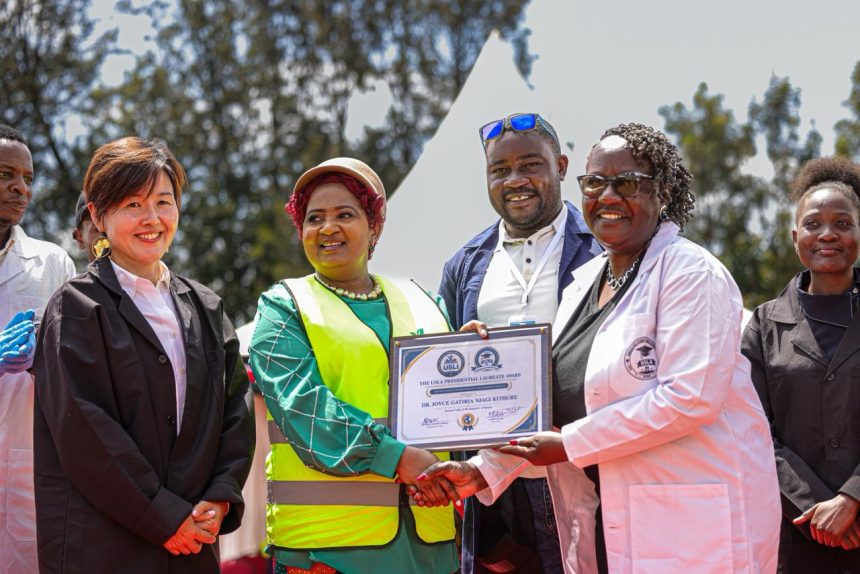
Second Lady Dr. Joyce Kithure has called for stronger collaboration between young people, community organisations and institutions in driving environmental protection efforts, saying sustainable change will only be achieved through collective responsibility.
Speaking during a World Environment Day clean-up exercise in Kibra, Nairobi, Dr. Kithure said the climate crisis demands sustained partnerships across all sectors of society, particularly at the community level where environmental challenges are most visible.

She noted that issues such as waste management, pollution, and environmental degradation cannot be addressed by government alone, stressing the need for citizens, schools, community groups and development partners to work together in building cleaner and healthier neighbourhoods.
“The challenges we face, including waste management, pollution, deforestation and climate change, require more than goodwill. They require sustained partnerships between government institutions, academia, community organisations and citizens. No single institution can solve these challenges alone,” she said.
The event, held in Kibra to mark World Environment Day 2026 under the global theme of Climate Action, brought together students, youth groups, volunteers, community leaders and residents who participated in a large-scale clean-up exercise aimed at promoting environmental responsibility.
Dr. Kithure said the participation of young people in such initiatives was a positive sign, noting that youth are not only beneficiaries of environmental programmes but also key drivers of innovation and leadership in climate action.
“I am especially encouraged by the active participation of young people in today’s exercise. The youth are not just beneficiaries of environmental action; they are leaders and innovators of today. Their energy, creativity and determination are essential in shaping a more sustainable and resilient future,” she said.
Through her initiative, Science Adding Value to the Environment and the Communities (SaVE Communities), Dr. Kithure said efforts have been made to turn environmental awareness into practical, community-based action across the country.
Over the past year, SaVE Communities has conducted clean-up exercises in several informal settlements, including Dandora and Kawangware, working closely with local residents, youth groups and community leaders to promote environmental stewardship and responsible waste management.
Dr. Kithure said these engagements have demonstrated that when communities are empowered with knowledge and resources, they are capable of leading meaningful environmental change from the ground up.
She further called for stronger civic responsibility among Kenyans, urging households, schools and workplaces to adopt simple but consistent practices such as waste reduction, recycling and proper disposal of waste materials.
According to her, small actions, when replicated across communities, have the power to create significant environmental impact over time.
Dr. Kithure also emphasised that World Environment Day should not be treated as a symbolic annual event, but rather as a continuous call to action that reinforces long-term behavioural change and collective responsibility.
She thanked Kibra residents, community leaders, volunteers and partners who participated in the clean-up exercise, saying their involvement reflects a growing awareness of the importance of environmental conservation at the grassroots level.
“Let this World Environment Day not be an isolated event, but a renewed commitment to continuous action. Together, we can build cleaner neighbourhoods, stronger communities and a more resilient Kenya for present and future generations,” she said.