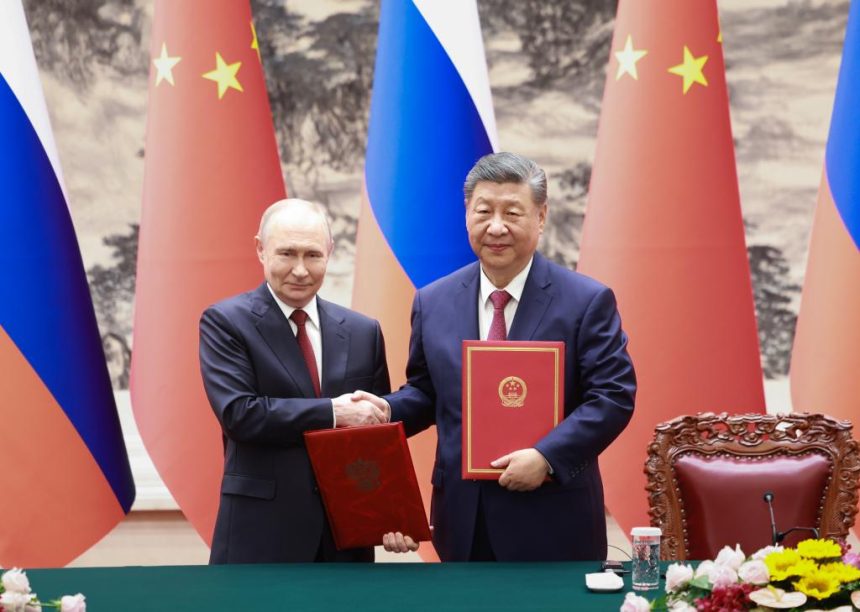
Chinese President Xi Jinping hosted Russian President Vladimir Putin in Beijing for high-level talks, announcing a deepening China-Russia strategic partnership and underscoring their growing alignment.
The meeting at the Great Hall of the People highlighted the increasingly close political, economic, and diplomatic partnership between the two countries amid major geopolitical realignments.

Putin’s visit, his 25th trip to China, coincided with the 30th anniversary of the establishment of the China-Russia strategic partnership of coordination and the 25th anniversary of the signing of the bilateral friendship treaty.
Addressing the talks, President Xi said the relationship between the two countries had strengthened steadily over the years because both sides continued to deepen political trust and strategic coordination while expanding practical cooperation.
“China-Russia relations have come this far step by step precisely because the two countries have kept deepening political mutual trust and strategic coordination with unyielding tenacity,” Xi said.
He added that the partnership had evolved on the basis of “equality, mutual respect, good faith, and win-win cooperation,” describing the relationship as having entered a new stage of greater achievements and faster development.
Xi stressed that China and Russia, as permanent members of the United Nations Security Council and major global powers, should work together to shape a more balanced international order.
“As permanent members of the UN Security Council and important major countries in the world, China and Russia should take a strategic and long-term perspective,” Xi said, adding that both countries should work to make the global governance system more just and equitable.
The Chinese leader also emphasised the importance of closer economic coordination, calling for expanded cooperation in trade, investment, energy, transportation, science, technology, and innovation. He urged both sides to strengthen alignment between China’s upcoming 15th Five-Year Plan for 2026-2030 and Russia’s long-term national development strategy.
“The two countries should promote the upgrading of practical cooperation in trade and investment, energy and resources, transportation, science, technology and innovation,” Xi said, while also encouraging cooperation in emerging and frontier industries to create new engines of growth.
The talks produced approximately 20 cooperation agreements covering areas including trade, education, science and technology, and people-to-people exchanges. Xi and Putin also signed and issued a joint statement on further enhancing comprehensive strategic coordination and deepening good-neighbourliness and friendly cooperation.
The two sides also released a separate joint statement advocating a multipolar world and a new type of international relations, signalling their shared push for broader reforms to the existing global governance structure.
Putin described Russia-China relations as stronger than ever, saying the partnership had reached “an unprecedented level” under the joint leadership of both countries.
“Russia-China relations, under joint efforts from both sides, have reached an unprecedented level, featuring close high-level exchanges and solid political mutual trust,” Putin said.
He pointed to growing bilateral trade, deepening energy cooperation, and expanding collaboration in logistics, transportation, science, and technology as evidence of the relationship’s momentum.
“Russia-China relations have withstood tests and grown stronger over time, becoming a paradigm of comprehensive strategic coordination,” Putin said.
The Russian president also underscored the strategic importance of the bilateral friendship treaty under current international conditions.
“The Treaty of Good-Neighbourliness and Friendly Cooperation is ever more relevant under the current situation,” he said, adding that Russia was ready to work with China to strengthen strategic coordination and elevate bilateral ties further.
Both leaders repeatedly emphasised cooperation within multilateral institutions including the Shanghai Cooperation Organisation, BRICS, and Asia-Pacific Economic Cooperation.
Xi called for stronger coordination to “firmly safeguard the post-war international order and the authority of international law,” while also stressing the need to unite countries of the Global South and guide reforms in global governance.
He said China and Russia should “oppose all forms of unilateral bullying and actions that seek to reverse the course of history.”
He also warned against what he described as “provocations that deny the outcomes of World War II and attempt to whitewash and revive fascism and militarism.”
Putin similarly described the bilateral cooperation as an important stabilising force amid global uncertainty.
“Russia-China bilateral cooperation is an important stabilising factor in the volatile international situation,” Putin said.
He added that Moscow would continue strengthening multilateral coordination with Beijing while supporting China’s hosting of the upcoming APEC Economic Leaders’ Meeting.
Putin further stressed that Russia-China cooperation “is not directed against any third party or affected by geopolitical changes,” while reaffirming both countries’ commitment to maintaining close strategic coordination on international affairs.
During the visit, the two leaders also exchanged views on the Middle East and other international and regional developments. Senior officials from both governments briefed the presidents on ongoing cooperation in investment, energy, regional development, and international diplomacy.
The visit included a formal state welcome ceremony outside the Great Hall of the People, featuring a military band performance, a 21-gun salute, and an honour guard inspection. Xi later hosted Putin at a state banquet.