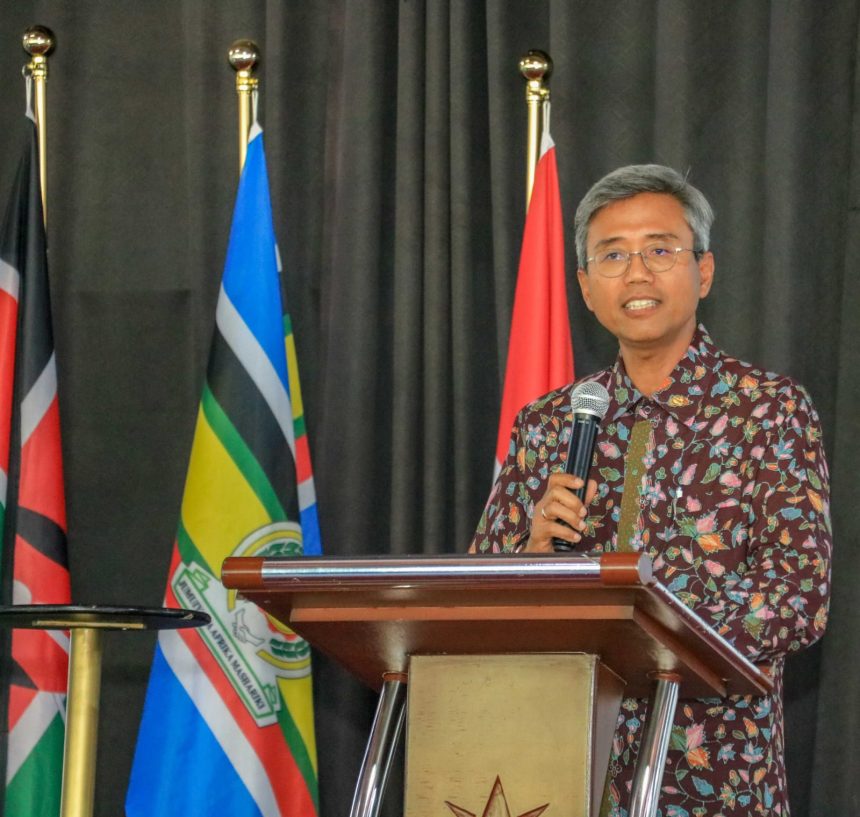
Indonesia’s Ambassador to Kenya, Witjaksono Adji has called for deepened and structured partnership between South-East Asian nations and Kenya in building a sustainable blue economy.
Speaking during the Diplomatic Day event held at Daystar University’s Athi River campus on March 11, 2026, the Ambassador noted that the Indian Ocean is a vital link between Africa and Asia, serving as a route for trade, cultural exchange and interregional cooperation.

“Maritime security, stability and diplomacy are essential foundations for economic development and the sustainability of the blue economy,” said Ambassador Witjaksono Adji, adding that “Indonesia also shares its experiences through ASEAN regional cooperation and encourages increased cross-regional collaboration between Asian and African countries in sustainable ocean management”.
Ambassador Witjaksono Adji’s address carried added diplomatic weight: this year, Indonesia holds the Chair of the Association of Southeast Asian Nations (ASEAN) Committee in Nairobi (ACN), a rotating responsibility that places Jakarta at the centre of ASEAN’s engagement with the African continent
The forum, which was attended by approximately 1,000 participants, also included representatives from the Kenyan government, ASEAN and Sri Lanka ambassadors, UN officials, academics and civil society leaders.
Mustafa Ibrahim, Deputy Director General and Head of the Policy, Research and Strategic Analysis Directorate at Kenya’s Ministry of Foreign Affairs, delivered the opening remarks on behalf of Principal Secretary Dr. Abraham Korir Sing’oei, noting that the blue economy is formally enshrined as a national priority in Kenya’s Blue Economy National Strategy 2025–2030.
The strategy commits the government to optimising Kenya’s marine potential, promoting biodiversity conservation and actively seeking international partnerships to realise those goals.
According to Indonesian embassy officials, Jakarta has been implementing various programmes in Kenya under the Indian Ocean cooperation framework. Among them, is an initiative to integrate women seaweed farmers along the Kenyan coast into Indonesian commodity markets.
Indonesia is the world’s second-largest seaweed producer, generating approximately 10 million metric tonnes annually, and is a dominant force in a global seaweed market valued at over USD 16.7 billion as of 2024, projected to surpass USD 22 billion by 2030.
Through its South-South Cooperation frameworks, Indonesia has facilitated direct buyer linkages between seaweed farmers along the Kenyan coast and Indonesian processors and exporters.
Embassy officials noted that pilot engagements have already been held with coastal county governments and producer networks, with a formalised bilateral programme expected to be launched in partnership with Kenya’s Ministry of Mining, Blue Economy and Maritime Affairs.
“Indonesia emphasizes the importance of maintaining healthy marine ecosystems, such as mangroves and coral reefs while utilizing maritime resources for sustainable economic growth,” explained Wisnu Lombardwinanto, Minister Counselor at the Indonesian Embassy in Nairobi.
The ASEAN Blue Economy Framework (ABEF), formally adopted by ASEAN leaders sets out a common architecture for sustainable fisheries, marine biodiversity protection, coastal tourism, renewable ocean energy and pollution control across the ten-member bloc. Indonesia has been among its most energetic advocates, drawing on its identity as the world’s largest archipelagic nation: a country of over 17,000 islands with more than 95,000 kilometres of coastline and a fisheries sector that contributes approximately USD 27 billion annually to the national economy.
Indonesia’s mangrove estate, the largest in the world at over 3.3 million hectares, is increasingly framed as a blue carbon asset, with potential carbon credit revenues that could both fund conservation and attract multilateral climate finance to partner countries like Kenya.
The Daystar University forum came in the immediate wake of the Indian Ocean Rim Association (IORA) commemorating its 29thyear of multilateral partnership. IORA, which brings together 23 member states and 12 dialogue partners spanning the Indian Ocean’s littoral rim from South Africa to Australia, has placed the blue economy, maritime safety and disaster management at the heart of its anniversary agenda. Both Kenya and Indonesia are member states, with Nairobi and Mombasa set to host the Indian Ocean University Network (UNIOR) forum later this year.
Participants also highlighted the security challenges which remain a barrier to viable blue economy partnerships in the region. Among the speakers included Joseph Boinet, former Inspector General of Police of Kenya who represented the United Nations Office on Drugs and Crime’s designate Executive Director as well as Lieutenant Colonel Ernest Ndirangu, Deputy Commandant of the Kenya Naval Training College.
Ambassador Nancy Karigithu, Kenya’s Special Envoy for Maritime Affairs and the Blue Economy, represented Cabinet Secretary Hassan Joho (Ministry of Mines, Blue Economy and Maritime Affairs), and delivered remarks underscoring Kenya’s sovereign resolve to monetise and protect its maritime estate.
Panel discussions featuring the Ambassadors of Malaysia and the Philippines, alongside Chargé d’Affaires of Thailand and Sri Lanka, as well as representatives from the International Committee for the Red Cross and International Maritime Organization representatives, reinforced that ASEAN-Africa maritime cooperation is becoming a structured diplomatic practice rather than an aspirational talking point.
“The event generated a shared understanding of the importance of strengthening cooperation in developing the Blue Economy, not only among countries in the African region, but also through interregional cooperation with ASEAN and Asian countries,” said Mirza Zen, Third Secretary of the Indonesian Embassy in Nairobi.