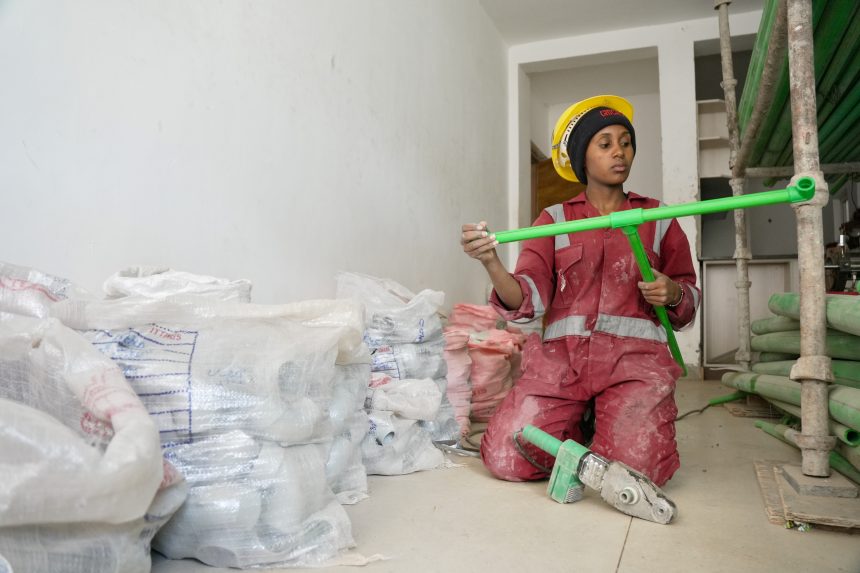
Ruth Njeri received a letter inviting her to college after completing high school. However, the course she had been admitted to was not one she wished to pursue. She had always hoped to study Building Construction, but her parents could not afford the university fees for privately sponsored students, and the Technical and Vocational Education and Training (TVET) course she had been called to join “was not the one I wanted to do,” she said.
Feeling caught between limited choices, she soon heard about something that would change the direction of her career, a skill-intensive diploma equivalent training programme offering a scholarship.

“Fortunately, PropelA called me, and since my parents would not have been able to pay my school fees to attend campus, that opportunity opened the way for me.”
The programme helps young people in Kenya gain work-ready skills driven by market demand. It is supported by the non-governmental organisation Swisscontact, which works with companies across different sectors, connecting them with TVET model training colleges and is regulated by the National Industrial Training Authority (NITA). Students spend 75 per cent of their time in on-the-job training, where they learn practical skills while earning a stipend, and 25 per cent in the classroom learning theory. The approach allows them to gain real work experience while they study.
Dr Esther Muoria, Principal Secretary in the State Department for TVET, says the approach could help resolve what she describes as the youth unemployment paradox. “This is the paradox that we must resolve. Across the economy, employers consistently report difficulty finding skilled technicians, artisans and operators, even as many young people struggle to secure employment.”
She described the moment as a turning point in the country’s skills agenda.
“Kenya stands at a defining moment in its skills development journey. The President has been clear that Kenya’s journey to becoming the Singapore of Africa will ultimately be driven by the productivity, skills and innovation of its people.”
“When we say we want to go the Singapore way, we must unlock private sector investment and workforce competitiveness in Kenya to transform our economy,” said Shadrack Mwadime, Principal Secretary for Labour and Skills Development renfrencing the Singapore metaphor popularly used by Kenya’s President William Ruto to describe the vision he has for Kenya in development and global competitiveness.
The now common analogy in Kenya refers to the transformation of Singapore from a resource-poor trading port into one of the world’s most advanced economies, driven by strong investment in skills, industrial productivity and close collaboration between government and the private sector, a model that Ruto frequently references when outlining his vision for Kenya to rise from a resource constrained developing economy into a globally competitive one.
“We want to see this change within one generation by unlocking private sector investment and workforce competitiveness, moving from a third world country to a first world country by putting a lot of emphasis on imparting skills,” added PS Mwadime
The Kenya Association of Manufacturers (KAM), the umbrella body that has served as the voice of industry in Kenya for more than six decades, said, “A key component of this work has been KAM’s partnership with Swisscontact to strengthen the implementation of dual training in Kenya. The Dual Apprenticeship model allows trainees to divide their time between training institutions and the workplace,” said KAM Head of Consulting and Sustainability Joyce Njogu.
For Ruth, the programme reflects Kenya’s adaptation of a long-established Swiss apprenticeship model, one that places strong emphasis on the well-being and dignity of apprentices while equipping them with practical, industry-relevant skills. Switzerland has refined this system over decades, helping build a workforce globally associated with precision, quality, reliability and craftsmanship, qualities that underpin some of Swiss strongest industries and its powerful national brand.
By borrowing from this model, Kenya is seeking to strengthen the link between training and industry needs, while ensuring that apprentices gain both practical experience and financial support as they transition into the labour market.
“While I was studying as an apprentice and still working at the company, I was fortunate because I received a stipend. This helped a lot because it reduced the burden on my parents. I could pay for my own lunch and bus fare, and I became more independent. I was even able to start living on my own and pay my rent. Life became better and more stable.”
Sharon Mosin, the Country Director of Swisscontact, says the programme is built on the innovation and creativity of young people, whose biggest missing link, according to her, is skills alignment with labour market demand.
“Kenya has a vibrant private sector. We have a growing digital infrastructure. We have expanding Technical and Vocational Education and Training institutions. We have innovation hubs across counties. And most importantly, we have resilient, creative, and ambitious young people.”
The push for technical skills training also addresses a two-pronged challenge facing Kenya, where a large share of the population is young, as in much of Africa. Nearly one million young Kenyans enter the labour market each year, while people aged 15 to 34 make up about 35 per cent of the population. At the same time, as Kenya undertakes large-scale infrastructure development across sectors such as transport, housing and agriculture, youth unemployment persists because of a shortage of critical technical skills.
“We are trained in technical skills as well as soft skills. In my area, which is plumbing, there are also opportunities in electrical work and other technical fields. The soft skills training includes things like confidence building and financial management, which are very helpful in life. You learn how to communicate with your clients and with your supervisors. You gain the confidence to face your bosses, you can negotiate deals, and you are able to do your work well. You also learn how to handle people at work and how to communicate effectively so that everyone understands each other and the work continues smoothly,” Ruth explained, breaking down the syllabus simply.
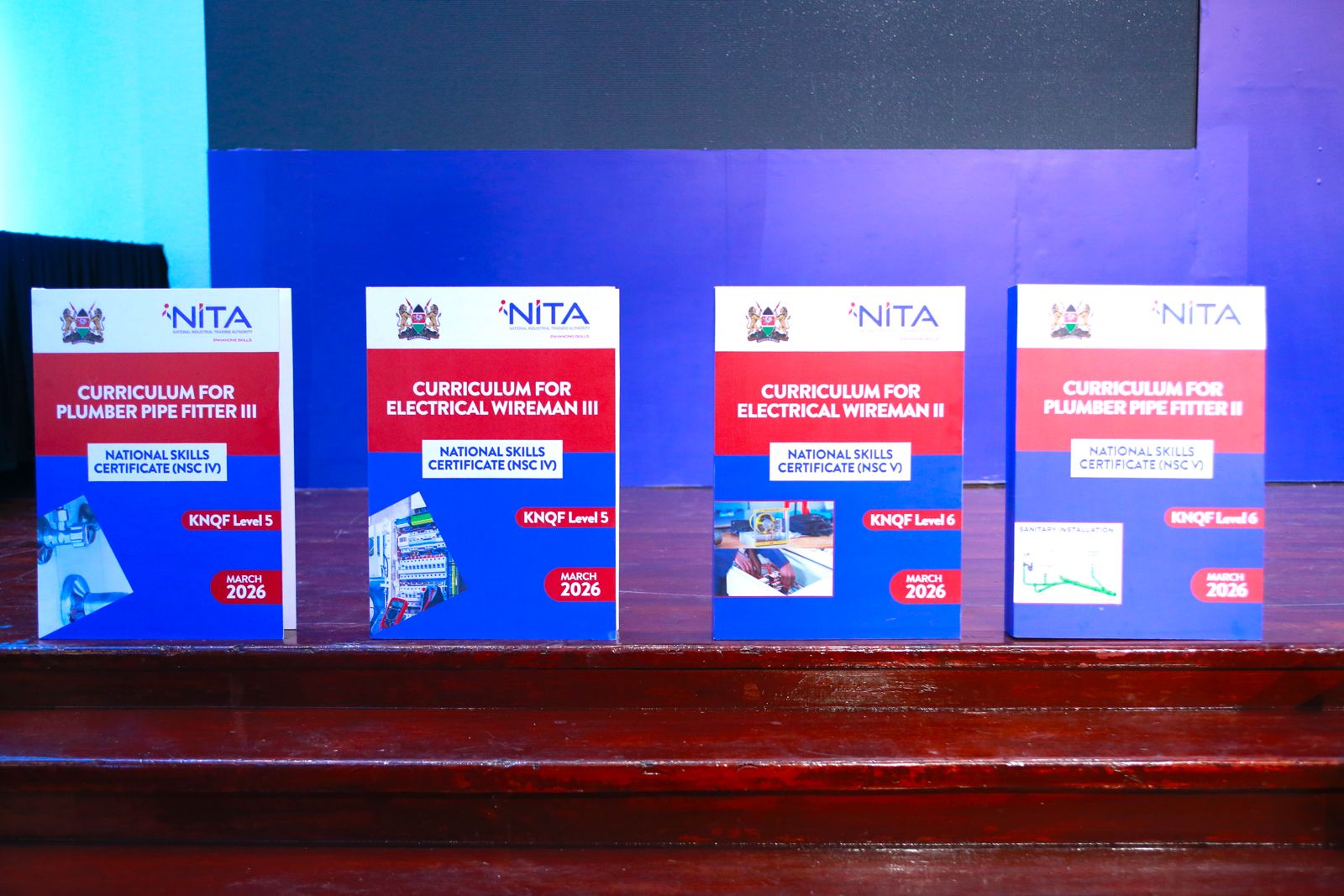
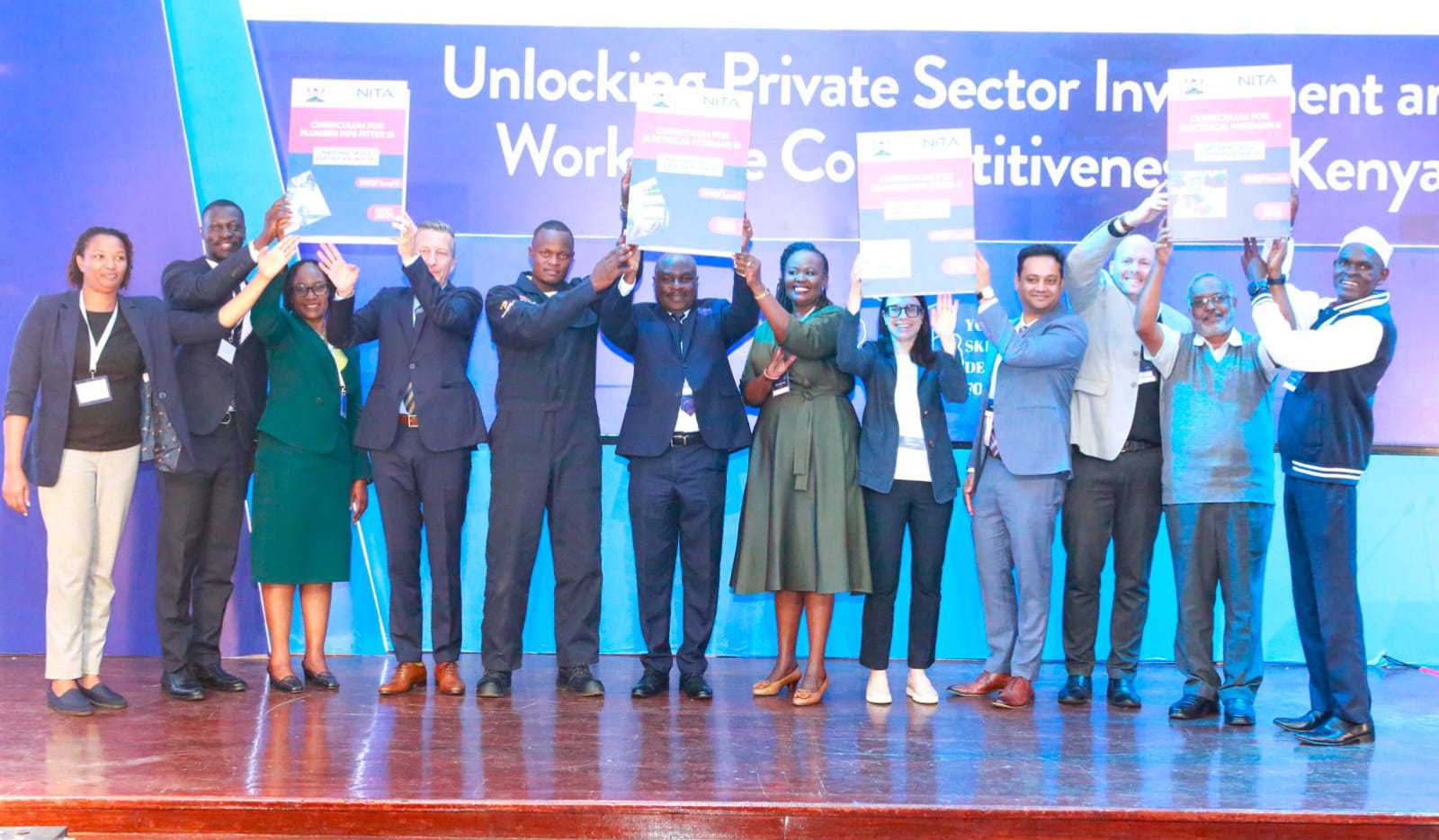
While the four curricula in plumbing and electrical trades were officially unveiled by the government on 4 March 2026, signalling the scaling up of the model, TVET institutions across the country can now implement the private sector-led training approach. The aim is to expand the programme into other skills that employers need.
“I received a certificate from NITA and also another certificate from the company, and this gives me a leg up when applying for jobs elsewhere. It makes it much easier for me to get a job, and I have a much better chance of being employed,” said Ruth.
Adding that: “The company where I had been getting practical experience while in school called me back after two months, and they offered us full-time employment, moving us from apprentices to employees.”
Her experience reflects the programme’s data-backed impact: about 80% of students who go through the dual 75:25 per cent training model move into employment or self-employment.