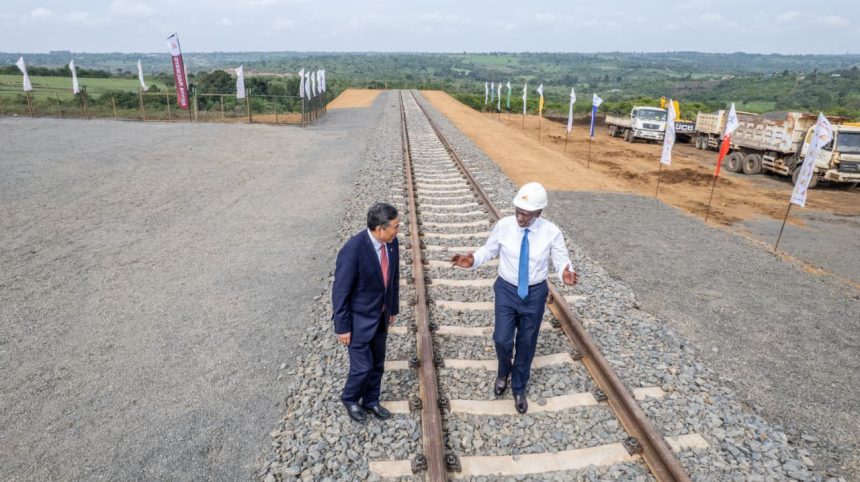
President William Ruto has launched the construction of the Naivasha-Kisumu Standard Gauge Railway (SGR) extension.
Speaking during the groundbreaking ceremony in Narok County, Ruto said the multibillion-shilling project will serve as a strategic intervention to lower transport costs, unlock Western Kenya’s economic potential and cement the country’s role as a regional trade hub.

The 262.3-kilometre Phase 2B line will connect Nairobi’s industrial corridor to key agricultural zones in Narok, Bomet, Kericho and Nyamira counties before linking to the port city of Kisumu.
Ruto described the project as critical to completing the SGR network, noting that terminating the railway at Narok had limited its economic value by failing to reach major production areas and regional trade routes.
“A railway that terminates at Narok is, by definition, incomplete. This is because it does not reach the major production zones of Western Kenya; it does not connect with the lake transport ecosystem in Kisumu; and it does not capture the full volume of outbound freight that sustains a modern rail economy,” he said.
The President cited rising demand for efficient cargo movement, pointing to increased transit freight through the Port of Mombasa, where volumes hit 7.37 million tonnes in the first half of 2025.
However, he noted that cargo movement remains slow, taking up to 80 hours from Mombasa to Malaba and over 100 hours to Kampala, underscoring the need for the extension.
“This project will increase freight volumes and economic activity. By linking production zones directly to the rail network, we transform the SGR into a two-way economic system, moving not only imports inland but also exports outward,” he said.
The President further said integrating rail, road and lake transport will position Kisumu as a key logistics hub serving the Great Lakes region, including Uganda, Rwanda, Burundi, South Sudan and the Democratic Republic of Congo.
Ruto announced that the government will on Saturday break ground on the 107-kilometre Kisumu-Malaba Phase 2C section, which will extend the line to the border town of Malaba in Busia County.
“When complete, this will establish a continuous railway artery of nearly 1,000km from Mombasa to Malaba, a corridor that will not only move goods but also secure Kenya’s place at the centre of Africa’s continental trade,” he said.