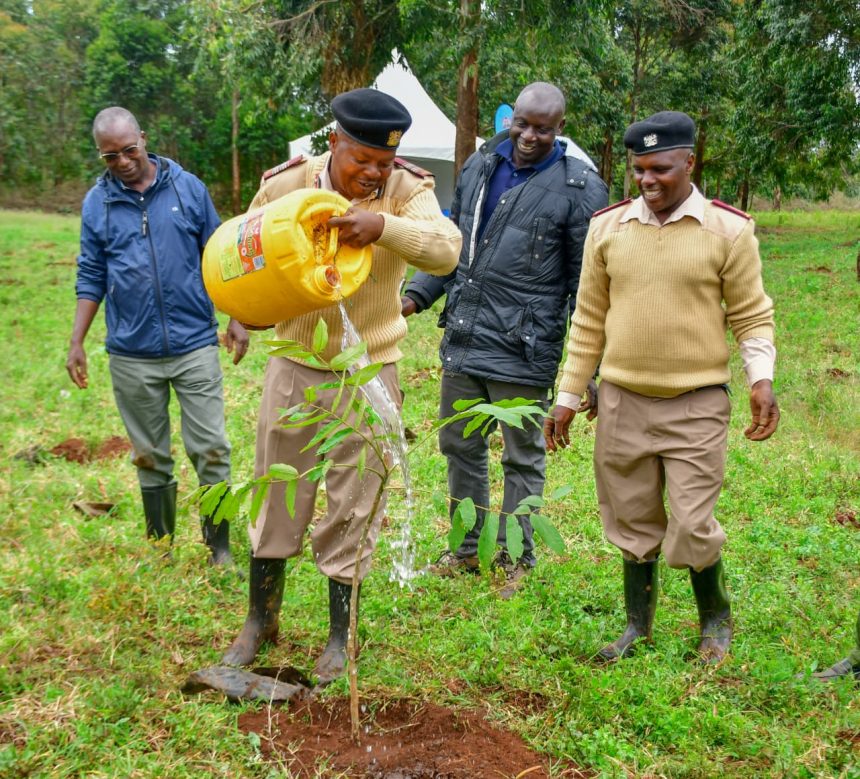
The government through the Ministry of Foreign and Diaspora Affairs, Ministry of Environment, Climate Change and Forestry, and Huawei Technologies Kenya Friday spearheaded a tree growing initiative in Uplands, Limuru Kiambu County, aimed at restoring endangered natural forests and strengthening climate resilience.
The initiative forms part of Kenya’s national ambition to grow 15 billion trees by 2032 while addressing the urgent need to protect threatened forest ecosystems.

Speaking during the exercise, Ambassador Michael Kiboino, Secretary, Management at the Ministry of Foreign and Diaspora Affairs, said the initiative demonstrates how diplomacy can be translated into meaningful environmental action.
“Diplomacy is not confined to boardrooms and foreign missions. Today, it is also expressed through practical action that responds to the global challenges we all share,”Amb. Kiboino noted.
Adding that: “Environmental challenges are global in nature, and through initiatives such as this, we are advancing environmental diplomacy through local action that contributes meaningfully to global environmental goals.”
The initiative brought together government leaders, local administrators, forest managers, Community Forest Associations (CFAs), Community Based Organizations (CBOs), and residents in a united effort to restore endangered natural forests and strengthen climate resilience.
Additionally, Amb. Kibino said that the partnership was ‘not just planting trees, but cultivating a lasting legacy of partnership, restoration and conservation of Mother Nature for posterity’.
According to the 2024 Kenya Forest Service report, Kenya loses more than 84,000 hectares of forest cover annually to deforestation, with a further 15,000 hectares affected by forest degradation. Limuru remains one of Kenya’s critical forest landscapes.
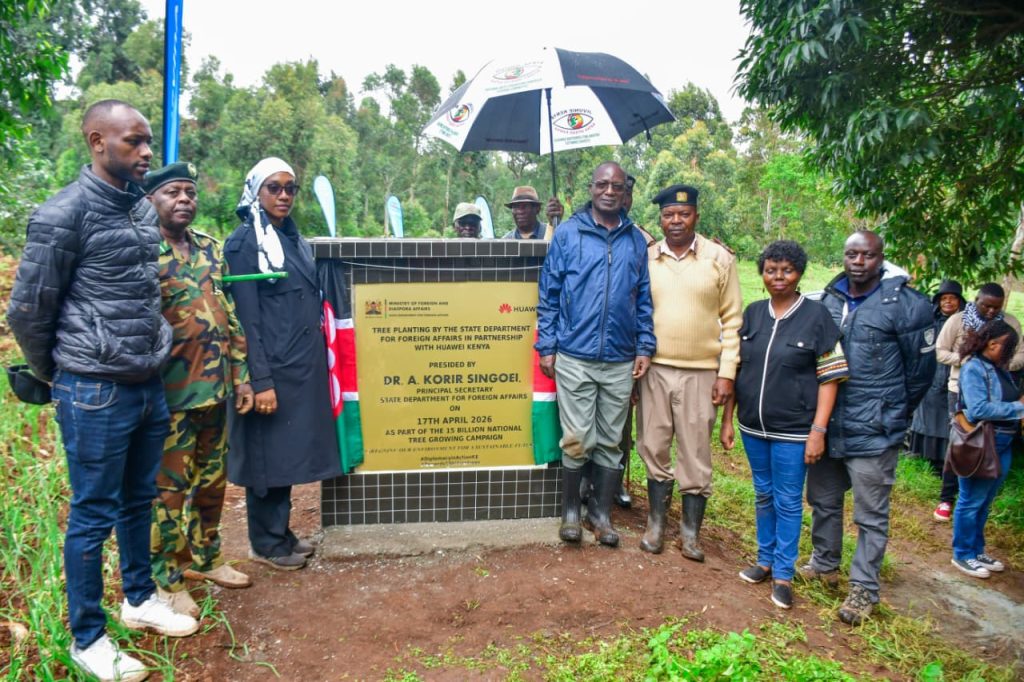
Lari Sub-County alone hosts six of Kiambu County’s eight forests, underlining the area’s ecological significance for biodiversity, water catchment protection, and environmental sustainability.
Representing Huawei, Khadija Mohammed, Public Affairs and Media Director, said the company’s participation aligns with its sustainability agenda.
“Our support for this initiative reflects Huawei’s #Tech4All agenda, which is grounded in using technology and partnerships to create a more inclusive and sustainable future. We are proud to contribute to the protection and conservation of Mother Nature while supporting the Government of Kenya’s goal of growing 15 billion trees by 2032,” she said.
Similarly, Khadija noted that through grassroots empowerment and partnerships, communities can strengthen climate adaptation and create lasting environmental impact. “Huawei’s support for the Limuru restoration initiative builds on the company’s broader sustainability efforts in Kenya under its #Tech4All platform,” she noted.
In 2025, Huawei partnered with the Kenya Wildlife Service, IUCN and the Wildlife Research and Training Institute under the Tech4Nature initiative to deploy digital conservation tools for the protection of the Kisite-Mpunguti Marine Park and Reserve, demonstrating how technology and partnerships can help safeguard both terrestrial and marine ecosystems.
Local leaders emphasized that success in forest restoration depends not only on planting seedlings, but on ensuring long-term survival through community stewardship.
Samuel Kariuki, Deputy County Commissioner, Lari, noted that collaboration with the Ministry of Foreign and Diaspora Affairs has been ongoing since 2024 and has strengthened restoration efforts in the region.
“We now need to move beyond tree planting to tree growing through consistent follow-up, monitoring and community involvement, because true success is measured by survival and sustainability,” said Kariuki.
Community representatives highlighted the direct connection between healthy forests, rivers, and livelihoods.
Tom Kimani, Community Forests Association (CFA) Uplands Chairman, said conservation efforts are helping reverse destructive practices while protecting communities downstream.
“River conservation and restoration is critical to the survival of communities downstream. Before the reforestation efforts began, charcoal burning was widespread, but today we are seeing positive change through collective action,” Kimani noted.
He added that more than 2,600 CFA and CBO members are actively involved in nurturing and safeguarding forests in the area. Kimani also underscored the importance of indigenous species in restoration programmes.
“Indigenous trees remain the best choice for conservation and agro-forestry because they protect our ecosystems while also creating sustainable benefits for local communities,” He said.
Further Kimani said that through the Tree Establishment and Livelihood Improvement Scheme, implemented in partnership with CFAs, communities are benefiting through improved household incomes while contributing to ecosystem restoration.
The event reinforced the growing importance of multi-stakeholder collaboration in addressing environmental challenges through local action.
By combining public sector leadership, private sector support, and community participation, the Limuru initiative demonstrates how partnerships can help secure Kenya’s natural heritage for future generations.