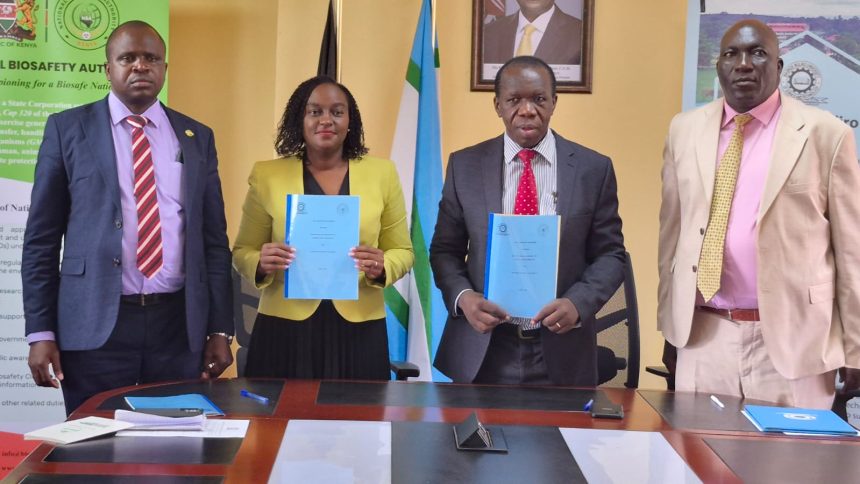
The National Biosafety Authority (NBA) and Masinde Muliro University of Science and Technology (MMUST) has today signed a memorandum of agreement on training of students undertaking modern biotechnology related courses.
The deal was inked at MMUST in Kakamega County by NBA acting Chief Executive officer Dr. Ann Karimi and MMUST Vice-Chancellor Prof. Solomon I. Shibairo in the presence of NBA director of legal services Mr. Moses Sande, Mr. Nehemiah Ngetich who is in charge of compliance and enforcement to
Dr. Karimi appreciated the agreement noting that it will go along way strengthening research and regulating of GMOs in the Country.

“We were established to handle GMOs, but we are now getting into other areas of modern biotechnologies,” said Dr. Karimi.
She added that manpower development is one of the mandates of the Authority and that is why we are reaching out to learning institutions in order to empower them.
“There so much we are doing together, and we look forward for more engagement with higher learning institutions,” explained the acting chief executive officer.
The Authority’s resources are available to benefit Kenyans, and we are working across the board to ensure the issue of misinformation and disinformation that do not hinder the rollout of GMOs in the country.
NBA acting Director Biosafety Assessment and Awareness Mr. Josphat Muchiri disclosed that its only Bt Cotton that has been commercialised in the Country. Bt maize and GM cassava have been approved by the Authority but now awaits Court ruling which has halted its commercialization since last year.
Prof. Shibairo also appreciated the agreement saying it will go along way in supporting students at the institution.
The VC assured Kenyans that GM products are safe as they undergo vigorous testing before release to the market. The University will be leading in training of more manpower and research and help the country to be leader in issues of biosafety.
The programme in which the two institutions agree to collaborate will in particular involve active participation of staff and students of the two institutions in fulfilment of their mandates in the following areas: training and capacity building ,supervision of students and trainees, field/industrial attachment, short-term training, availing internal/external examiners and part-time lecturers, capacity building programs on biosafety and modern biotechnologies, development of training modules on biosafety and biosafety regulatory compliance.
In the area of research and publication; the focus will be on research projects for technology generation, demonstration and transfer, Joint publication, Information sharing through libraries, journals and electronic databases, Sharing of research and training facilities and curriculum development and review on biosafety, biotechnology and emerging technologies.
The deal will benefit among other students undertaking Bachelor of Science programmes in Biosafety and Biosecurity which is designed to meet the growing demand for qualified biosafety and biosecurity professionals to support national and global health preparedness and response.
The institution joins a list of various partners among them Kenya Agricultural and Livestock Research Organization (KALRO), International Livestock
Research Institute (ILRI), Kenyatta University and International Centre of Insect Physiology and Ecology (ICIPE) that the Authority is working with as the regulator of Genetically modified organisms (GMOs) in the Country.
Under the Biosafety Act, Cap 320, the Authority is mandated to exercise general supervision and control over the transfer, handling and use of Genetically Modified Organisms (GMOs) with a view to ensuring safety of human and animal health and provision of adequate protection of the environment.
The study on national requirements for manpower development and capacity building in biosafety in Kenya, 2025, Commissioned by National Biosafety Authority and conducted by Prof. George O. Obiero of the Department of Biochemistry at the University of Nairobi, in 2025 proposed a review of the curriculum to include biosafety in modern biotechnology training which is crucial for ensuring safe and responsible development and application of biotechnology advancements.
The report noted that majority of the institutions of higher learning institutions were training scientists in modern biotechnology without integration of modern biosafety matters.
“A comprehensive biosafety course dedicated specifically to biosafety is only offered at BSc level at Masinde Muliro University of Science and Technology (MMUST). Therefore, there is need for other higher education institutions and tertiary institutions (TVETs) to develop and integrate biosafety course at BSc, MSc and PhD levels,” read the report .
Universities that training students in the sector are; Jomo Kenyatta University of Agriculture and Technology (JKUAT), University of Eldoret,Moi University, Kisii University, Technical University of Kenya, Kenyatta University, University of Nairobi and Maseno University among others.
Kenya signed Cartagena Protocol on Biosafety to the Convention on Biological Diversity (CBD) in 2000 and ratified it in 2003 with National Biosafety Authority as the national focus point.
This is an international agreement which aims to ensure the regulation of GMOs to ensure their safety to humans, animals and environment.
The protocol is part of the global convention on biological diversity (CBD) and provides a framework for the utilization of biotechnology while also recognizing the potential risks that may be posed by the new technologies.
The study aimed to provide a quantitative picture of biotechnology activities in the country (according to international standards), to identify needs and constraints and to fulfill the national and international obligations of the National biosafety Authority (NBA).