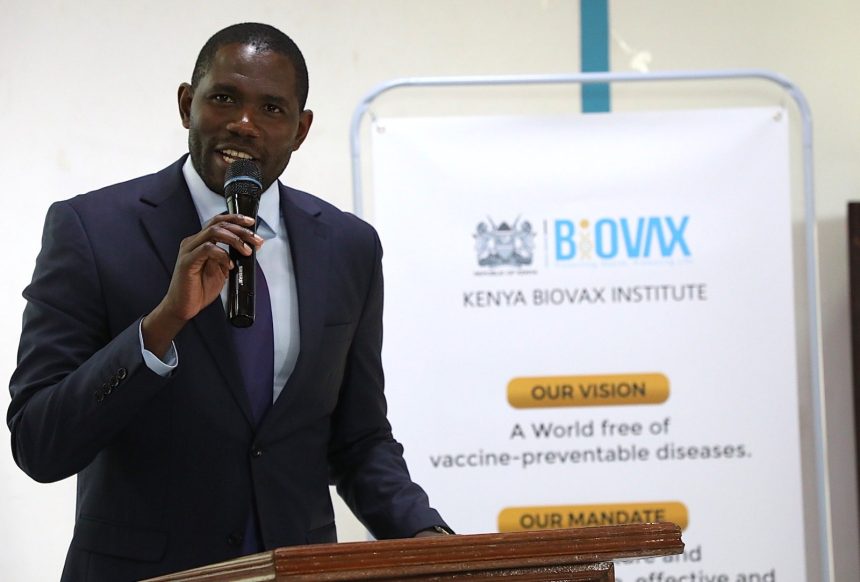
Principal Secretary for Medical Services Dr. Ouma Oluga has called on institutions of higher learning to play a more active role in advancing local manufacturing by translating research, innovation, and training into practical solutions that address Kenya’s healthcare needs.
Speaking during a Public Lecture and Stakeholder Engagement Forum on Academia, Industry and the Trigger for Local Manufacturing at the University of Nairobi’s Faculty of Health Sciences, Dr. Oluga said the country is benefiting from strong political commitment to health sector transformation, creating an opportunity for closer collaboration between academia, industry, and government in the production of vaccines, pharmaceuticals, diagnostics, and other essential health products.

The forum, organised by Kenya BioVax Institute in partnership with the University of Nairobi, brought together representatives from academia, industry, government, research institutions, and development partners to discuss strategies for accelerating local manufacturing through research, skills development, technology transfer, and strategic partnerships.
Dr. Oluga identified commodity security, healthcare financing, health workforce development, and domestic resource mobilisation as key priorities in the Government’s health transformation agenda.
He urged universities to strengthen their contribution to evidence generation, innovation, and workforce development, noting that local manufacturing depends on a highly skilled workforce and commercially viable innovations.
The Principal Secretary challenged researchers to focus on generating intellectual property, patents, and market-ready technologies that can support industrial growth and strengthen Kenya’s healthcare system.
He also highlighted the importance of leveraging the country’s expanding digital health data systems to inform policy, improve service delivery, and develop locally driven solutions to emerging health threats, including antimicrobial resistance.
Dr. Oluga commended Kenya BioVax Institute for advancing vaccine and biotherapeutics manufacturing and described the University of Nairobi as a critical partner in research, innovation, vaccine development, and clinical trials.
He reaffirmed the Government’s commitment to creating an enabling environment for local manufacturing through supportive policies, technology transfer, human capital development, regulatory strengthening, infrastructure investment, and strategic partnerships.
The forum also featured a public lecture by Prof. Stephen Gacheru on the potential for biopharmaceutical manufacturing in Kenya.
Other participants included Prof. Daniel Ojuka, Dean of the Faculty of Health Sciences at the University of Nairobi; Dr. Charles Githinji, Chairperson of Kenya BioVax Institute; Dr. Wesley Ronoh, Chief Executive Officer of Kenya BioVax Institute; and Dr. Emmanuel Kombe Nzae, Chairperson of the Kenya Vision 2030 Delivery Board.