Environment and Climate Change Principal Secretary Dr Eng Festus Ng’eno has hailed the significant progress made in the restoration of the Mau Forest Complex, saying a community-led conservation programme has successfully rehabilitated 1,500 hectares of degraded forest and planted 1.5 million tree seedlings within a mere ten months.
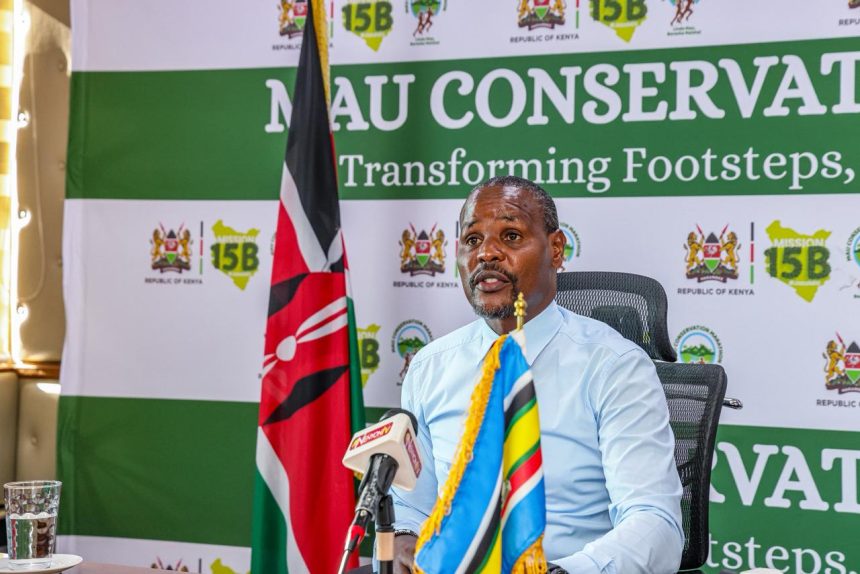
Speaking at a media briefing in Nairobi on Thursday, ahead of the second Mau Forest Conservation Marathon, Dr Ng’eno explained that the Mau Forest Complex Integrated Conservation and Livelihood Improvement Programme (MFC-ICLIP) was specifically designed to tackle environmental degradation while simultaneously enhancing the livelihoods of communities residing near the forest.

The Mau Forest Complex, Kenya’s largest water tower, supports millions of livelihoods through agriculture, hydropower generation, and water supply. It is also the source of twelve major rivers and five significant lakes.
However, Dr Ng’eno cautioned that the ecosystem remains under severe threat from illegal logging, shifts in land use, and an over-reliance on forest resources, largely driven by poverty.
“As a son of the Mau Forest who has experienced this destruction first hand, I came together with my community, development partners, private sector and government and designed the Mau Forest Complex Integrated Conservation and Livelihood Improvement Programme,” Dr Ng’eno stated.
The PS described the initiative as a unique ten-year programme that integrates conservation with livelihood improvement. He says the initiative requires an estimated funding of Ksh21 billion over this period, equating to approximately Kshh2.1 billion annually.
According to Dr Ng’eno, the programme focuses on five core areas, including sustainable land management, community livelihood enhancement, circular economy initiatives, environmental education, and project governance.
“The Programme targets in 10 years are huge. We aim to rehabilitate 33,138 hectares of South West, Eastern, Western and Molo Forest blocks, restore 668.7 hectares of wetlands and 143,803 hectares of agro-ecosystems, benefiting 148,000 households,” he elaborated.
Dr Ng’eno noted that the programme aligns with Kenya’s broader climate and environmental objectives, including Vision 2030, the Bottom-Up Economic Transformation Agenda, and the national goal of planting 15 billion trees.
Since its inception in August 2025, the PS disclosed that the initiative has attracted 74 partners who have contributed approximately Ksh884 million, primarily through in-kind support. Nevertheless, Dr Ng’eno indicated that a funding gap of about Ksh1.27 billion remains for the first phase, which concludes in June 2026.
“And as we start Edition Two on July 1, 2026, we require Sh2.1 billion. We thank our current partners for their support and invite others to join this transformative journey,” he added.
The PS highlighted the Trees Establishment and Livelihood Improvement Scheme (TELIS), commonly known as the shamba system, as a significant breakthrough in restoration efforts.
Through the initiative, communities are allowed to cultivate crops while nurturing tree seedlings, thereby strengthening household food security and diversifying incomes.
“In total, we have 657 hectares approved for TELIS by the Kenya Forest Service and we have 4,625 households producing crops, mostly potatoes, as they tend to tree seedlings,” he explained.
Dr Ng’eno further noted that over 10,000 farmers have also benefited from complementary livelihood programmes such as pyrethrum farming, avocado growing, beekeeping, agroforestry, and tree nursery establishment. The programme has additionally established avocado orchards in 180 schools.
Mau Forest Conservation Marathon
Beyond restoration efforts, the government and its partners are increasingly leveraging sports as a platform to mobilise resources and raise environmental awareness through the Mau Forest Conservation Marathon.
The inaugural marathon, held in October 2025, attracted over 1,000 athletes from more than ten counties, competing in 21km, 10km, and 5km categories.
This year’s event, scheduled for 3 July 2026 and sanctioned by Athletics Kenya, will introduce a full 42km marathon alongside the existing categories.
“The Marathon is transforming footsteps into conservation action,” Dr Ng’eno remarked.
Organisers are targeting 2,500 participants, although only about 500 runners had so far registered.
The marathon will commence in Olenguruone, Kuresoi South, and conclude at Baringo Senior School in Kuresoi North, traversing high-altitude terrain ranging between 2,547 and 2,790 metres above sea level.
Dr Ng’eno stated that the unique course is ideal for nurturing athletic talent, adding that world champion Faith Kipyegon serves as the race ambassador. In total, organisers plan to award Ksh7.8 million in prize money, with winners of the 42km race set to receive Sh600,000.
Dr Ng’eno urged Kenyans, institutions, and development partners to support the initiative and help amplify awareness regarding the necessity of restoring the Mau Forest Complex.
“The climate crisis demands urgency. Ecosystem degradation demands action. Communities living around the Mau deserve dignity, livelihoods, and resilience. The Mau cannot wait,” he said.