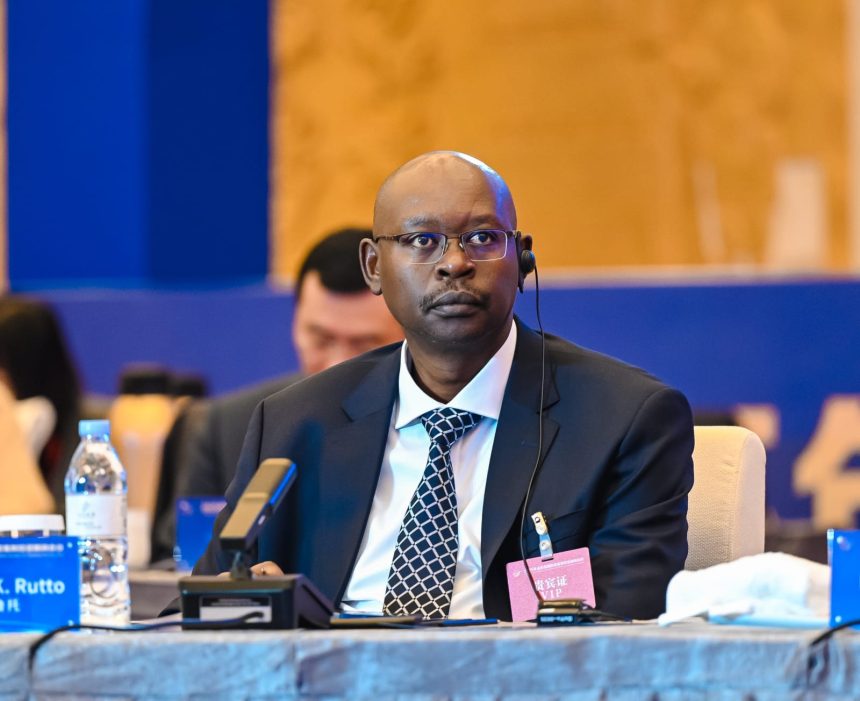
President of the Kenya National Chamber of Commerce and Industry (KNCCI), Dr. Erick Rutto, says China’s decision to grant zero-tariff market access to Kenyan products could significantly boost Kenya’s export expansion, investment attraction, and job creation efforts.
“We are very excited about China’s decision to grant zero-tariff market access to Kenyan products. This presents a significant opportunity to strengthen trade between our two countries and improve Kenya’s export competitiveness in one of the world’s largest markets,” Dr. Rutto remarked.

Speaking in an interview about China’s initiative to provide duty-free access to African products starting this May, Dr. Rutto explained that the implications for Kenya extend beyond the direct value of goods sold to China.
Increased exports, he noted, would stimulate demand across agricultural production, processing, packaging, logistics, and other services, potentially generating jobs and additional income throughout supply chains.
“In the short term, agriculture offers the greatest export potential. Kenya already enjoys a strong global reputation for tea, coffee, cut flowers, and avocados,” he said.
“Tea remains our leading export, while Kenya is among the world’s top producers of cut flowers and a leading global avocado exporter. These products are well-positioned for immediate benefits from duty-free access.”
Dr. Rutto highlighted that this preferential access to a major consumer market offers Kenya a unique chance to address a long-standing imbalance in bilateral trade. This, however, is contingent on the country’s ability to increase production, improve competitiveness, and ensure its exporters meet Chinese market requirements.
“For every one container Kenya exports to China, about 37 containers come into Kenya,” he said, describing the zero-tariff arrangement as an opportunity to narrow the gap by making Kenyan products more competitive and increasing export volumes.
Dr. Rutto believes the scale of the opportunity is considerable, noting that China imports goods worth approximately US$2.68 trillion annually, and that the opportunity provides Kenyan producers access to a market whose demand could support substantial expansion in sectors where Kenya already holds a competitive advantage.
Rutto said KNCCI has been preparing the private sector for greater access to the Chinese market for the past two and a half years.
The Chamber established a representative office in China to provide market intelligence, facilitate business linkages, and support companies aiming to enter the market.
“These efforts have already facilitated exports worth KSh765 million,” Dr. Rutto confirmed, citing avocados, tea, value-added coffee, avocado oil, and leather products among those that have successfully reached the Chinese market.
KNCCI now aims to leverage the new tariff environment to significantly increase this volume.
“Our immediate goal is to help double or even triple Kenya’s exports to China,” Dr. Rutto stated.
However, this opportunity comes with a significant challenge. While KNCCI has a database of about 4,000 exporters, only around 1,500 are actively trading monthly, and only a small proportion currently export to China.
Dr. Rutto attributed the low participation partly to stringent customs registration requirements and compliance procedures. He disclosed that the Chamber is now training exporters on Chinese customs regulations, phytosanitary standards, pricing, and other market requirements.
The Chamber is also collaborating with logistics providers to ensure that perishable Kenyan products can reach Chinese consumers within the required timelines.
With the new policy, Dr. Rutto is also urging Kenya to diversify beyond its traditional agricultural exports. He suggested that livestock products, including beef, goat meat, and mutton, could become important export earners once the two governments finalise the necessary veterinary and regulatory approvals.
Dr. Rutto noted that Chinese buyers have already shown interest, with substantial orders awaiting Kenyan suppliers who can meet the required standards.
According to Dr. Rutto, Kenya could also expand mineral exports to China while ensuring a greater share of processing and value addition occurs locally. Several companies are already interested in investing in mineral processing in Kenya, which could enable the country to supply processed products to China and other international markets instead of exporting raw minerals.
However, unlocking this investment will require Kenya to address regulatory bottlenecks. Dr. Rutto pointed out that licensing processes, particularly in mining, remain lengthy and could deter investors.
“While obtaining a mining licence can take between six months and two years in Kenya, similar approvals in neighbouring countries can take as little as two or three months,” he explained.
Reducing approval timelines, he argued, would make Kenya more competitive as an investment destination and allow businesses to respond more quickly to international demand.
The zero-tariff opportunity is also expected to stimulate Chinese investment in Kenya. Dr. Rutto said KNCCI’s China office has already helped attract eight Chinese companies that have invested approximately KSh3 billion in Kenya. Among them is Allen Textile Company, which he said is currently creating about 1,000 jobs for young Kenyans.
The Chamber wants more Kenyan companies to develop investment-ready projects and establish joint ventures with Chinese investors in energy, manufacturing, and construction. Such partnerships, he believes, could allow Kenya to utilise Chinese capital, technology, and market access to build local productive capacity while serving markets beyond Kenya.
“The private sector is ready to take advantage of the new opportunities,” Dr. Rutto affirmed, even as he argued that the objective should not simply be to increase shipments of Kenyan products to China, but to leverage the market opportunity to support Kenya’s broader industrialisation agenda.
Rutto notes that manufacturing investment linked to the Chinese market could enable companies to produce in Kenya for the domestic market, the East African region, and the wider African Continental Free Trade Area.
Services could also become a significant component of the new economic relationship. Dr. Rutto noted that tourism, in particular, presents a potentially large market, with approximately 150 million Chinese citizens travelling abroad annually.
“If Kenya attracted just one percent of that market, it would represent approximately 1.5 million visitors,” he said.
Such an increase would have far-reaching implications beyond hotels and airlines, supporting employment and business activity in transport, hospitality, entertainment, retail, food production, and other parts of the tourism economy.
Dr. Rutto emphasised that Kenya must use this opening to expand productive capacity rather than merely increasing the value of existing exports. He believes the country now has a rare opportunity to use trade policy as a catalyst for broader economic transformation.
“The zero-tariff initiative marks a major step forward in Kenya-China economic relations,” he said.