Kenya is considering a new legal framework to register and disclose foreign agents, lobbyists and foreign-funded activities.
Prime Cabinet Secretary Musalia Mudavadi said the move would strengthen transparency and protect the country’s national interests.

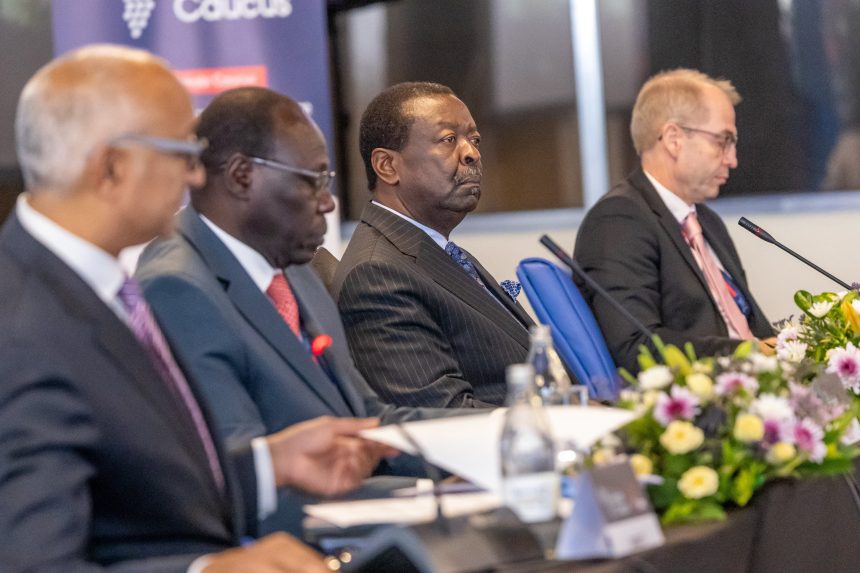
Speaking in Nairobi at the Fifth Nairobi Caucus on Protecting Critical Infrastructure Systems and Public Spaces, Mudavadi said the proposed framework would enable Kenya to better understand and monitor foreign influence while ensuring legitimate international partnerships and cooperation remain protected.
“Ultimately, a nation that understands the foreign forces shaping its decisions is a nation that safeguards its sovereignty,” Mudavadi said.
The announcement came as the Prime Cabinet Secretary warned that terrorism was evolving beyond attacks on conventional security targets to increasingly sophisticated assaults on telecommunications, transport, energy, digital systems, public spaces and other infrastructure critical to national survival.
Mudavadi said Africa had become the global epicentre of terrorism, with the Horn of Africa facing particularly acute risks.
He warned that the convergence of violent extremism, prolonged conflicts, weakening state institutions and geopolitical instability could further worsen the security situation in the region.
Election rallies could become terror targets
With Kenya moving towards the 2027 General Election, Mudavadi placed particular emphasis on the security of political rallies and other large public gatherings.
He warned that terrorists could exploit crowded public spaces to cause maximum casualties and generate panic.
“As we head towards the general elections, protecting public spaces is crucial, given the large public gatherings that characterize campaigns in Kenya,” he said.
Mudavadi also sounded the alarm over organised criminal gangs, warning that criminal networks could evolve into violent extremist organisations capable of challenging the authority of the State.
He raised a provocative question on whether heavily armed gangs that terrorise populations, undermine democratic institutions and deliberately target critical infrastructure should continue to be treated merely as criminal organisations.
His remarks come against the backdrop of growing concern globally over the ability of organised criminal networks to acquire sophisticated weapons and challenge state authority.
Critical infrastructure now a security frontline
Mudavadi said Kenya’s rapid infrastructure development had created an extensive network of assets that must now be treated as part of the country’s national security architecture.
He identified dams, railways, telecommunications networks, energy systems, health facilities, stadia, ports and digital infrastructure among assets requiring heightened protection.
“Critical infrastructure systems form the backbone of governance and the delivery of essential services,” he said.
“Destruction or degradation of these systems can paralyse economies, compromise public safety, and gravely undermine institutions and State stability.”
The Prime Cabinet Secretary cited the July 2026 attack on a telecommunications mast in Garissa by Al-Shabaab as an example of how terrorist organisations can disrupt essential services while simultaneously undermining security and economic activity.
He said the threat was no longer confined to physical attacks.
Cyber war and digital terrorism
Mudavadi warned that Kenya’s growing dependence on digital systems was creating a new frontier for terrorism and hostile activity.
A successful cyberattack, he said, could interfere with electricity grids, water systems, transport networks, financial services and other essential infrastructure without a conventional physical assault.
“We therefore need to protect not only the physical asset, but also the data, networks, software and human systems upon which that asset depends,” he said.
He cited Kenya’s Virtual Assets Service Providers Act, 2025, as an important development in addressing vulnerabilities associated with the rapidly expanding digital economy.
He also pointed to the draft Critical Infrastructure Protection Bill, 2024, which seeks to establish a framework for identifying and protecting infrastructure considered critical to the country.
Mombasa Port in regional security spotlight
Mudavadi also linked Kenya’s infrastructure security to the growing instability in the Middle East and Red Sea.
He said attacks, blockades and disruptions around strategic maritime chokepoints such as the Strait of Hormuz and Bab el-Mandeb had demonstrated how vulnerable global supply chains were to geopolitical and security shocks.
The Prime Cabinet Secretary singled out the Port of Mombasa as a critical regional asset whose security extends beyond Kenya because it serves several countries in the region.
He said the same principle applied to major aviation hubs and other interconnected infrastructure whose disruption could have consequences across borders.
“The security of shared global logistics networks, including ports and aviation hubs, requires greater attention and investment,” he said.
Kenya tightens anti-terror architecture
Mudavadi said Kenya had built an extensive legal and institutional framework to combat terrorism, organised crime, terrorist financing and cyber threats.
Among the laws he cited were the Prevention of Terrorism Act, the Proceeds of Crime and Anti-Money Laundering Act, the Computer Misuse and Cybercrimes Act, the Public Benefits Organisations legislation, the 2025 anti-money laundering and counter-terrorism financing amendments, and the Virtual Assets Service Providers Act.
He said institutions including the National Counter Terrorism Centre and Financial Reporting Centre were critical to the national response.
The laws, he said, provided the foundation for protecting both physical and digital systems that underpin Kenya’s economy, public safety and national security.
From reaction to prevention
Mudavadi challenged governments and the private sector to abandon a largely reactive approach to terrorism.
“It is imperative that we collectively move beyond reactive defence and establish proactive and resilient protective security frameworks,” he said.
He argued that investment in security should not be regarded simply as an additional cost to government or business.
“Investments in protective security must never be seen as mere operational costs, but as strategic investments in national stability, security and sustainable development.”
He called for stronger information-sharing between government agencies and the private sector, arguing that early warning and coordinated action could prevent threats from becoming full-blown crises.
Five-point security plan
Mudavadi proposed a five-point approach centred on anticipation, readiness, mitigation, response and recovery.
He called for stronger national and regional systems to anticipate terrorist threats; joint development of capabilities to protect critical infrastructure; proactive measures to harden vulnerable facilities; coordinated response mechanisms; and comprehensive recovery frameworks to restore stability after an attack.
He said the Nairobi Caucus offered an opportunity for African countries and international partners to close gaps in protective security and develop a common response to an increasingly complex terrorist threat.
“Protective security must be a shared responsibility, supported by effective information-sharing arrangements, to enable Government and industry to act together before a threat becomes a crisis,” Mudavadi said.
His warning comes as Kenya strengthens its position as a regional diplomatic, transport, financial and humanitarian hub—making the protection of its strategic infrastructure increasingly important not only to Kenya but to the wider East African region.