As Kenya marks Kenya Defence Forces (KDF) Day, the country recognises not only the military’s role in safeguarding national security, but also its contribution to national development through major civilian infrastructure projects.
From sports facilities and healthcare infrastructure to convention centres, these projects are intended to expand public services, create economic opportunities and strengthen Kenya’s capacity to host international events.

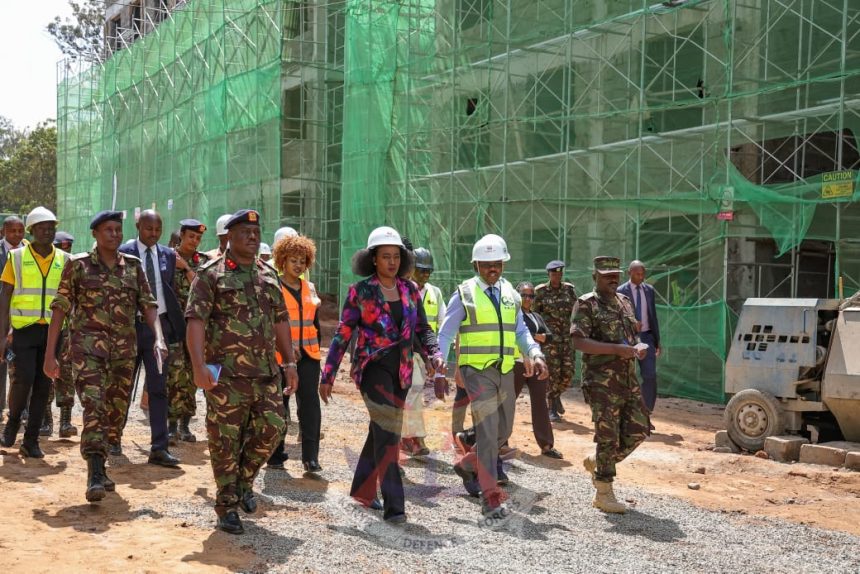
Under President William Ruto’s administration, KDF’s engineering expertise has been deployed in the construction and supervision of key public infrastructure, working alongside civilian ministries, contractors and other government agencies.
The approach draws on the military’s technical capacity, discipline and project management experience to support the delivery of facilities with long-term public value.
One of the flagship projects is the 60,000-seat Talanta Stadium in Nairobi, which is being developed to support Kenya’s preparations for the 2027 Africa Cup of Nations (AFCON).
Beyond hosting major sporting events, the facility is expected to create opportunities in sports, entertainment, tourism and related businesses.
In December 2025, Ministry of Defence project manager Major Victor King’e described its construction as being undertaken “with military precision”.
The Bomas International Convention Complex in Nairobi is another significant undertaking.
Designed to include an 11,000-seat convention centre, hotel and cultural facilities, the complex is expected to strengthen Kenya’s capacity to host international conferences, exhibitions and other major gatherings. Phase One is projected for completion in March 2027.
In healthcare, the multispecialty hospital project at Kiplombe in Eldoret is planned to provide 4,000 beds in two phases. The first phase, comprising 2,000 beds, is scheduled for completion in April 2027.
Once operational, the facility is expected to expand access to specialised treatment, medical training and research.
KDF’s involvement also extends to regional sports infrastructure. Kipchoge Keino Stadium in Eldoret is being developed as a 15,000-seat facility, while Ithookwe Stadium in Kitui hosted the 2025 Mashujaa Day celebrations.
Wajir Stadium was brought into use for the 2026 Madaraka Day celebrations, with finishing works expected to continue afterwards.
These facilities provide venues for sporting competitions and national events, while creating opportunities for local businesses, traders and hospitality enterprises.
In Nyeri, KDF is involved in the development of Ruring’u Stadium and the Mwai Kibaki Clinical Annex at Othaya’s Mwai Kibaki Referral Hospital. Construction of the clinical annex began in April 2026, with completion expected within a year.
The project is intended to expand specialist clinics, laboratory services and blood services. Its progress will be measured against the approved schedule, construction standards and delivery commitments.
The portfolio also includes upgrades at Moi International Sports Centre, Kasarani, and Nyayo National Stadium. Both facilities were handed over following renovation works in July 2025, ahead of the African Nations Championship.
As the country celebrates KDF Day, these projects demonstrate how the military’s technical and engineering capabilities can support development beyond its core defence mandate.
Their success depends on effective supervision, quality assurance, adherence to timelines and responsible use of public funds.
Ultimately, the value of KDF-led infrastructure will be reflected in the services and opportunities it delivers to Kenyans: better access to specialised healthcare, improved sporting facilities, stronger tourism and business activity, and public infrastructure that serves communities for generations.