
Parliament’s Departmental Committee on Social Protection has backed the National Social Security Fund’s (NSSF) investment in the Rironi–Mau Summit road project, terming it a viable investment that will yield good returns in posterity, while contributing to the socio-economic development of the country.
The committee chair Alice Ng’ang’a affirmed the Fund’s investment decision, saying it “made the right decision”.

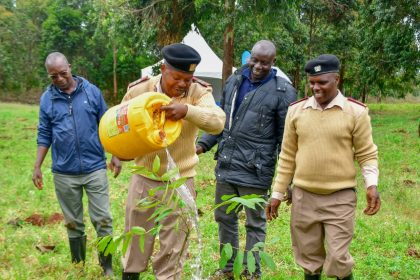
She made the remarks when she led the committee on an inspection tour of the 81-kilometre Rironi–Gilgil section, in which NSSF is a partner.
The Committee was accompanied by the NSSF Board of Trustees and Management, led by Board Chairman David Kariuki Njeru and Managing Trustee/CEO David Koross.
“From where I sit at the National Assembly, you made the right decision,” Ng’ang’a told the NSSF leadership. “We have seen that the progress is good,” she added.
She further noted that the works are about 40 percent complete, while the contractor had assured that the Rironi-Naivasha-Gilgil stretch could be fully usable by March 2027.
The Rironi-Mau Summit highway is a 233-kilometre dualling project under a public-private partnership launched in November 2025. It is split into three sections: Rironi-Naivasha-Gilgil (81 km), Rironi-Mai Mahiu-Naivasha (58 km) and Gilgil-Nakuru-Mau Summit (94 km).
NSSF and China Road and Bridge Corporation (CRBC) are building the first two, while Shandong Hi-Speed Road and Bridge International Engineering are building the third stretch. The Rironi-Naivasha section is targeted for December 2026 and the full corridor for June 2027.
The project is financed 25 percent by equity and 75 percent by debt, with NSSF contributing 40 percent of the equity. Over the 30-year concession, NSSF will receive 40 percent of toll collections and CRBC the remaining 60 percent. NSSF’s exposure is limited to its share of the equity, with the debt held at project level.
NSSF said the investment is part of a deliberate strategy to diversify beyond traditional instruments such as government bonds, and to pair members’ long-term savings with long-term, income-generating assets.
Toll revenue over the 30-year concession, the Fund said, offers steady returns and helps hedge pensioners’ savings against inflation. It cited similar moves in the region, where national pension schemes have taken equity stakes in toll roads, power projects and transport corridors.
Koross said the Fund assessed the long-term risks before investing and has instituted necessary guardrails to safeguard contributors’ funds, noting that the concession carries government assurances that the legal framework governing it will not change, and an agreed minimum toll rate.
Traffic projections point to continued growth on the corridor, he said, and the risks identified were adjusted for in setting the toll rate.
Toll policy and rates are set by the Government through the Kenya National Highways Authority (KeNHA). Motorists will pay Ksh8 per kilometre, or about Ksh648 for the full 81 kilometers, across three toll stations between Rironi and Gilgil.
Koross said local traffic will not be charged; a motorist who joins the road and exits before the next toll station pays nothing. “If you are in your own local errands, you will not be charged toll fees,” he said.
He welcomed the inspection by parliament, describing it as part of oversight of the Fund. “They came to satisfy themselves that we have invested members’ funds in the most prudent manner,” he said.