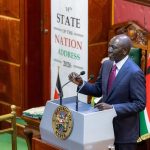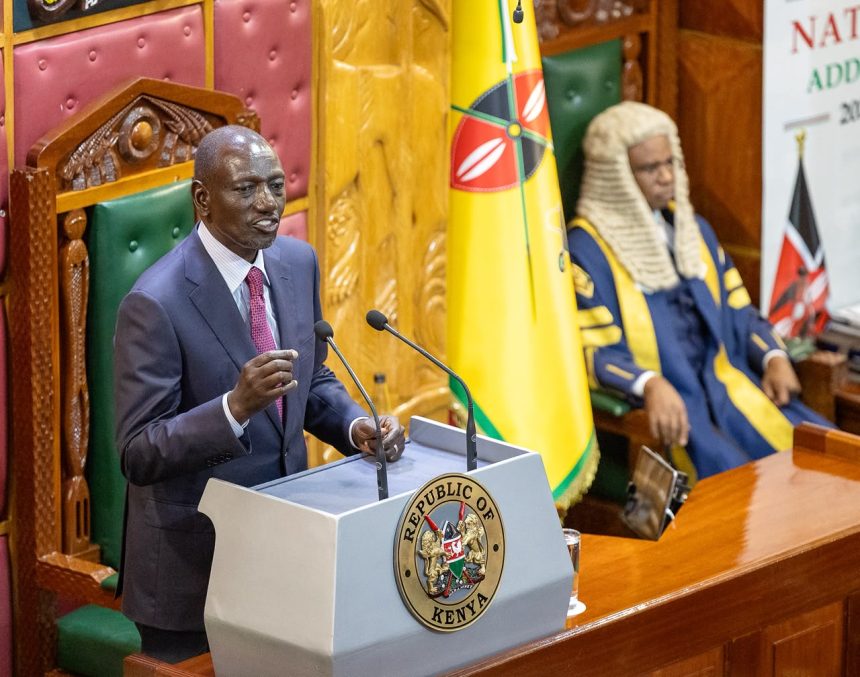
President William Ruto has outlined his administration’s economic record, citing gains in agriculture, healthcare, education, infrastructure and job creation over the past four years.
The President said the Government had undertaken extensive reforms since assuming office in 2022 when the economy was facing significant challenges, including concerns over the country’s ability to meet its international debt obligations.

“We confronted those challenges through extensive but necessary reforms,” he said during his State of the Nation Address in Parliament on Wednesday,
He added: “Despite global uncertainty and disruptions to international trade, our economy has been expanding.”
On the economic front, President Ruto said the Kenya shilling had stabilised at KSh129 against the US dollar compared to KSh162 in 2022 while inflation averaged 4.1 per cent in 2025, down from 9.6 per cent in 2022.
He further noted that the country’s foreign exchange reserves had increased from $7.37 billion in 2022 to a peak of $15.3 billion this year.
The President said agricultural reforms, particularly Government subsidies on farm inputs, including fertiliser and seeds, had contributed to increased production across key sub-sectors, including maize, tea, coffee, sugar and dairy.
He cited maize production as one of the major success stories, saying output had increased from 44.3 million bags in 2022 to 71 million bags last year.
Increased production, he said, had also contributed to a reduction in the cost of staple foods, with the average price of a 2kg packet of sifted maize flour falling from a high of KSh230 in September 2022 to KSh152 in September this year.
“Our determination is to sustain increased production so that food becomes more affordable and farmers continue earning better returns,” he said.
On the sugar sub-sector, President Ruto said it was showing signs of recovery, with sugarcane crushed increasing by 57 per cent and sugar production rising by 60 per cent between January and October this year.
He projected that the industry would produce more than 900,000 tonnes by the end of the year, which he described as the highest annual production in Kenya’s history.
To ensure farmers benefit from the industry’s improved performance, the President announced that a KSh1.2 billion bonus package would be paid to sugarcane farmers, with disbursements expected to begin next week.
He said the Government is also building 600 modern markets across the country at a cost of KSh57 billion, providing traders with improved trading space, storage facilities and cold rooms.
Health
In the healthcare sector, the President said 33.7 million Kenyans had registered with the Social Health Authority (SHA) compared with eight million under the National Health Insurance Fund (NHIF) in 2022.
He said thousands of Kenyans were now accessing specialised medical services through SHA, easing the financial burden of treatment that would otherwise be unaffordable for many households.
He announced that 53,465 patients are receiving cancer treatment, 24,468 undergoing dialysis while 89 Kenyans have received kidney transplants under the scheme.
“These are among the most expensive forms of medical care often beyond the financial reach of ordinary households,” he said.
Education
On education, President Ruto said his administration had employed 100,000 teachers over the past four years, with another 20,000 expected to be recruited next year.
Additionally, 23,000 classrooms have been built and 1,600 laboratories are being constructed and equipped across the country, expanding access to learning and easing pressure on communities to finance essential school infrastructure.
The annual education budget has also increased from KSh521 billion in the 2022/2023 financial year to KSh784 billion in the current financial year.
The President further noted that a record 3.6 million learners have sat respective national examinations this week, including the Kenya Primary Schools Education Assessment (KPSEA), Kenya Junior School Education Assessment (KJSEA) and Kenya Certificate of Secondary Education examinations without the heavy police presence that characterised previous periods.
“Examinations are a normal part of learning, not a security operation or a matter of life and death. They should assess our children’s progress, not instil fear about their future,” he said.
Housing
Under the Affordable Housing Programme, President Ruto said more than 313,000 housing units were at various stages of construction and completion across the country, creating more than 1.1 million job opportunities.
The President also highlighted employment opportunities created through overseas employment and the digital economy, saying more than 707,000 Kenyans had secured jobs abroad, l while another 350,000 had found work in the digital economy.
Despite these gains, he acknowledged that more needed to be done to lower the cost of living and ensure Kenyans received better returns from their work.
To this end, he said the Government had proposed several tax measures to Parliament, including exempting workers earning KSh32,333 or less per month from Pay As You Earn (PAYE), removing stamp duty on land transactions valued at KSh1 million or less, and eliminating the 25 per cent import duty on mobile phones.
Pending bills
On pending bills, the President said the government had approved the payment of 28,726 verified claims amounting to KSh27.8 billion dating back to 2005 and covering claims of KSh50 million and below.
He added that the National Treasury had approved the payment of KSh18 billion owed to public universities and a further KSh16 billion to public and private hospitals under the former NHIF.
“Together, these measures will increase incomes, make property ownership and digital access more affordable, restore cash flow to businesses, protect jobs and sustain livelihoods,” he said.
Infrastructure
On infrastructure, he pointed out that 7,000km of roads were under construction across the country, including projects that had stalled for several years.
He cited the Rironi-Mau Summit highway and the 750km Horn of Africa Gateway Development Project in Northern Kenya as key projects progressing towards improved connectivity and economic opportunities in previously underserved regions.
“What many of us take for granted has remained a distant hope for other citizens. That is the inequality we are correcting. That is the Usawa they deserve,” he said.
The President also said expansion works at Jomo Kenyatta International Airport were underway, with plans to modernise the ports of Mombasa and Lamu to strengthen the country’s transport and logistics infrastructure.
Devolution
On devolution, he explained that the National Government had disbursed KSh1.55 trillion to county governments as equitable share over the past four financial years, with a further KSh428 billion allocated in the current financial year.
He added that KSh16.8 billion had been appropriated this year for development projects in marginalised areas under the Equalisation Fund.
“That is the promise of Bottom-Up finding expression in Usawa ni Sawa: A Republic in which opportunity is not the privilege of a few regions, communities or families but the rightful expectation of every Kenyan,” he said.
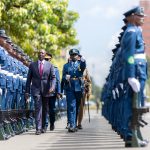
Present were First Lady Rachel Ruto, Deputy President Kithure Kindiki, Prime Cabinet Secretary Musalia Mudavadi, Orange Democratic Movement (ODM) Party Leader and Siaya Senator Oburu Odinga, Cabinet Secretaries Aden Duale (Health), Opiyo Wandayi (Energy), John Mbadi (Treasury), Hassan Joho (Mining) and Geoffrey Ruku (Public Service).
Also present were Chief Justice Martha Koome, Chief of Kenya Defence Forces General Charles Kahariri and Service Commanders, Inspector-General of Police Douglas Kanja, Attorney-General Dorcas Oduor, Council of Governors Chairman and Tharaka-Nithi Governor Muthomi Njuki, Bungoma Governor Ken Lusaka, former Senate Speaker Ekwee Ethuro, and the Government Chief Whip of Uganda Jane Ruth Aceng, MPs and members of the diplomatic corps, among others.