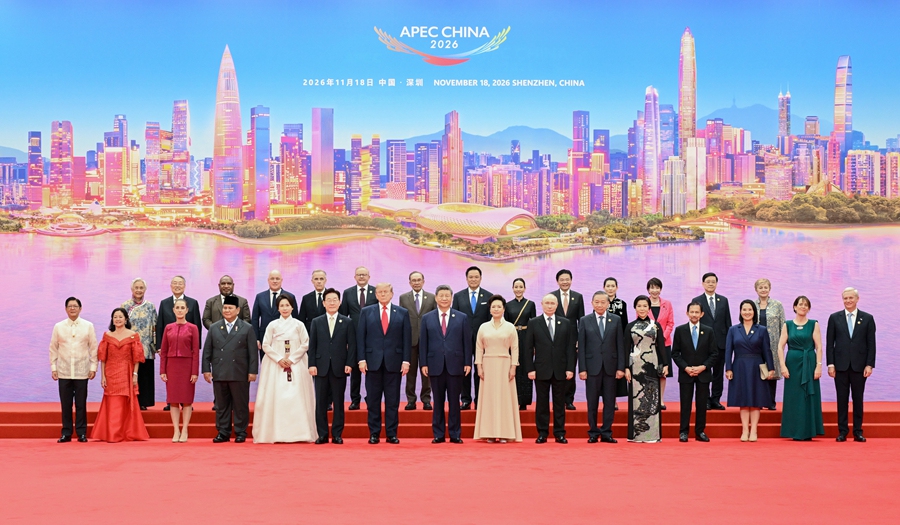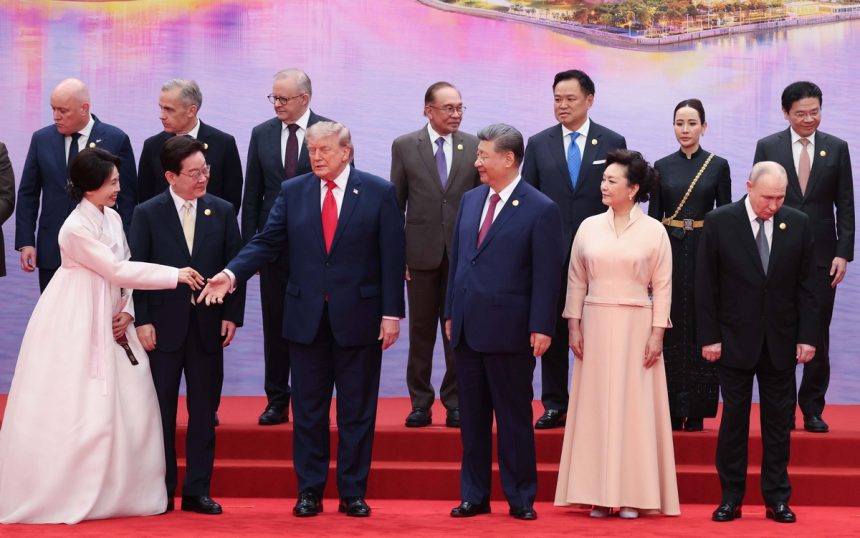
Chinese President Xi Jinping engaged in discussions with US President Donald Trump, Russian President Vladimir Putin, and South Korean President Lee Jae-myung on the sidelines of the Asia-Pacific Economic Cooperation (APEC) meeting in Shenzhen, signaling Beijing’s intensified diplomatic outreach to major global powers.
The meetings, following a series of diplomatic activities on Tuesday, underscored China’s commitment to strengthening bilateral ties, managing differences, and fostering regional cooperation amidst increasing geopolitical and economic volatility.

During his meeting with Trump, Xi advocated for a stable and constructive relationship between China and the United States, founded on mutual respect, fairness, and reciprocity. Welcoming the US president at Shenzhen Bao’an International Airport, Xi expressed anticipation for in-depth discussions on bilateral relations, Asia-Pacific cooperation, and critical global issues.
He referenced his state visit to the United States in September, emphasizing China’s value for diplomatic courtesy and the principle of reciprocating goodwill.
Trump thanked Xi for his personal reception and the arrangements for his visit, describing China as a great nation and Xi as a great leader.
He expressed confidence that their engagement would further advance relations between the two countries, noting that previous meetings with the Chinese leader had been productive and pleasant.
Earlier, Xi held talks with Putin, stressing the crucial role of China-Russia relations in promoting stability and certainty within an increasingly turbulent international environment.
Xi stated that both countries should deepen comprehensive cooperation and uphold their responsibilities as major powers in advancing a multipolar world and greater democracy in international relations.
He also highlighted the significance of the Asia-Pacific region, characterizing APEC as an important platform for strengthening cooperation and promoting shared prosperity.
China, he affirmed, was prepared to collaborate with Russia and other regional economies to advance development and build an Asia-Pacific community.
Putin remarked that his engagements with Xi had sustained positive momentum in bilateral relations, noting their four productive meetings during the year.
He pointed to increased high-level exchanges, record bilateral trade, and progress in practical cooperation across various sectors.
Russia, he said, was committed to strengthening strategic coordination with China and expanding cooperation in trade, energy, education, culture, and people-to-people exchanges.
Xi also met with South Korean President Lee Jae-myung, calling for stronger bilateral relations as the two countries prepare to commemorate 35 years of diplomatic ties next year.
He urged both nations to uphold strategic independence, preserve the political foundations of their relationship, and strengthen cooperation in emerging industries.
Xi specifically highlighted the progress made in negotiations on the second phase of the China-South Korea Free Trade Agreement, stating that the arrangement should be utilized to enhance economic policy coordination and promote cooperation in emerging technology sectors, including artificial intelligence.
Lee noted that relations between the two countries had experienced a comprehensive restoration, with expanding economic and trade cooperation, increasing people-to-people exchanges, and improving mutual perceptions.
He reaffirmed South Korea’s commitment to the one-China policy, stating that the country’s position had not changed and would not change. The meeting provided an opportunity for the two leaders to consolidate diplomatic and economic ties following their previous engagements in Beijing in January and at last year’s APEC summit in South Korea.
Beyond the bilateral engagements, China’s role as host of the APEC meeting has garnered international attention, with analysts highlighting the importance of direct diplomatic engagement in complementing multilateral discussions.
Prof. Wang Yiwei, a professor at Renmin University’s School of International Studies, stated that China’s diplomacy as a host reflected a more proactive approach to international engagement and sharing development opportunities.
He noted that China’s industrial capacity and integration into global supply and value chains offered opportunities for cooperation in agriculture, manufacturing, and the digital economy.
He argued that China’s emphasis on openness, regional cooperation, and multilateralism provided countries with additional opportunities to pursue economic partnerships amidst growing international uncertainty.
Wang emphasized that the Shenzhen engagements underscore the importance of sustained dialogue among major powers, with Xi’s meetings placing economic cooperation, strategic stability, and regional development at the forefront of China’s diplomatic agenda.