Prime Cabinet Secretary Musalia Mudavadi has said the African Day is a symbol of solidarity, resilience, and a shared vision for prosperity across the continent, and the celebration reflects Africa’s rich diversity while reinforcing the collective commitment to peace, cultural exchange, and sustainable development.
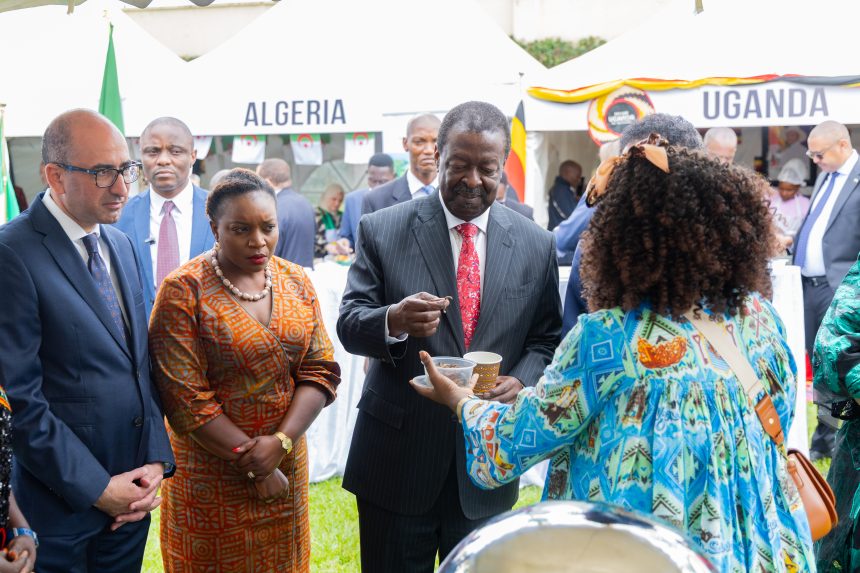
Speaking as the Chief Guest at the Africa Day 2026 celebrations marking the 63rd anniversary of the Organisation of African Unity (OAU), PCS emphasised the importance of the celebration that was not only a cultural showcase but also a reaffirmation of the enduring spirit of unity that defines Africa.

The event brought together African nations in a colourful showcase of culture, cuisine, and heritage. Exhibition stands from Senegal, Sudan, South Africa, Angola, Ghana, Zimbabwe, Cameroon, Botswana, Sahrawi, Burkina Faso, Zambia, Eritrea, Egypt, Uganda, Algeria, Democratic Republic of Congo, Nigeria, and Sierra Leone offered guests a chance to experience authentic African cuisines, traditional attire, music, and art.
Mudavadi, also the Cabinet Secretary for Foreign and Diaspora Affairs, said the African Day serves as a constant reminder of where we have come from as a continent, who we are as a people, the strength of its unity in the rich diversity, and their collective responsibility and solidarity to forge a prosperous future.
“African Day embodied the African Union’s vision of “An Integrated, Prosperous and Peaceful Africa, driven by its own citizens and representing a dynamic force in the global arena. We must remain resolute in translating this collective vision into reality, guided by the African Union Agenda 2063,” said Mudavadi.
Mudavadi said Africa must be at the centre of finding solutions to its own challenges. Accordingly, we must support African-led peace and security initiatives and strengthen our institutions such as the African Union, the Intergovernmental Authority on Development (IGAD), and the International Conference on the Great Lakes Region.
Mudavadi noted that, even as the African countries gathered in unity, thoughts remain with communities affected by the devastating Ebola outbreak in the region, which has claimed the lives of many of fellow Africans.
PCS said the continent was commemorating this year’s Africa Day under the African Union’s 2026 theme, “Assuring Sustainable Water Availability and Safe Sanitation Systems to Achieve the Goals of Agenda 2063”.
“Therefore, the 2026 Africa Day renews our commitment to advancing water and sanitation as essential enablers for industrialisation, climate resilience and food security. Additionally, safe drinking water is a critical component of a healthy continent,” said Mudavadi.
Mudavadi said Africa was endowed with sufficient water resources to meet the basic needs while supporting agriculture, energy generation, and industrialisation, and the challenge was not one of scarcity, but of governance, infrastructure, and climate resilience.
“Notably, Kenya hosted the 11th Our Ocean Conference in Mombasa in June 2026, the first to be held in Africa, reflecting Africa’s growing leadership in Ocean governance and the blue economy. A notable outcome of the Conference was the adoption of the Mombasa Declaration, which advances sustainable fisheries, marine conservation and the fight against illegal, unreported and unregulated (IUU) fishing, that costs African economies an estimated USD 11 to 13 billion annually,” said PCS.
He said commemoration renews our commitment to amplify Africa’s collective voice in multilateral fora, including calls for United Nations reform, to advance our shared aspirations for peace, prosperity and a more inclusive international order.
Mudavadi said the continent continues to grapple with the twin challenge of governance and violent conflicts.
“As we mark 63 years of African Unity, we must consolidate our governance gains and encourage each other to firmly embrace democratic values, recognising that accountable leadership and strong institutions are important to sustainable peace and the silencing of the guns in Africa,” he said.
PCS said the Africa Forward Summit held in Nairobi in May 2026 reaffirmed the continent’s collective resolve to take greater charge of its future by enhancing African Agency through stronger African financial institutions; greater domestic resource mobilisation; industrialisation and value addition; human capital development, and more assertive African representation in global decision-making.
Similarly, during the G7 Summit in June 2026, Mudavadi said that President William Ruto articulated Africa’s priorities and position as crystallised at the African Forward Summit, noting that Africa was diversifying and strengthening mutually beneficial partnerships founded on trade and investment, rather than aid, and on manufacturing and value-addition, rather than extraction.
“Indeed, Africa is no longer an apologist for its circumstances, nor defined by lamentations. We are a voice to be heard, a valued global partner with immense opportunities for shared prosperity, and not a problem to be solved,” said Mudavadi.
He said the outcomes of the G7 Summit included commitments to reform the development cooperation system and shape mutually beneficial partnerships, address escalating global debt vulnerabilities that threaten economic stability and constrain fiscal space for essential public service interventions, and reinforce the guarantee architecture, notably through African Trade and Investment Development Insurance (ATIDI).
“It also advanced the need for democratisation of technology, including Artificial Intelligence (AI), and underpinned the imperative of ensuring responsible use of these digital platforms. The Summit further called for deeper cooperation in health, including cancer research and resource mobilisation to tackle emerging Ebola outbreaks. As such, we must strengthen African health systems and institutions, including the Africa Centres for Disease Control and Prevention (Africa CDC),” he said.
Amid rising economic nationalism, PCS said that Africa must accelerate the full implementation of the African Continental Free Trade Area (AfCFTA) to foster intra-African trade, reduce dependence on external markets and strengthen economic resilience.
Equally important, he noted, the continent’s sustained campaign to raise public awareness of the benefits and opportunities of the Continental Free Trade Area. We must also support and strengthen African-oriented financial institutions such as the African Development Bank and African Export-Import Bank (Afreximbank).
He noted that the realisation of Agenda 2063 depends on a stronger and more effective African Union spearheaded by President Ruto, in his capacity as the Champion of the African Union Institutional Reforms, continuing to engage stakeholders, to enhance inclusivity, and building consensus in advancing the Union’s Reform Agenda.
PCS took the opportunity to market the candidatures of Professor Pheobe Okowa for her re-election as Judge to the International Court of Justice (ICJ) for the period (2027–2036), and Lady Justice Njoki Ndung’u for election as Judge to the International Criminal Court (ICC) for the period (2027-2036)
“Kenya has put forward candidates for positions where we believe our country can make a meaningful contribution. We have nominated distinguished and experienced jurists who, we are confident, will serve with excellence and integrity. On behalf of the people and the Government of Kenya, I wish to respectfully commend Kenya’s candidatures to the consideration and support of Member States.