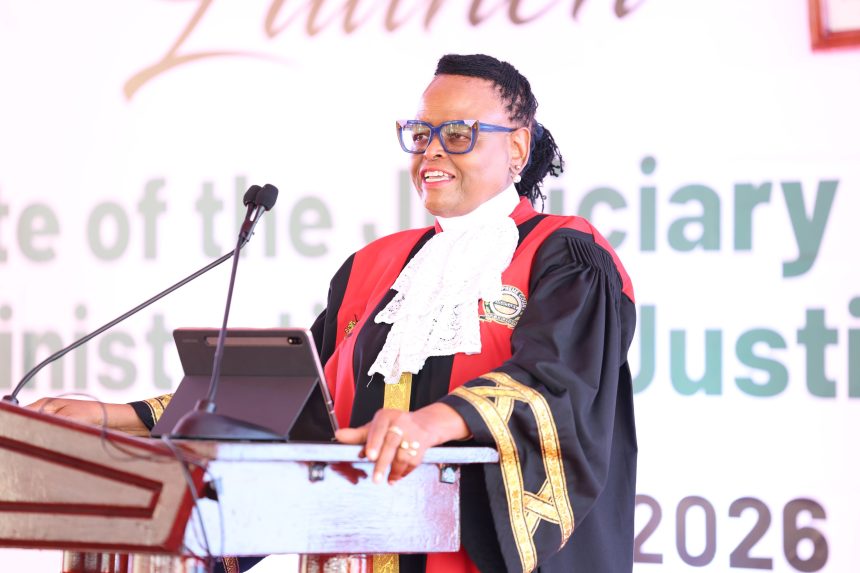
Backlog remains a major challenge for the Judiciary despite courts resolving more cases than were filed in the 2025/2026 financial year.
This is according to the State of the Judiciary and the Administration of Justice Annual Report for the financial year, released on Friday.

Chief Justice Martha Koome said the number of pending cases declined by 2.5 per cent, from 595,076 at the beginning of the financial year to 579,954 by June 30, 2026.
Cases that had remained unresolved for more than one year also dropped by 15.8 per cent.
However, 341,412 cases, representing 59 per cent of all pending matters, had remained unresolved for more than a year.
Koome said addressing the backlog required additional judicial officers and staff, noting that the Judiciary had 8,017 employees against an approved establishment of 12,079, representing about 66 per cent of its staffing requirements.
During the year, courts resolved 576,702 cases against 561,580 filed, achieving a case clearance rate of 103 per cent.
Koome attributed the improved performance to enhanced court efficiency, stronger institutional systems and improved access to justice.
The Judiciary appointed 53 Judges and 100 Resident Magistrates, among other appointments, bringing the total number of new appointments to 1,280.
It also expanded its presence across the country by establishing new Court of Appeal stations in Kakamega and Meru and operationalising the Eldoret Court of Appeal station.
Five additional Magistrates’ Courts became operational, bringing their total to 148, while 15 new Small Claims Courts increased the number of stations to 55.
On alternative dispute resolution, court-annexed mediation was extended to all 47 counties, supported by 42 additional mediation registries, bringing the national total to 128.
Disputes valued at Ksh20.88 billion were referred for mediation, resulting in settlements worth Ksh13.05 billion without full trials.
The Judiciary also expanded its digital services, with electronic filing and the Case Tracking System operational across all courts and tribunals. A further 192,633 case files were digitised, bringing the cumulative number to 749,522.
On accountability, the Office of the Judiciary Ombudsman resolved 1,111 of the 1,243 complaints received during the year, representing an 89 per cent resolution rate.
Koome maintained that corruption, bribery, favouritism and misconduct had no place in the administration of justice.
She also cited inadequate funding as a constraint on the Judiciary’s operations, despite a 19 per cent increase in its budget to Ksh27.15 billion in the 2025/2026 financial year.
The allocation remained below its operational requirements, leaving a funding shortfall of Ksh12.95 billion.
Koome called for adequate and predictable financing to support recruitment, infrastructure development, technological modernisation and the expansion of court services to underserved communities.