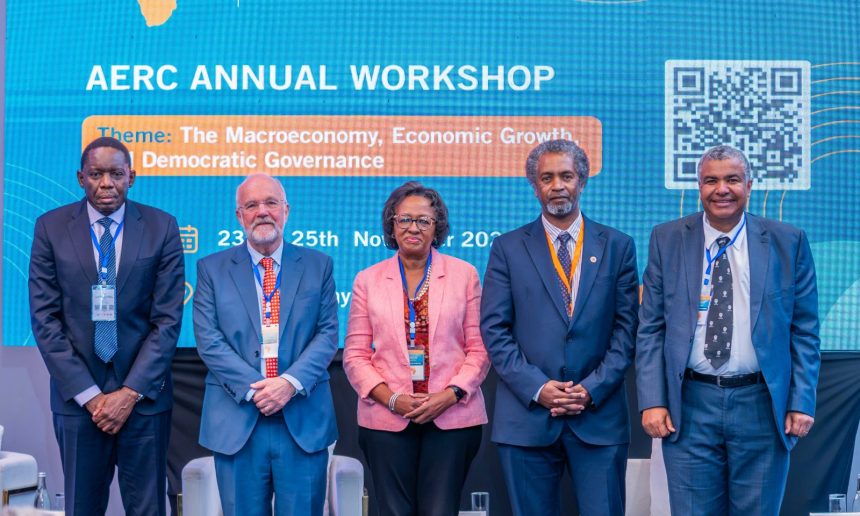
The African Economic Research Consortium (AERC) has commenced its 2026 Annual Workshop, bringing together 2,969 registered participants from 68 countries to examine the policy choices shaping Africa’s economic future amid evolving global and domestic challenges.
Held under the theme, “The Macroeconomy, Economic Growth, and Democratic Governance,” the workshop provides a platform for African and international researchers, policymakers, central bankers and development partners to interrogate the relationship between macroeconomic management, sustainable economic growth and accountable governance.

Discussions are taking place against a backdrop of uneven post-pandemic recovery, increasingly frequent climate shocks and declining Official Development Assistance (ODA).
With traditional sources of external development financing becoming less predictable, African governments face growing pressure to strengthen domestic resource mobilisation, safeguard fiscal stability and build resilient institutions capable of sustaining long-term development priorities.
Opening the workshop, Dr. Adelaide Matlanyane, Lesotho’s Minister of Finance and Development Planning and an AERC Board Member, presented an overview of the region’s economic outlook, noting that sub- Saharan Africa is projected to grow by 4.5%.
Drawing on Lesotho’s experience, she highlighted the country’s 2026/2027 budget priorities, which place economic resilience at the centre of its development agenda.
These include repositioning the state to facilitate private sector-led growth, strengthening public financial management and broadening domestic resource mobilisation.
She emphasised that macroeconomic stability is not an end in itself, but an essential foundation for economic growth and the generation of resources needed to improve citizens’ livelihoods.
She challenged participants to consider a question that framed the broader workshop discussions: How can countries with limited fiscal space protect development priorities during climate shocks?
The Governor of the Central Bank of Kenya, Dr. Kamau Thugge, who officiated as Guest of Honour, reinforced the importance of macroeconomic stability as a prerequisite for sustained economic growth.
He observed that formulating and implementing monetary policy to maintain stability has become increasingly complex in an environment characterised by global uncertainty and multiple economic shocks.
Reflecting on Kenya’s economic performance, Dr. Thugge noted that the economy had demonstrated resilience, recording average growth of approximately 5% between 2022 and 2025 despite prevailing headwinds.
He also acknowledged AERC’s contribution to strengthening economic research and institutional capacity across the continent, highlighting the Central Bank of Kenya’s longstanding engagement with the Consortium. He noted that the institution had benefited significantly from AERC’s research and capacity-building initiatives, with several of its staff members having participated in its programmes.
In outlining AERC’s strategic priorities, Dr. Abbi Kedir, the Consortium’s Acting Executive Director, highlighted emerging programmes aimed at strengthening central bank capacity at different levels, alongside initiatives exploring artificial intelligence and the future of economics.
He underscored the importance of strategic partnerships in advancing the Consortium’s mandate, citing collaborations with the African Capacity Building Foundation, World Bank and African Development Bank.
Kedir further emphasised AERC’s continued commitment to supporting thematic researchers and their mentors while expanding opportunities for research, knowledge exchange and policy engagement.
The workshop’s opening technical session featured a presentation by Prof. Finn Tarp of the University of Copenhagen, titled “Navigating Africa’s Development Challenges.”
The session was chaired by Mukami Kariuki, Regional Hub Manager for the Africa Eastern and Southern Region at the World Bank Group.
The discussion examined six interconnected areas of economic and policy discourse, including foreign aid and development financing, jobs and industrial policy, climate change and macroeconomic management, domestic resource mobilisation and tax reform. Participants explored the evidence underpinning current economic thinking, while interrogating areas where significant policy questions remain unresolved.
Beyond examining the challenges, the session sought to stimulate joint thinking on policy approaches that safeguard democratic principles, strengthen domestic economic resilience and reshape international development partnerships. It also highlighted opportunities to translate emerging research questions into practical, policy-relevant research capable of informing decision making across African economies.
As the workshop progresses, these discussions will provide an opportunity to strengthen the connection between economic research, public policy and institutional practice.
By bringing together researchers, governments, central banks and development partners, AERC seeks to advance evidence-based approaches to the continent’s development challenges and support policies that promote inclusive and sustainable economic growth.