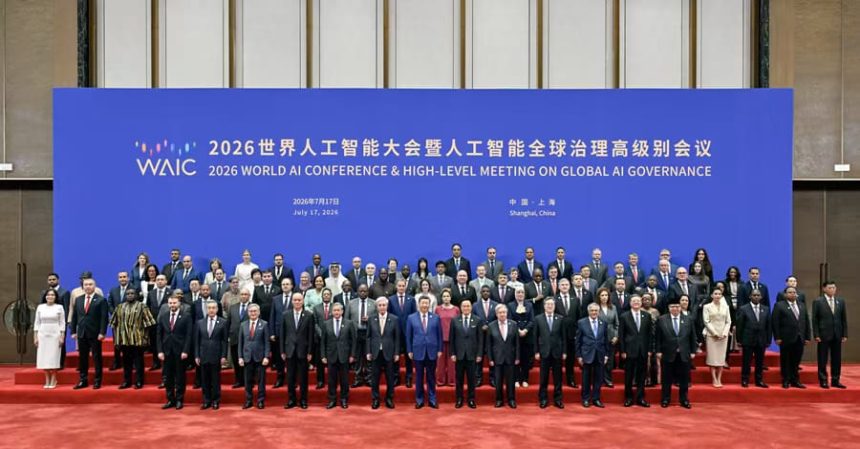
Leaders attending the 2026 World Artificial Intelligence Conference (WAIC) and High-Level Meeting on Global AI Governance have called for stronger international cooperation to ensure artificial intelligence drives inclusive development while addressing growing concerns over security, ethics and unequal access to emerging technologies.
The four-day conference, held in Shanghai from July 17 under the theme “AI Partnership for a Brighter Future,” brought together representatives from over 100 countries and international organisations, along with business leaders, researchers, and technology experts to chart a common path for global AI governance.

Chinese President Xi Jinping opened the conference with a keynote address, joined by leaders such as Kazakhstan President Kassym-Jomart Tokayev, Cambodian Prime Minister Hun Manet, Thai Prime Minister Anutin Charnvirakul, and United Nations Secretary-General António Guterres.
In the Chair’s Statement, participants acknowledged that AI is rapidly reshaping economies, industries, and societies, creating unprecedented opportunities for innovation, but it also raises complex questions regarding ethics, data governance, cybersecurity, and regulation.
The conference emphasised that AI has become a new frontier of global governance, necessitating a “new paradigm” based on international solidarity, collaboration, and multilateral cooperation. Delegates highlighted the importance of balancing technological innovation with security, governance, and the broader interests of humanity.
The statement underscored a people-centred approach to AI development, focusing on fairness, inclusivity, and international cooperation to ensure that AI benefits all countries and does not deepen existing technological inequalities.
A key focus of the conference was narrowing the AI divide between developed and developing nations. Delegates urged urgent action to address unequal access to computing power, data, talent, and digital infrastructure, stressing that Global South countries must participate fully in the AI revolution to help achieve the United Nations Sustainable Development Goals.
Innovation remained central to the conference agenda, with participants advocating for an AI ecosystem driven by enterprises, scientific research, market demand, and skilled talent. Governments were encouraged to invest in digital skills, innovation, and research, while accelerating AI adoption across various sectors including education, healthcare, agriculture, manufacturing, transportation, climate action, and public services.
The conference also endorsed responsible open-source development to make AI technologies more accessible. Delegates called for enhanced international collaboration in research and innovation, safeguarding intellectual property rights, and respecting the independent choices of enterprises.
Recognising data as the foundation of AI, participants urged countries to strengthen data governance by protecting personal information, enhancing cybersecurity, and establishing clear frameworks for data ownership and cross-border data flows to ensure information remains secure, traceable, and responsibly managed.
Another significant focus was the environmental impact of AI as the conference called for closer integration between AI development and sustainable energy systems, promoting the deployment of large-scale computing infrastructure powered by renewable energy while advocating for greener, lower-carbon AI technologies.
Participants also examined AI’s impact on labour markets and society, urging governments to expand AI education, workforce reskilling, and entrepreneurship while safeguarding workers’ rights amidst technological transformations.
On security, the conference adopted a cautious approach, highlighting risks associated with powerful frontier AI models. Delegates called for stronger legal and regulatory frameworks, improved technical monitoring, early warning systems, and agile governance mechanisms to prevent misuse and ensure AI remains under meaningful human control.
Delegates further expressed concerns over potential AI misuse by terrorist organisations, extremist groups, and transnational criminal networks. They called for enhanced international cooperation, crisis management mechanisms, and coordinated efforts to counter malicious AI technology applications.
The conference stressed the need for international standards covering AI safety, ethics, industrial development, and governance. Participants called for transparent, science-based, and inclusive standards that can be mutually recognised across countries to reduce barriers to international cooperation and support stable AI supply chains.
Cultural diversity was a central theme in the final declaration, with delegates emphasising that AI development should respect differences in history, civilisation, and national cultures while supporting the preservation and creative development of diverse cultural traditions.
One of the significant outcomes of the conference was the signing of an agreement establishing the World Artificial Intelligence Cooperation Organisation (WAICO), the world’s first intergovernmental international organisation dedicated to artificial intelligence.
Headquartered in Shanghai, WAICO will focus on supporting Global South countries through AI innovation, governance, and capacity building while promoting international cooperation based on equality, multilateralism, and shared development.
According to the Chair’s Statement, the organisation will uphold the principles of the United Nations Charter, respect national sovereignty and cultural diversity, and remain open to participation by all countries.
The delegates expressed renewed commitment to deepen international dialogue, strengthen multilateral cooperation, and ensure that the rapid advancement of artificial intelligence contributes to sustainable development, shared prosperity, and the well-being of humanity.