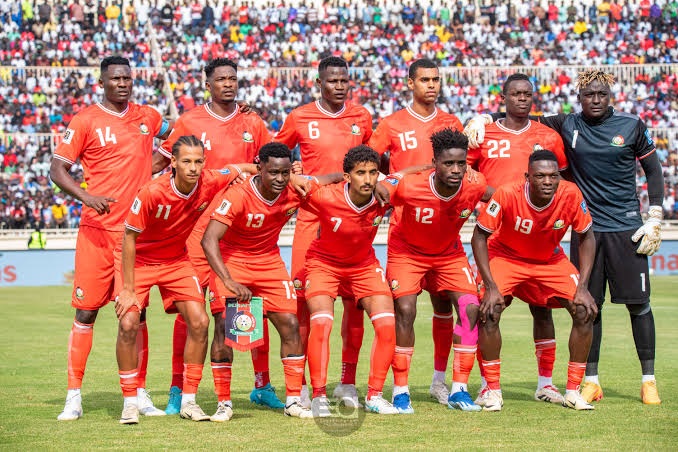
Kenya’s Harambee Stars have held their ground in the FIFA World Rankings even as the football world reshuffles dramatically following Spain’s triumph at the 2026 World Cup.
FIFA’s first post-tournament update, released this week, saw Spain reclaim top spot with 1,995.88 points after their extra-time win over Argentina in the final, while the runners-up slipped to second.

Amid that seismic shift at the summit, Kenya’s own standing has stayed unchanged, last placed at 109th in the world following a strong 4-0 friendly win over Lesotho in June, a position the Harambee Stars have now carried through the World Cup ranking cycle untouched.
Within East Africa, Kenya remains the region’s second-highest ranked side, trailing only Uganda, who sit at 89th globally.
The gap highlights both the progress Kenya has made in recent months under coach Benni McCarthy and the work still needed to close the distance on their regional rivals.
On the continental stage, Morocco continues to set the standard as Africa’s highest-ranked nation. The Atlas Lions are ranked sixth in the world in the post-World Cup update, leapfrogging Portugal after another strong showing on the global stage, underlining just how far the gap still is between Kenya and Africa’s elite.
The rankings update was also shaped by one of the tournament’s standout stories: Cape Verde’s fairytale World Cup run.
The Blue Sharks, competing in their first-ever World Cup as one of the smallest nations to reach the finals, defied expectations by advancing out of the group stage and into the Round of 32, where they were eventually eliminated by Argentina.
Their journey has been widely celebrated as proof that smaller footballing nations can still make history on the biggest stage.
For Kenya, the numbers offer a mixed picture. Holding a ranking during a period of major upheaval reflects a measure of stability.
With Morocco cementing its place among the world’s best and Cape Verde showing what a well-run campaign can achieve, the pressure remains on the Harambee Stars to convert steady progress into the kind of breakthrough that redraws expectations for East African football.