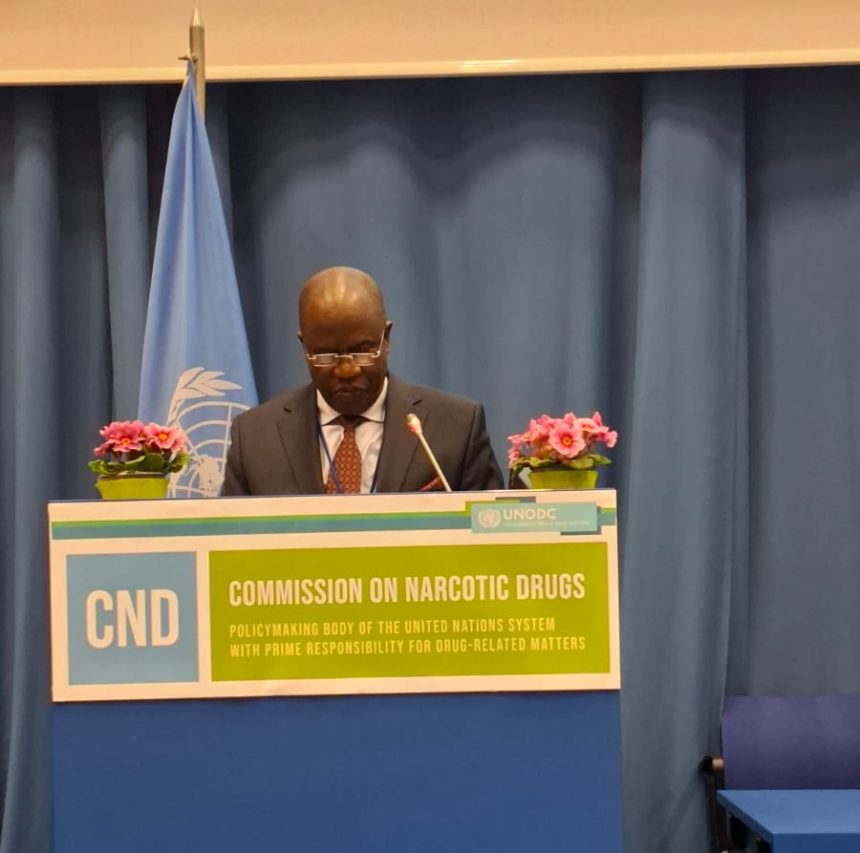
Kenya has called for stronger international cooperation and technical support to address the growing global threat posed by synthetic drugs, warning that evolving drug markets are complicating efforts to combat narcotics trafficking and abuse.
The appeal was made during the 69th session of the Commission on Narcotic Drugs in Vienna, where Kenya reiterated its commitment to global anti-narcotics efforts while urging increased capacity-building support for developing countries.
Kenya’s Head of Delegation, Bishop Dr. Stephen Mairori, who also chairs the board of the National Authority for the Campaign Against Alcohol and Drug Abuse (NACADA), said the rapid emergence of synthetic drugs is reshaping the global drug landscape and requires a coordinated international response.
Speaking during discussions on the implementation of the 2019 Ministerial Declaration, Mairori outlined Kenya’s legal and policy framework on drug control, noting that the country has adopted a national policy that integrates security measures, public health interventions and comprehensive care for affected individuals.
He said Kenya remains guided by the principle of shared responsibility in addressing the global drug problem, but cautioned that emerging drug trends present new obstacles.
According to the Kenyan delegation, the drug market has expanded beyond traditional plant-based narcotics to synthetic substances that can be produced in laboratories anywhere in the world. The envoy also pointed to the rising trend of combining different substances, a practice he described as increasingly dangerous.
“These evolving trends are a catalyst to a paradigm shift in countering the world drug problem,” Mairori stated.
“Our interventions must also be live to the impact these substances and drug mixtures have on the health and well-being of individuals, families, and communities.”
To counter these new threats, Kenya called for a specific focus on developing countries.
The delegation stressed the urgent need to strengthen modern forensics to analyze synthetic drugs and New Psychoactive Substances, enhance technological platforms to monitor drug-related activities, and prevent the diversion of precursor chemicals.
Mairori welcomed the Commission’s decision to retain the implementation of global drug control commitments as a standing agenda item.
He expressed hope that by the next major review scheduled for 2029, member states will have made measurable progress in protecting communities from the evolving drug threat.