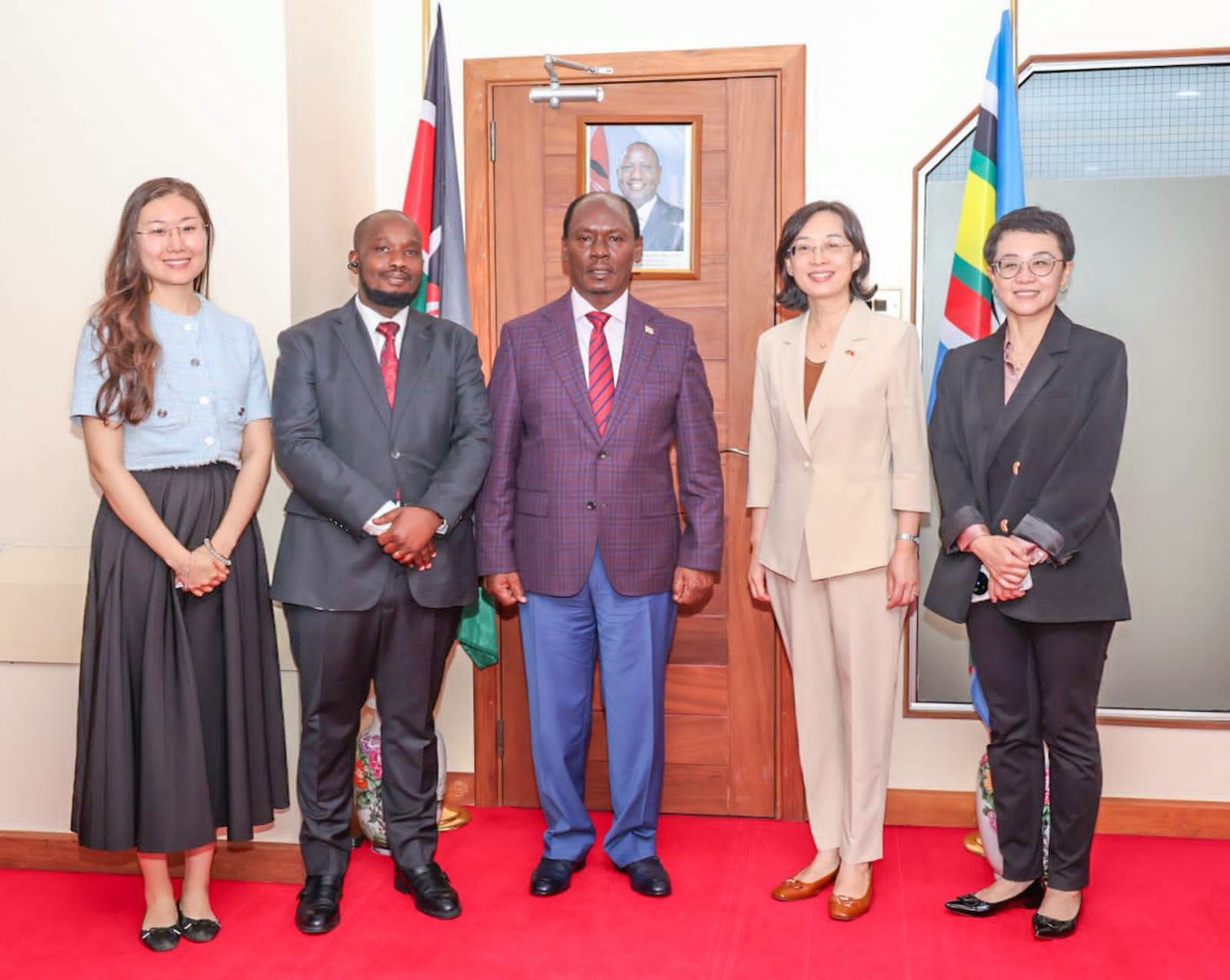
Kenya and China are set to deepen their cooperation in the digital economy, with recent discussions focusing on artificial intelligence (AI), cloud computing infrastructure, skills development, and the digitisation of government services.
The renewed engagement follows a meeting between William Kabogo, Cabinet Secretary for Information, Communications and the Digital Economy, and Chinese Ambassador to Kenya Guo Haiyan, who paid him a courtesy call to explore areas of collaboration in Kenya’s digital transformation agenda.

The discussions centred on strengthening partnerships and investments, ensuring alignment with Kenya’s national development priorities, data sovereignty requirements, and existing ICT regulations.
A key proposal was the establishment of an AI capacity-building programme to equip Kenyans with the necessary skills to develop, manage, and deploy emerging technologies.
Kabogo emphasised Kenya’s desire for its youth, professionals, and institutions to participate meaningfully in AI adoption and benefit from the economic opportunities it presents.
“As we embrace AI, it is important that our people have the knowledge and skills to develop, manage, and use these technologies,” he stated.
The two sides also explored a proposed US$180 million grant for Phase One of the AI Cloud Data Project, slated for Eldoret. This project aims to strengthen Kenya’s AI and cloud computing infrastructure, providing a crucial foundation for the country’s digital ambitions.
Another area of discussion was the acceleration of government digitisation to make public services more accessible, efficient, and responsive to citizens.

The latest discussions build on Kenya’s ongoing engagement with China on AI cooperation. This includes Mr Kabogo’s visit to Shanghai in July 2026, where he signed the agreement establishing the World Artificial Intelligence Cooperation Organization (WAICO) on behalf of the Republic of Kenya.
At the summit, Mr Kabogo described Kenya’s participation as part of a broader effort to ensure AI accessibility for developing countries, delivering practical benefits beyond major technology economies.
He argued that AI should be treated as a global public good, with developing countries participating in its development and benefiting from access to technology, computing resources, and skills.
“For Kenya, this is practical,” Mr Kabogo said during the July engagement, citing potential applications such as farmers receiving agricultural advice in Kiswahili via mobile phones, health facilities improving patient triage, and young developers accessing computing resources and AI models at fair prices.
He also highlighted Kenya’s experience in mobile money innovation and the National Artificial Intelligence Strategy as foundations for the country’s ambition to become a leading AI innovation hub in Africa.
The WAICO agreement provides another avenue for Kenya to expand cooperation with China and other international partners. Mr Kabogo expressed Kenya’s keenness to explore opportunities to tap into the US$5 billion allocated through the organisation to support AI cooperation.
“Our position is simple. We want partnerships that train our people and grow our own industries, not arrangements that only sell to us,” he affirmed.
The emphasis on skills transfer, local innovation, and infrastructure development was also reflected in the recent engagement with the Chinese Ambassador.
“Looking forward to working together to promote digital transformation and deliver more tangible benefits to our two peoples,” Ambassador Haiyan stated after the meeting with Mr Kabogo.