Kenya is seeking to attract billions in private sector investment and green climate financing to support its ambitious plan to expand irrigation coverage by one million acres by 2035.
This is expected to be undertaken through a new five-year partnership with the United Nations Office for Project Services (UNOPS).

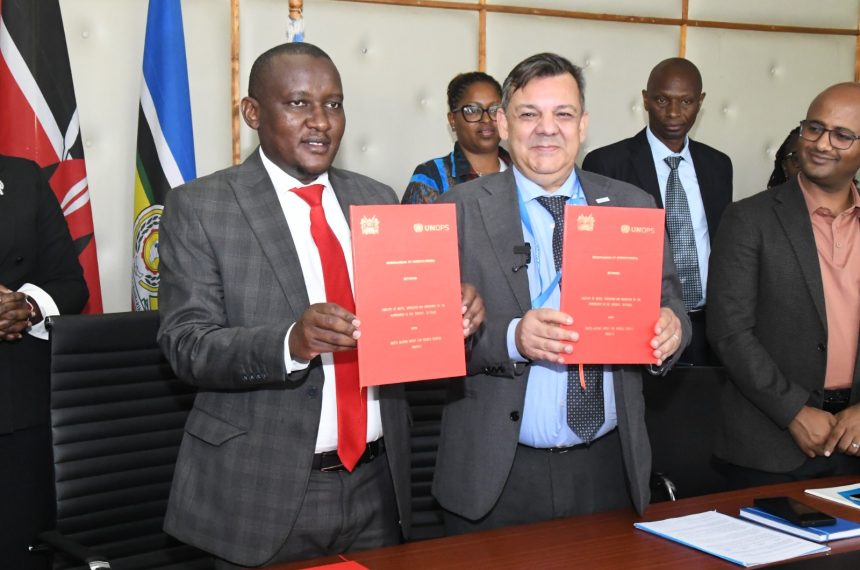
The partnership, formalised through a Memorandum of Understanding (MoU) between the State Department for Irrigation and UNOPS in Nairobi, seeks to strengthen technical capacity, improve project preparation and mobilise financing to accelerate irrigation development and enhance national food security.
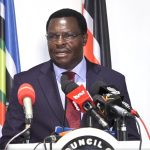
Speaking during the signing ceremony, Irrigation Principal Secretary Ephantus Kimotho said the collaboration would provide specialised expertise in project structuring, feasibility studies, environmental and social impact assessments, procurement, and financial mobilisation.
“That’s why we are also seeking partnership with people who have actually done this before in terms of climate finance. This will enable us to access green climate finance, attract more private sector funding and structure better the funds we have from development partners,” stated Kimotho.
He noted that the partnership would support the implementation of the National Irrigation Sector Investment Plan (NISIP), which provides a roadmap for maximising productivity in existing irrigation schemes before expanding coverage by an additional one million acres.
Kenya currently has approximately 700,000 acres under irrigation, with the Government seeking to increase private sector participation in financing the planned expansion.
Under NISIP, approximately 40% of the required investment is expected to come from the Government and development partners, while the private sector is projected to contribute 60 percent.
Kimotho observed that attracting private investors and accessing green financing requires projects to meet sustainability, commercial viability and risk management standards, areas where UNOPS would provide additional technical expertise.
“Some of the conditions require aspects of sustainability. When we talk about the private sector, it also talks about making a project commercially viable. Again, that speaks to issues of risk management and finance, and those are skills that, as a State Department, we don’t have,” he remarked.
Further, the PS pointed out that the partnership would also address technical capacity gaps within the State Department, particularly in conducting environmental and social impact assessments, which are critical in developing large-scale irrigation projects involving communities and natural resources.
Kimotho also disclosed that the government has expanded irrigation coverage by approximately 114,000 acres over the last four years, contributing to increased agricultural production.
UNOPS Director for East and Southern Africa Multi-Country Office Massimo Diana, affirmed that the organisation would work with the the government to identify priority projects and ensure they were properly structured, financially viable, and ready for implementation.
Diana explained that the agreement establishes a technical review committee that would guide collaboration in project prioritisation and deployment of specialised expertise.
“The MOU is not specifying any specific initiative. It is establishing a technical review committee. We’ll be working together hand-in-hand to identify and to offer our technical expertise to the government in the process of prioritisation of the projects,” he elaborated.
Additionally, the Director announced that UNOPS would provide support in feasibility studies, procurement, project readiness, infrastructure implementation, and long-term asset management, while facilitating connections with potential financing institutions, including development banks.
The partnership is expected to strengthen project governance, improve the sustainability of irrigation investments and accelerate the Government’s efforts to expand agricultural production and enhance food security.