Prime Cabinet Secretary and Cabinet Secretary for Foreign and Diaspora Affairs Musalia Mudavadi has defended Kenya’s expanding diplomatic engagement, saying the country is increasingly converting international partnerships into opportunities for trade, investment, employment and national development.
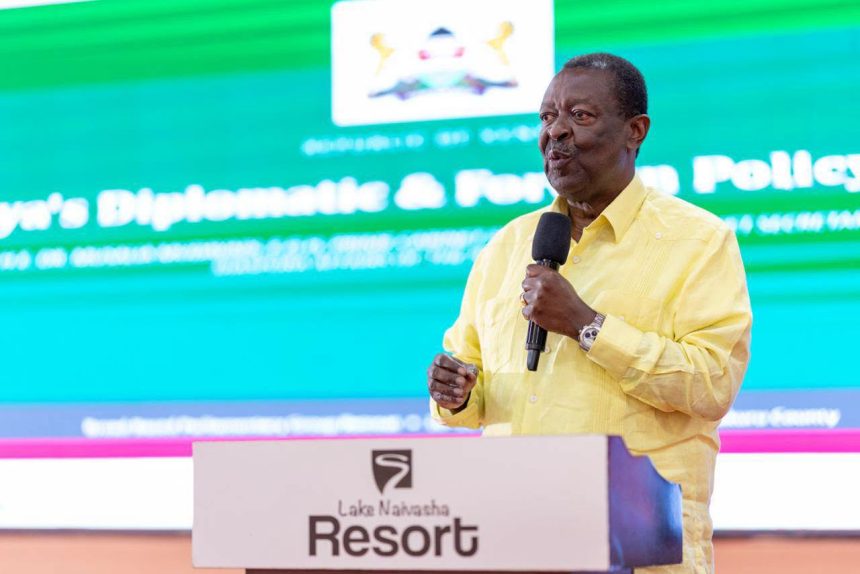
Speaking during the Broad-Based Parliamentary Group Retreat in Naivasha, Nakuru County, Mudavadi outlined the government’s foreign policy achievements since 2022, highlighting increased high-level engagements, new strategic partnerships and efforts to position Kenya as a regional diplomatic and investment hub.

Mudavadi said the country’s foreign policy has been anchored on a broad-based government agenda focused on national unity, inclusivity, reduced ethnic polarisation and stronger national stability.
The broad-based government was formally established on March 7, 2025, following a Memorandum of Understanding, with the administration saying the arrangement was intended to promote fairness in the sharing of positions and constitutional mandates while improving service delivery.
“The reform agenda seeks to move beyond winner-takes-all politics and advance equitable development,” he stated.
Mudavadi said Kenya’s diplomatic profile has also been strengthened by sustained State and Official Visits, inbound engagements and participation in multilateral forums, with President William Ruto providing strategic leadership in elevating the country’s global standing.
Between September 2022 and June 2026, Kenya recorded 145 high-level diplomatic engagements, comprising 55 outbound State and Official Visits, 38 inbound visits and participation in 52 major international conferences and summits.
The government also signed 297 bilateral cooperation instruments with 57 partner countries and organisations during the period.
Among the major diplomatic milestones highlighted was Kenya’s designation by the United States as the first sub-Saharan African country to become a Major Non-NATO Ally in May 2024.
Kenya has also elevated its relationship with China to an All-Weather Comprehensive Strategic Partnership, concluded a Comprehensive Economic Partnership Agreement with the United Arab Emirates and established a bilateral strategic partnership with Malaysia.
The country has further expanded its role in international peace and security through its leadership of the Multinational Security Support Mission in Haiti.
Mudavadi said Kenya’s growing diplomatic footprint is increasingly being used to promote economic interests, with embassies and consulates being repositioned as active centres for trade, investment, tourism and diaspora engagement.
The government’s economic diplomacy strategy is focused on expanding market access, attracting foreign direct investment and strengthening links with Kenyans living abroad.
The 19th Ambassadors’ Conference held in March 2026 focused on economic diplomacy, trade expansion and investment attraction, with diplomatic missions increasingly being assessed against measurable outcomes such as trade volumes, investment inflows and strategic partnerships.
Kenya’s hosting of major international events has also enhanced its position as a diplomatic and investment hub. More than 52 major international conferences and summits were hosted or attended by Kenya between 2022 and July 2026.
Among the major events was the Africa Forward Summit held in Kenya in May 2026, which attracted 54 delegations, including 29 Heads of State and Government, five Vice Presidents or Deputy Prime Ministers, three First Ladies and 12 Ministers.
The summit also brought together 23 Heads of International Organisations, alongside representatives of non-governmental organisations and the private sector.
According to the presentation, the summit resulted in the Nairobi Declaration and approximately €23 billion in investment commitments.
Mudavadi also highlighted Kenya’s Foreign Policy 2024, which was approved by Cabinet in January 2025. The framework focuses on emerging areas including the blue economy, climate change diplomacy, the creative economy and global innovation partnerships.
Sessional Paper No. 1 of 2025, which sets out key foreign policy directions, was approved by Cabinet, adopted by Parliament and gazetted on May 9, 2025.
The government is also seeking stronger parliamentary support for sustainable Foreign Service financing and professional recruitment while promoting people-centred diplomacy through initiatives such as Foreign Policy Mashinani.
On diaspora affairs, Mudavadi said the government had facilitated more than 580,000 Kenyans into overseas job placements through Kazi Majuu programmes.
Mobile consular services have reached nearly 16,000 Kenyans across 124 cities in 58 countries, while more than 5,292 Kenyans in distress have been evacuated or repatriated from various countries.
Kenya currently has 72 diplomatic missions globally, with the government saying their expansion is guided by strategic importance and cost-effectiveness.
Mudavadi further cited bilateral cooperation with major partners as a key driver of development. China has signed 28 cooperation instruments with Kenya, while strategic engagements with the United States, Egypt, the UAE, Malaysia and other partners cover areas including infrastructure, health, trade, education, security and investment.
A five-year strategic health partnership with the United States is valued at KSh208 billion.
The government also pointed to new economic opportunities arising from international partnerships, including a 25-billion-yen Japanese financing facility approved under TICAD 9 to support electric-vehicle manufacturing and energy efficiency.
The Kenya-European Union Economic Partnership Agreement, meanwhile, provides duty-free and quota-free market access for Kenyan goods, with the government expecting increased trade, investment, employment and economic opportunities.
Mudavadi said Kenya must now focus on ensuring that existing partnerships deliver tangible benefits to citizens.
The government’s way forward includes completing outstanding agreements, ensuring strategic partnerships serve people-centred national interests and undertaking timely reviews to respond to changing geopolitical developments.
“Whole-of-government and whole-of-society cooperation is essential to sustain diplomatic gains,” Mudavadi added.
Mudavadi said Kenya’s growing international engagement was ultimately aimed at translating diplomacy into practical benefits for citizens and businesses.
“Kenya’s diplomacy is increasingly delivering measurable outcomes for citizens and businesses,” the Prime CS said, adding that international partnerships were being leveraged to mobilise investment, expand trade and strengthen peace and security.