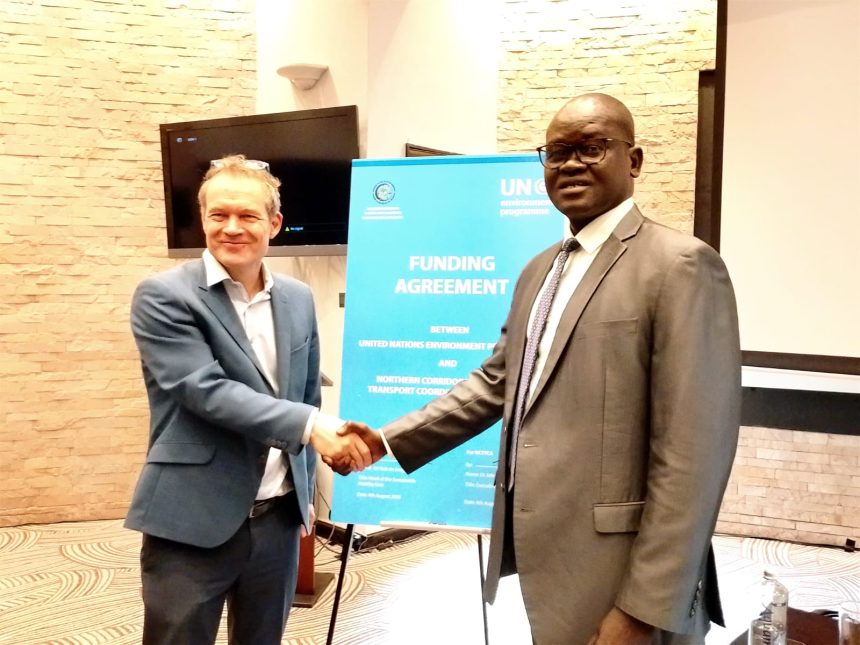
Northern Corridor Transit and Transport Coordination Authority (NCTTCA) has secured Ksh 26 million ($200,000) to support green energy transition within the route.
NCTTCA Secretary General Dr John Deng said the seed funding from the United Nations Environment Programme (UNEP) is expected to help the authority transform freight transport sub-sector in the region into electric vehicle ready by 2030 and achieve net-zero by 2050.

“The $200,000 is just a seed funding but has been able to attract a lot of other programmes that we developed together. if we talk about the funding that has been mobilised in relation to this, it is about $1.6 million by the Northern Corridor,” said Deng.
Dr Deng said the funding is key in helping member states achieve net-zero emission by 2050 given that transport sector is one of the biggest emitters of green house gases.
Through the funding, NCTTCA will update the Northern Corridor Freight Emission accounting framework helping the region to collect GHG emission data along Northern Corridor routes in Kenya, Uganda and Rwanda.
“We are looking at zero-emission by 2050 and so we are projecting 10% reduction every year and of course we will improve our tools of data collection and also impact on the transport shift from hydrocarbon driven transport to EV and we hope the amount of emissions is going to reduce as we continue to intervene,” he added
Localization of carbon emission data along the route is further expected to support the development of policies to address green transition along the route.
NCTTCA will also deploy the funds for the study of ways to support electrification at the Port of Mombasa which handles at least 50 million tonnes annually.
“Ports by definition are very pollutive and all the operations are based on fossil fuels,” said Rob de Jong, Head of Sustainable Mobility Unit Industry and Economy Division, UNEP.
“We have what is called captured fleet and so we can start looking as a first opportunity for freight and heavy duty to electrify these types of operations that are very controlled. So the study we are going to do under this agreement is how can we electrify these types of operations in the port that are controlled,” he added.
The authority says Northern Corridor currently facilitates a daily road freight movement of about 75,000 tonnes using between 2,000-3,000 trucks from Mombasa to the hinterlands of Kenya and EAC nations.
The funding will also help promote gender-inclusivity within green freight transport programme as the authority targets to increase and improve women participation and reduce emissions along teh corridor.