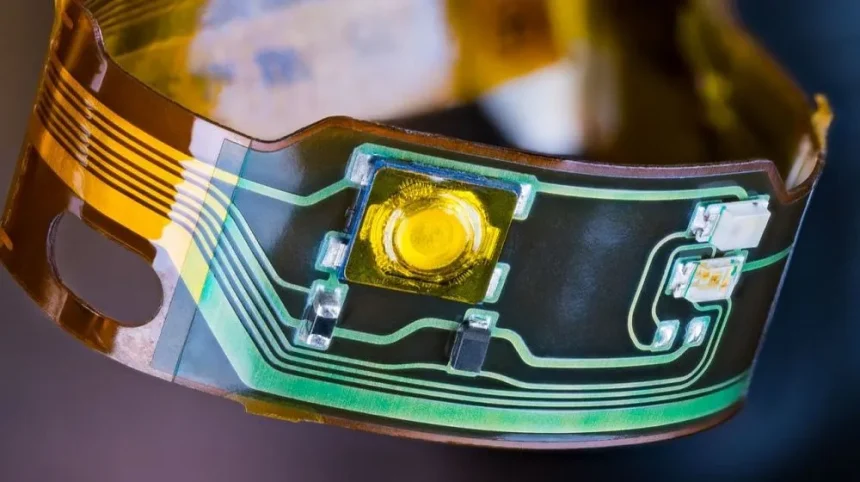
A group of Russian scientists, including researchers from Immanuel Kant Baltic Federal University (IKBFU), a TV BRICS partner, has demonstrated that the electrical response of a flexible magnetoelectric material can be significantly enhanced and stabilised by predefining the arrangement of magnetic microparticles within a polymer layer.
The findings could help in the development of flexible sensors, autonomous energy sources and biocompatible electronic devices. This was reported on the website of the university.

Flexible polymer materials offer advantages for wearable and soft electronics, but their properties can change due to the mobility of magnetic particles within the elastic matrix. The researchers found a way to control the material’s properties through its internal structure.
The physicists studied a two-layer flexible composite. One of its components was a magnetoactive polymer material (elastomer) containing iron microparticles. During fabrication, the scientists exposed the material to a magnetic field, causing the iron particles to align into directed parallel chains. The study showed that this ordering affected the properties of the entire composite.
“The results obtained open up opportunities for creating autonomous energy-harvesting systems capable of converting dispersed mechanical and electromagnetic vibrations in the environment into electrical energy,” said Valeria Kolesnikova, Director of the Smart Materials Research and Education Centre at IKBFU.
In the future, such materials, which are able to remain soft while providing a reproducible electrical signal, could be used in flexible sensors, autonomous power supply components, wearable and portable electronics, as well as biocompatible sensors.
Courtesy/ TV BRICS