Every day, community health promoters visit households, identify health concerns, refer patients to health facilities and support families facing difficult circumstances. But limited resources and expanding responsibilities can make their work challenging.
The SHINE Project, led by LVCT Health, is exploring ways to protect the mental health and wellbeing of community health promoters in Nairobi and Kiambu counties. Through mental health training, self-care, peer support and supportive supervision, the project aims to help promoters manage work-related stress while strengthening the support they receive from supervisors. Their experiences also highlight the need for adequate resources and better working conditions.

Carrying the Weight of Community Needs
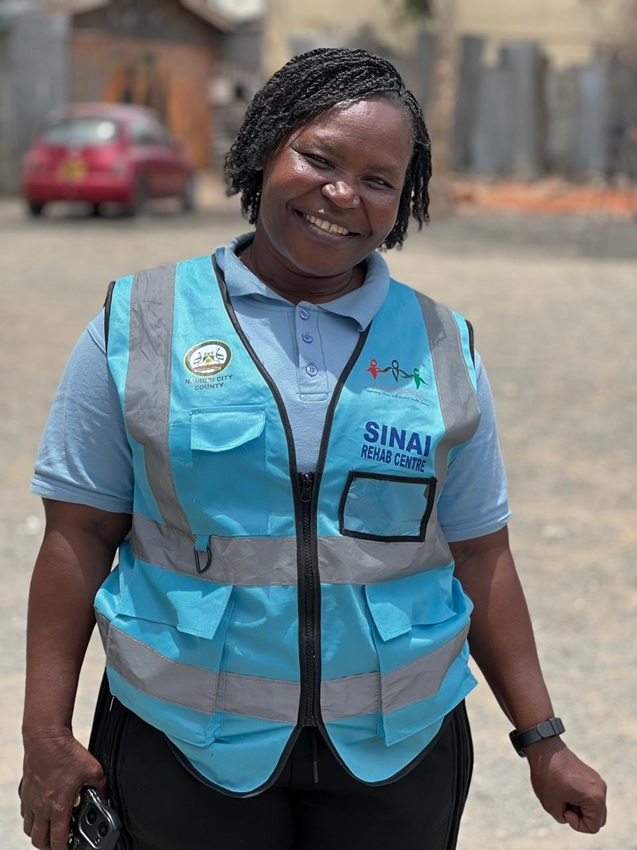
For Rodah Mbuau, household visits involve more than checking on people’s health. She must listen to patients, identify their needs and help them access care, even when they are reluctant to cooperate.
“Sometimes you visit a patient whose blood pressure or blood sugar is high, and they do not want to talk to you. You have to leave and return when they feel better, because that is when they are more willing to cooperate,” Mbuau said.
The work also comes with practical challenges. Promoters carry equipment during household visits, including weighing scales and blood pressure machines, which can make their work physically demanding.
“The equipment is very heavy to carry. Previously, we were not required to measure people’s weight, but now it is part of our work, so we have to carry everything when visiting households,” she said.
Maintaining the equipment can be difficult when promoters must meet some operational costs themselves.
“Sometimes you go to take someone’s blood pressure and find that the machine has no power. If you do not have money to buy batteries, you have to struggle to find it, especially when your stipend is delayed,” Mbuau said.
Digital reporting presents another challenge. Community health promoters use the electronic Community Health Information System (eCHIS) to record and submit information, but doing so requires internet access.
“We asked for support to buy data bundles, but we are still waiting. Sometimes, if I get even Sh10, I buy data to synchronise the information. When I cannot afford it, I write everything in my notebook and upload it later,” she said.
Despite these difficulties, Mbuau remains committed to serving her community.
“This work is a passion. It cannot be forced on someone. We volunteer our services in good and difficult times because we are part of the community and have a responsibility to support the people we serve,” she said.
However, commitment alone cannot replace the resources needed to deliver effective healthcare. Promoters must also be able to refer patients when their needs exceed the care they can provide.
“If you find someone with dangerously high blood pressure, you have to refer them to a health facility to ensure they receive the care they need,” Mbuau said.
Recognition from the community also matters. “When someone tells you that you are doing a good job and that you are valued, it keeps you going. You do not feel alone, and it motivates you to continue serving the community despite the challenges,” she said.
Learning to Care Without Carrying Every Burden
Veronica Muthengi, a community health promoter at Donholm Unit in Viwandani Ward, begins her day by planning her activities before visiting households, checking on clients and identifying those who need care or referral.
Her encounters with families have taught her that supporting the community also requires protecting her own wellbeing.
“Sometimes, I return home carrying the weight of what I have witnessed. I may have food in my house, but when I sit down to eat, I remember a client who has nothing. I lose my appetite and become sad because I have seen the suffering they are going through,” she said.
Through the SHINE Project training, Muthengi has learned to recognise the limits of what she can do for households experiencing hardship.
“Before the training, I would leave such households thinking about taking them flour or giving them money to buy food. The programme has helped me understand the importance of setting boundaries and protecting my own mental well-being. I have learned that I cannot solve every problem using my personal resources,” she said.
She says the grounding techniques have also helped her manage stress after difficult visits. But she believes practical changes are equally important.
“I would like to call on both the national and county governments to make our work easier by providing lighter equipment bags and increasing our stipend. We carry many items during household visits, and better, more practical equipment would reduce the burden. Our current stipend is not enough to meet our basic needs. Increasing it would go a long way in supporting us as we continue serving our communities,” she said.
Making Mental Health Part of Supervision
Esther Achieng Okoko, a Community Health Assistant at Lungalunga Health Centre in Viwandani Ward, Makadara Sub-County, Nairobi County, supervises six community health units. She says promoters are often expected to respond to problems extending beyond their formal health responsibilities.
“The community believes that the CHP has to take care of everything. If a child is not going to school, the CHP is called. If there is violence in the community, the CHP is called. Everything is referred to the CHP,” Okoko said.
The pressure makes supportive supervision important, particularly when promoters encounter situations they cannot resolve on their own.
“After the SHINE project, when we meet, we normally do a mental health assessment before anything else. From there, we can identify someone experiencing challenges and encourage them to practise skills that help them take care of themselves,” she said.
Such assessments offer supervisors an opportunity to identify concerns and encourage promoters to seek support before stress becomes overwhelming.
Expanding Responsibilities, Limited Support
Judith Adhiambo, from the Nairobi County Mental Health and Psychosocial Support Unit, says the responsibilities of community health promoters have expanded as their role in primary healthcare develops.
Promoters connect households to services, identify health concerns, refer patients and mobilise communities for immunisation and medical camps. Depending on their training and authorisation, they may also undertake basic assessments using blood pressure monitors, weighing scales and other equipment.
They may encounter violence, poor sanitation and social needs that require support beyond their immediate responsibilities.
“We agree with the President that CHPs are the backbone of healthcare in the country,” Adhiambo said.
However, she acknowledges the pressure this places on them.
“The work is really overwhelming to the CHP,” she said.
Adhiambo says the role has also evolved beyond identifying health concerns.
“Now the role has moved from identifying to actually offering an intervention in the community,” she said.
Clear limits and referral pathways are therefore important to ensure promoters do not take on responsibilities beyond their training or capacity.
“For the CHP, their role is in case there’s a suspected case and it is within their limit, then they report,” she explained.
Strengthening referral systems and ensuring that health facilities respond to cases referred by promoters would help them carry out their responsibilities without being left to manage complex needs alone.
What the Research Shows
Research involving 1,236 community health promoters in Nairobi and Kiambu counties highlights the pressures they face. Screening results showed moderate or higher depressive symptoms among 26.4 per cent of participants in Nairobi, compared with 8.2 per cent in Kiambu. Anxiety symptoms were reported by 33.8 per cent in Nairobi and 18.9 per cent in Kiambu, while stress symptoms stood at 15.4 per cent and 3 per cent, respectively. These are screening results, not clinical diagnoses.
The study also found that 93–97 per cent considered their stipends inadequate or unfair, while 92–94 per cent used their own money to meet work-related expenses. Only 8 per cent of promoters in Nairobi and 24 per cent in Kiambu considered their workload manageable.
The findings point to the importance of timely payments, adequate operational resources and manageable workloads, alongside mental health support. Other concerns included supervisory workloads exceeding policy guidance, reports of sexual harassment among female promoters and disruptions caused by the 2024 floods.
From Training to Sustainable Support
Dr Stephen Mulupi, Head of Research at LVCT Health and Principal Investigator of the SHINE Project, says the intervention seeks to address mental health and wellbeing while strengthening the support promoters receive.
The project is a collaboration between Kenya, Bangladesh and the Liverpool School of Tropical Medicine in the United Kingdom. In Kenya, LVCT Health leads the qualitative research component, while the African Population and Health Research Center (APHRC) leads the quantitative surveys. The two approaches complement each other by combining statistical findings with insights into the experiences, feelings and working conditions of community health promoters.
“The system has always been asking what community health promoters can do for us. During monthly meetings, much of the time is spent asking how many households they visited, how many women they referred or how many mosquito nets they distributed. But this study is asking a different question: we know they are doing a lot, but do we also care about them?” he said.
The project reached 500 promoters in Nairobi and Kiambu through mental health literacy, self-care, peer support and supportive supervision. It also draws on the World Health Organization’s Doing What Matters in Times of Stress guide.
“The intervention is aimed at helping community health promoters understand mental health, practise self-care and support one another, while supervisors learn how to provide more supportive supervision,” Mulupi said.
Financial support remains another concern. The monthly stipend is generally KSh5,000, comprising KSh2,500 from the national government and KSh2,500 from county governments. Nairobi County contributes KSh3,500, bringing the monthly total for promoters in the county to KSh6,000.
Mulupi says the project is assessing whether the intervention improves mental health outcomes and could be extended beyond the two participating counties.
“The project is assessing changes in stress, depression and anxiety to understand the impact of the intervention. We hope county governments will budget for the programme and extend it to the other 45 counties that did not participate. The approach could also be adapted for refugee communities, where health workers face different pressures,” he said.
For Mbuau and Muthengi, the ability to serve their communities depends not only on personal commitment but also on adequate resources and institutional support. Investing in community health promoters would help them carry out their responsibilities more effectively and sustainably.
Story by Victoria Musimbi