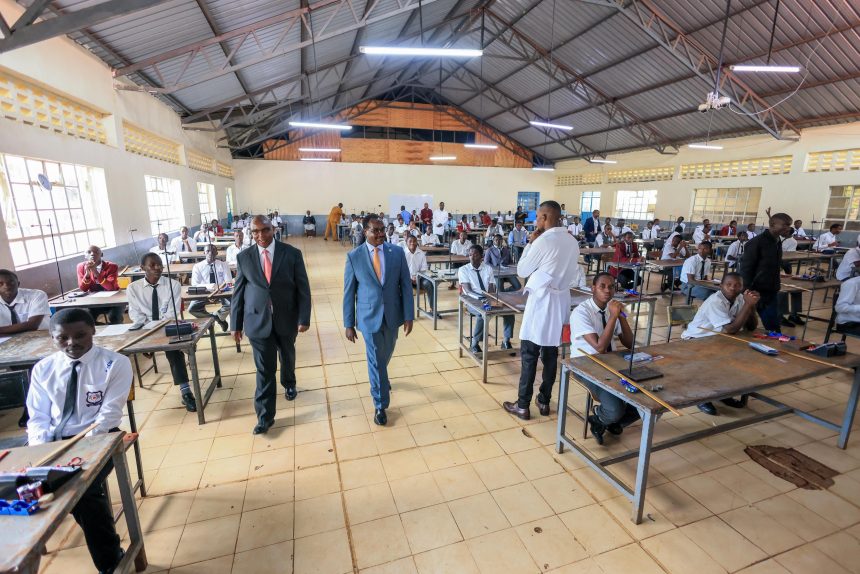
Schools across the country are grappling with teacher shortages, limited classroom space and inadequate facilities, as growing enrolment places demands on available teaching staff and infrastructure.
The 2024 Kenya School Census, released on Thursday by the Kenya National Bureau of Statistics (KNBS), shows that public junior schools have an average of 74 learners for every Teachers Service Commission (TSC) teacher, compared with the recommended ratio of 40 learners per teacher.

The ratio drops to 59 learners per teacher when Board of Management (BoM) teachers are included, and to 34 when TSC interns are also factored in.
The findings come as the Government plans to recruit an additional 20,000 teachers in the coming months to address staffing gaps in learning institutions.
Speaking during the release of the census, Principal Secretary for Economic Planning Bonface Makokha acknowledged the staffing gaps, saying the findings will guide the government in reviewing existing plans and addressing regional differences in the education sector.
“In public junior schools, there are 74 learners for every teacher against a target of 40. This gap will widen as junior-school cohorts grow unless we plan for it now,” said Makokha.
He noted that the Government had already recruited 100,000 teachers, with a further 20,000 expected to be employed from next year.
The distribution of teachers across counties shows variations in public junior schools. Mandera recorded the highest learner-teacher ratio at 140:1, meaning there are 140 learners for every TSC teacher.
Marsabit followed at 134 learners per teacher, Kirinyaga at 133:1 and Wajir at 130:1, based on TSC teachers alone.
The census also documented 492,652 classrooms across pre-primary, primary, junior and secondary schools. Of these, 87.3 per cent were permanent structures, while 12.7 per cent were temporary.
Public schools had a higher share of permanent classrooms at 91.7 per cent, compared with 76.5 per cent in private institutions.
Only 2.4 per cent of classrooms nationwide had been adapted for learners with special educational needs, pointing to the limited availability of facilities designed to accommodate their requirements.
Classroom congestion also varied across education levels. Junior schools recorded an average of 37 learners per classroom nationally, with public institutions having 41 learners per classroom.
Secondary schools recorded a higher national average of 46 learners per classroom, rising to 48 in public schools.
Turkana County had the highest pre-primary classroom congestion, with an average of 76 learners per classroom, while its secondary schools recorded 64 learners per classroom.
On enrolment, the school census recorded 17.8 million learners across basic education institutions, comprising 50.7 per cent boys and 49.3 per cent girls.
Boys accounted for 51.2 per cent of primary school enrolment and 51.3 per cent in junior schools, while girls represented 50.6 per cent of secondary school learners.