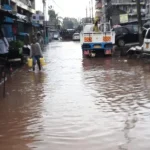
When torrential rains sweep through Nairobi’s streets, few pause to consider the science behind the flash floods. Beyond clogged drainage and poor planning, scientists point to a deeper, global driver: climate change. Shifts in rainfall intensity and duration are not only straining Kenya’s capital but also exposing rural regions to life-altering risks.
Recent research shows climate change has doubled the chance of extreme rainfall in southern Kenya, while intensifying its downpours by up to 5 percent. In practice, this means a two-hour storm today can deliver nearly the same volume of water that a full day’s rain did 30 years ago. For informal settlements in Nairobi, already built on fragile, poorly drained land, the science translates into human suffering.
Last year alone, at least 70 Nairobi residents were displaced when the Nairobi River burst its banks after unusually heavy rains. Scientists at the Intergovernmental Panel on Climate Change (IPCC) confirm that East Africa is seeing more frequent, intense wet spells, leading to widespread pluvial flooding. Such data gives numbers to what city dwellers have long experienced in lived reality: rain that comes heavier, faster, and deadlier.
But the story of Kenya’s climate crisis does not end in its urban centers. In Mbita, Homa Bay County, a different but equally destructive picture is playing out. Farmers and traders who rely on the Mbita-Sindo-Kiabuya-Sori Road for daily livelihoods have watched it crumble under extreme rainfall events. The road, under construction, is a lifeline to markets, schools, and hospitals. Its collapse during last year’s floods left women trekking kilometers of muddy detours to sell fish, students stranded in villages, and healthcare access nearly impossible for expectant mothers.
The Kenya Meteorological Department’s State of the Climate Report (2023) confirms this vulnerability, highlighting abnormal rainfall in highlands and river basins that disrupted both rural and urban systems. In practical terms, poor road drainage combined with heavy storms can cut off an entire community from development for weeks. The ILRI study on extreme rainfall patterns warns that such disruptions will only grow, unless climate resilience is factored into infrastructure planning.
Rural voices echo the science. “When it rains, everything stops. Our fish rots before we can reach the market,” says Michael Aluoch, a fishmonger in Sindo. His lived reality mirrors findings from climate scientists who warn that shorter but more intense rains are eroding soils and destroying rural livelihoods across Kenya’s Rift Valley. For subsistence farmers, this translates into lost harvests and uncertain food security.
The Kenyan government has acknowledged this challenge. President William Ruto recently noted that ongoing roadworks in Mbita align with his BETA Development Agenda, designed to open up rural economies through accessible infrastructure. Yet, experts caution that unless these investments integrate climate projections, today’s construction risks becoming tomorrow’s collapse.
Here lies the heart of science journalism: connecting the dots between peer-reviewed data and community voices, between global climate models and the woman whose fish never made it to market. While drainage redesign, urban planning, and rural road upgrades are important, the bigger question is: can Kenya afford to build infrastructure that ignores science?
Globally, climate adaptation financing for Africa remains low. The IPCC warns that Africa faces the highest cost-to-GDP ratio for climate damages worldwide. For Kenya, this cost is already visible in displacement, in market losses, in damaged classrooms, and in the billions lost to flood recovery.
Yet the solution is not despair. Across Nairobi, youth climate groups are partnering with engineers to design low-cost community drainage systems. In Homa Bay, county officials are exploring climate-resilient gravel roads designed to withstand seasonal floods. And nationally, Kenya’s Vision 2030 emphasises science-driven planning as a pillar for development.
The task ahead is clear. To secure the future of its citizens, Kenya must not only build more roads and drains it must build smarter, climate-informed infrastructure. Scientists have given the data. Communities are raising the alarm. What remains is the political will to act.
Inaccessible infrastructure is no longer a rural inconvenience or an urban nuisance. In an era of climate change, it is a national threat and one that Kenya cannot afford to ignore.