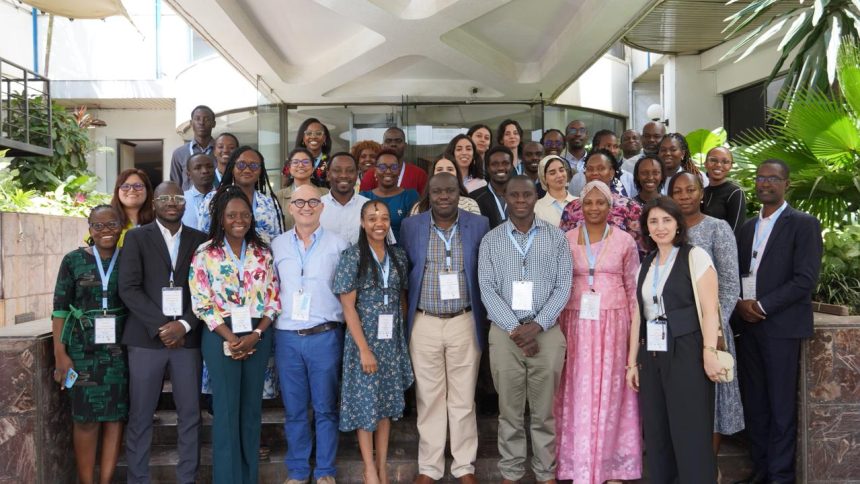
Researchers from across Africa gathered in Nairobi for the 3rd African Modelling and Analytics Academy for Women (AMAX) Summer School, a pan-African initiative aimed at strengthening the continent’s capacity in mathematical modelling and advancing women’s health research through data-driven public health solutions.
The two-week summer school, hosted by the University of Nairobi’s Center for Epidemiological Modelling and Analysis (CEMA) in collaboration with the Laboratory of Bioinformatics, Biomathematics & Biostatistics at the Pasteur Institute of Tunis, focuses on “Modelling for Health Decision-Making: Integrating Epidemiological, Economic, and Equity Evidence for Policy Action.”

The school was hosted by the University of Nairobi’s Center for Epidemiological Modelling and Analysis (CEMA) and collaborated with the Laboratory of Bioinformatics, Biomathematics & Biostatistics at the Pasteur Institute of Tunis.
It brought together partners from across Africa under the AMAX network including the Centre Pasteur du Cameroun (Cameroon), CEMA at the University of Nairobi (Kenya), the Centre de Recherche Médicale et Sanitaire (Niger), the Institut Pasteur de Dakar(Senegal), the Pasteur Institute of Tunis (Tunisia), and Mbarara University of Science and Technology (Uganda), with support from the Gates Foundation.
As Africa continues to tackle complex public health threats including infectious disease outbreaks, and rising antimicrobial resistance, a network of African scientists is transforming health decision making through data driven, equity centered mathematical modelling.
This vision is driving the African Modelling and Analytics Academy for Women (AMAX), a pan-African initiative bringing together Francophone and Anglophone research institutions to strengthen Africa’s capacity in mathematical modelling and advance research on women’s health across the continent.
AMAX was established under the Gates Foundation’s Global Grand Challenges initiative within the Gender Data Equity program. The initiative recognizes that women’s health challenges are often underrepresented in health data systems and insufficiently integrated into public health modelling and policy design.
At the same time, outbreaks and health emergencies are becoming increasingly complex in Africa where health systems often operate under limited resources highlighting the urgent need for stronger modelling and analytics capacity across government and public health institutions.
“COVID-19 showed the world that mathematical modelling is not just an academic exercise, it is essential for epidemic preparedness, rapid response, and policy action,” said Prof. Amira Kebir, Principal Investigator of the AMAX project. “AMAX was created to ensure African countries have the expertise and collaborative networks needed to respond to public health challenges while also addressing gender inequities in health data and decision-making.”
Mathematical models can help policymakers predict disease spread, estimate healthcare needs, identify vulnerable populations, evaluate vaccine strategies, optimize resource allocation, and prepare for future pandemics before crises escalate.
Through intra-African collaboration, AMAX is helping build a new generation of African modelers capable of translating complex data into practical policy solutions for ministries of health and public health agencies across the continent. The researchers apply epidemiological, statistical, and economic models to answer urgent public health questions, forecast disease trends, evaluate intervention strategies, and support evidence-based policy decisions.
The initiative focuses on five major health challenges affecting women and vulnerable populations including: human papillomavirus (HPV), hepatitis B virus (HBV), COVID-19, antimicrobial resistance (AMR) and schistosomiasis.
Dr. Mutono Nyamai, Senior Research Fellow at the Center for Epidemiological Modelling and Analysis, says, “This initiative reflects the growing need of building strong local research capacity to develop locally grounded solutions for Africa’s most pressing health challenges.”
“Strengthening expertise in data analytics and mathematical modelling within African institutions will enable countries to respond more effectively to outbreaks and health emergencies through timely, evidence-based decision-making, ultimately, saving lives,” she added.
Over the past three years, AMAX has supported PhD researchers, postdoctoral fellows, and young scientists through placements and exchanges across partner institutions in North, West, East, and Central Africa with continued support secured to sustain and expand these efforts over the next three years.
For example, Joy Kalekye, a PhD fellow at CEMA and member of the AMAX project team in Kenya worked closely with Senegal’s Ministry of Health and Public Hygiene last year to inform strategies for achieving control and elimination of schistosomiasis, a neglected tropical disease of public health concern in Africa.
Her research highlighted the benefits of expanding treatment to include children below five years in the fight against schistosomiasis and recommended aligning Senegal’s National Strategic Plan for Neglected Tropical Diseases (2025-2030) with the 2022 WHO guidelines.
She also advocated for inclusion of these children into mass drug administration (MDA) campaigns, tailored to levels of endemicity, to accelerate progress toward schistosomiasis control and elimination in Senegal.
Additionally, during a six-month fellowship at CEMA, Dr. Oumaima Laraj, a postdoctoral research fellow, and Sahar Trabelsi, a PhD student in Applied Mathematics, both from Institut Pasteur de Tunis and members of the AMAX project team in Tunisia, applied mathematical modelling and gender-based data analysis across several research projects. Their work focused on four infectious diseases that disproportionately affect women: human papillomavirus (HPV), hepatitis B, COVID-19, and antimicrobial resistance.
Dr. Laraj’s research examined the economic impact of HPV vaccination strategies across several African countries.
She developed models to estimate both health outcomes and financial costs of different vaccination and screening approaches, helping identify options that are effective and affordable for national health systems.
Meanwhile, Trabelsi focused on developing adaptive, data-driven models to strengthen epidemic response strategies and optimize healthcare resource allocation, with a particular emphasis on equity and real-time public health decision-making.
Many other high-impact collaborations between African countries have been made possible through the AMAX network. Building on AMAX’s earlier HPV modeling work in Tunisia, where vaccination scenarios informed national strategy and long-term impact, a Senegal–Tunisia analysis extended the same framework to Senegal’s epidemiological and financing context.
At a critical time of transition away from Gavi, the Vaccine Alliance support, this study provided essential evidence to guide sustainable and equitable health investment decisions in Senegal. This example of the AMAX network’s work illustrates how a shared modeling approach can be adapted across countries to support public health policymaking.
Antimicrobial resistance work was also strengthened through a fruitful collaboration between the team at Mbarara University of Science and Technology in Uganda and the team at the Institut Pasteur de Tunis, Tunisia
“Africa is growing its expertise in mathematical modelling,” noted Prof. Slimane Ben Miled, Full Professor of Applied mathematics at Pasteur Institute of Tunis. “The challenge is that expertise remains unevenly distributed across the continent. Some countries and institutions have established modelling programs, while others still face significant gaps despite carrying a high burden of public health challenges. AMAX was created to help close those gaps by strengthening local expertise, fostering collaboration, and promoting shared learning across African institutions.”
“Importantly, AMAX is not only training scientists, it is creating a collaborative ecosystem linking researchers, ministries of health, data providers, and policymakers across Africa.” he added.
Participants in the Nairobi Summer School have engaged in lectures, practical group work, case studies, and policy-focused hackathons designed to address real-world health questions facing African ministries of health. The training integrated epidemiology, health economics, research ethics, and equity considerations to ensure models are relevant for decision-making.
Beyond the Summer School itself, the initiative has a broader continental mission: ensuring Africa can generate its own evidence, strengthen its own modelling expertise, and design policies rooted in African realities.
This growing network is helping shape a new generation of African scientists who are not only technically skilled, but also deeply connected to the policy needs of their countries.