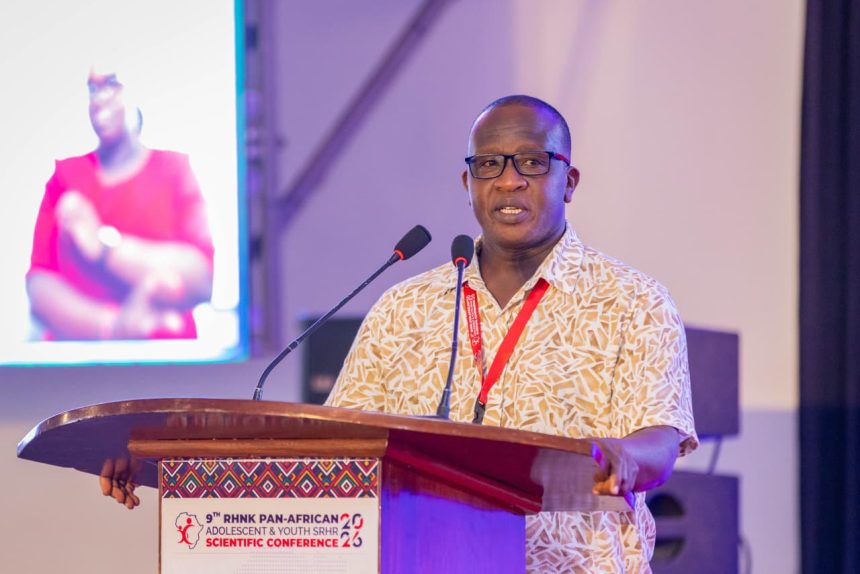
The 9th Pan-African Adolescent and Youth Sexual and Reproductive Health and Rights (AYSRHR) Scientific Conference opened in Mombasa this week with a stark collective message from health leaders, government officials, and young people: Africa’s adolescents are being systematically failed by the institutions meant to serve them, and the window to reverse course is closing fast.
Convened by the Reproductive Health Network Kenya (RHNK) in partnership with the Kenyan Ministry of Health, the National Council for Population and Development, and, for the first time, the Government of Uganda as an official partner, the four-day conference has drawn over 1,500 delegates from more than 40 countries. Its theme — Strengthening SRHR to Achieve Youth Agency, Full Potential and Meaningful Engagement in Africa’s Dynamic Socio-Political and Economic Landscape — reflects an agenda that is as much about political will and financing as it is about service delivery.

The Scale of the Crisis
Dr Edward Serem Head of the Division of Reproductive, Maternal, Newborn, Child and Adolescent Health (RMNCAH) at the Ministry of Health officially opened the conference. He hailed the conference as a response to challenges that cut across every part of the continent.
“In Africa, mostly in sub-Saharan Africa, we see the challenges of teenage pregnancy, HIV infections, and drug and substance abuse. It is those challenges which are facing each and every part of our continent, which has made us to converge here,” Dr Serem said, urging delegates to use the four days to exchange working policies and learn interventions they can take home.
Dr Claudia Shilumani, who assumed the role of IPPF (International Planned Parenthood Federation) Africa Regional Director three months ago, grounded the discussion in evidence. “Sub-Saharan Africa has the highest teenage pregnancy and adolescent birth rates in the world. Eastern and Southern Africa has the highest prevalence of HIV,” she said, warning that the consequences extend far beyond health. “A fifteen-year-old girl who becomes pregnant does not just face a health risk. She faces the end of her education, the narrowing of her economic future, the weakening of her voice in her own community.”
FP2030 Executive Director Dr Samukeliso Dube reinforced the point with regional data, noting that while countries such as Rwanda have brought teenage pregnancy rates down to 39 per thousand, others like Mozambique still record 180 per thousand — a gulf that underscores the unevenness of progress. “We are running a continent, ladies and gentlemen, on luck and hope,” Dr Dube said. “We have, for many years, hidden behind ‘it’s just maternal health, maternal mortality,’ when we don’t fund reproductive health services for adolescents. Yet we know the very numbers that we see in maternal mortality are driven by these unintended pregnancies.”
Consent, Access, and Legal Barriers
A recurring thread across speeches was the age-of-consent barrier that locks adolescents out of reproductive health services. RHNK Executive Director Nelly Munyasia brought the crisis to life through the story of “Amina” — a composite figure representing hundreds of thousands of girls across the continent. Amina, she recounted, was a sixteen-year-old who dreamed of becoming an engineer, but upon discovering she was pregnant, found every door shut. “She did not know where to go. She was afraid of the clinic because she’d be asked, ‘Where is the guardian?’ She was also scared to go to school, because the teachers were going to send her away,” Munyasia said.
Munyasia announced that a referral document on adolescent consent, developed through a collaboration between RHNK, the Kenya Judiciary Academy, healthcare providers, and young people from across Africa, will be launched during the conference. “The judiciary told us, if only they knew better, they would not have made the kind of decisions they’ve made in courts,” she said, adding that justices from Zambia, Malawi, and other nations are in attendance to engage directly with the evidence on adolescent health.
Funding Rollbacks and the Global Gag Rule
Speakers were unsparing in naming the financial pressures bearing down on SRHR programming. Dr Shilumani described a hostile operating environment in which civic space is tightening and funding is shifting dangerously. “The expanded Global Gag Rule has disrupted integrated health systems, fragmented services, and disproportionately harmed the most vulnerable — our women and girls. Its ripple effects extend far beyond abortion services. We are seeing impacts on HIV prevention, maternal health, as well as primary healthcare,” she said.
Dr Dube was equally direct, challenging delegates to confront their own complicity in the funding retreat. “Some of you work for organizations that, in 2025, removed the words ‘family planning’ from their websites. Some removed ‘reproductive health’ from their emails. Some removed that language from their LinkedIn profiles, in the hope that they could be funded, lest USAID be revived,” she said, calling on the sector to stop self-censoring and to name the challenge plainly. She urged domestic financing mechanisms, including the UNFPA match fund, to fill the gap, and pressed health economists in the room for a concrete denominator: “How much money are we looking for, and what are we going to use that money for?”
Young People as Architects, Not Objects
Across every address, a common insistence emerged: young people must move from the margins to the centre of policy design. Munyasia announced that fifteen young Pan-African leaders from fifteen countries had helped shape the conference programme. “Every time we are told, ‘You are the leaders of tomorrow,’ and you did not see it,” she told the room, before challenging young delegates directly: “Push, challenge, disagree. Ask the questions that the rest of us are too uncomfortable to ask.”
Dr Shilumani echoed the call, reframing Africa’s youth population not as a problem but as an asset. “You are not a problem to be managed. You are not a demographic to be monitored. You are an asset, a force, a movement in motion,” she said, pledging that IPPF Africa would fund youth-led movements, protect feminist spaces, and embed young people’s participation in governance structures “beyond tokenism toward genuine, sustained power sharing.”
That sentiment was embodied by Esther, a young tech student at the conference, who described growing up in a household where sexual and reproductive health information was virtually non-existent. “I hope to learn that sex is not just ‘don’t have sex, don’t have sex,’” she said. “I wish to learn the different ways how you can have safe sex instead.”
Looking Ahead
With 1,310 days remaining before the 2030 UN development deadline, speakers made clear that the conference is not an exercise in rhetoric. Eleven policy briefs emerged from last year’s convening, the consent referral document launches this week, and the conference has expanded its partnership base to include government, judiciary, faith-based organizations, and the private sector.
Dr Dube closed with a challenge to every organization and funder in the room: start measuring success not by the populations easiest to reach, but by the most vulnerable — adolescents in fragile settings, conflict zones, and remote communities. “In Africa, we say that children eat first. Do you know why? Because they are vulnerable. If adults eat first, children might not be left with anything,” she said. “I would love for you to start with the most vulnerable in our continent, and measure that as success.”
As nearly half of Africa’s population is adolescent, and one in three adolescents globally will live in sub-Saharan Africa by 2050, the conference’s central argument is difficult to dispute: the continent cannot achieve its development ambitions while millions of young people still lack the information, services, protection, and opportunities they need to thrive.