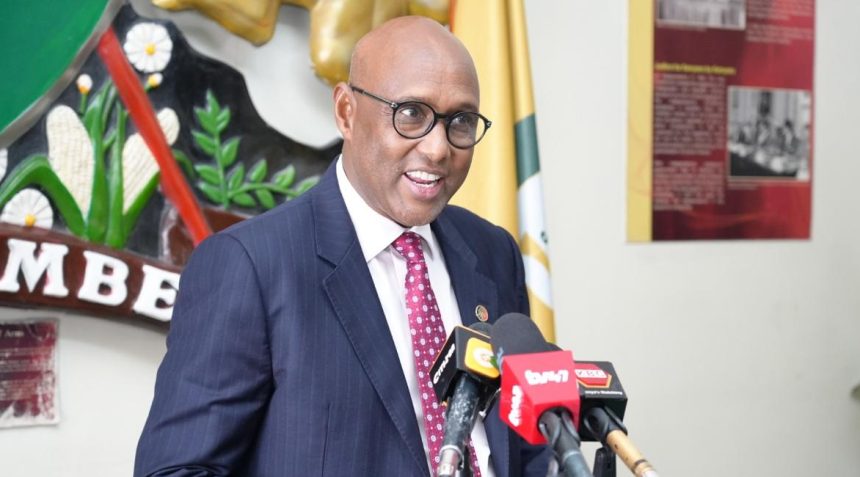
Kenya’s tax collector closed the 2025/26 financial year on its strongest footing in recent memory, hauling in Kshs. 2.844 trillion and posting growth that nearly doubled the pace set a year earlier.
Kenya Revenue Authority said that collections rose 10.6% over the twelve months to June, a sharp acceleration from the 6.8% expansion recorded in FY 2024/25. The haul amounts to roughly Kshs. 273 billion more than the Kshs. 2.572 trillion banked the previous year — a performance the agency is pointing to as evidence that domestic revenue mobilisation is gaining traction even as businesses continue to navigate a difficult operating climate.

Five Sectors Carry the Load
A handful of industries did most of the heavy lifting. Manufacturing, energy, financial and insurance services, information and communication, and wholesale and retail trade together generated about 62% of everything KRA collected, despite representing just over a quarter of the country’s nominal economic output — a sign, the authority suggests, of how disproportionately these sectors feed government coffers relative to their size in the economy. Collectively, revenue from the five grew 8% for the year.
Manufacturing edged out energy as the single largest contributor among them, bringing in Kshs. 462 billion, up from Kshs. 423 billion — a 9.2% climb. VAT, PAYE, excise and corporation tax accounted for nearly three-quarters of that total, while raw material imports into the sector made up roughly half of all import value for the year.
Energy wasn’t far behind, delivering Kshs. 445 billion on 9.1% growth, with customs oil taxes doing much of the work. Financial and insurance firms contributed Kshs. 320 billion, up from Kshs. 311 billion, with corporation tax and combined withholding-and-PAYE remittances driving most of that. ICT collections climbed to Kshs. 248 billion — a comparatively modest 7.9% gain — while wholesale and retail trade rounded out the group with Kshs. 288 billion, a 10.3% jump attributed largely to stronger consumer and business activity.
Where the Money Actually Came From
Beneath the headline figure, the breakdown tells a more layered story. Exchequer revenue — the core pool that funds government operations — grew 10.5% to Kshs. 2.568 trillion, landing at 95.2% of target. Customs collections outperformed expectations entirely, coming in at 100.8% of target and growing 12.4%, powered by both oil and non-oil trade. Domestic revenue grew more modestly, at 9.7%, and fell short of its target, reaching 93% of the Kshs. 1.991 trillion goal.
Individual tax heads moved at different speeds. PAYE, the tax on salaries, grew just 6.7% — an improvement on the anemic 3.3% of the prior year, but still trailing the 8.5% average KRA had grown accustomed to in 2022/23 and 2023/24. The authority linked the slowdown to a shrinking formal-employment base, which has slipped from 15.7% of total employment in 2022 to 15.3% last year, according to the 2026 Economic Survey.
Corporation tax told the opposite story, climbing 14% — its third straight year of acceleration — with banks alone contributing more than a quarter of all corporate tax remittances. Betting and gaming taxes blew past their target entirely, coming in nearly 16% ahead of plan, while digital service tax collections from non-resident platform operators doubled after lawmakers scrapped a Kshs. 5 million revenue threshold that had previously shielded smaller foreign digital earners.
Technology and Enforcement Behind the Numbers
KRA credited much of the improvement to a widening digital compliance net. Its electronic invoicing system had onboarded more than 750,000 taxpayers by June, while integration between its tax platforms and government payment systems now gives the authority near real-time visibility into withholding taxes on state contracts. A whistleblower platform, iWhistle, helped recover Kshs. 3.2 billion tied to nearly 900 tips, and debt-recovery efforts on non-compliant taxpayers clawed back a further Kshs. 144.8 billion.
Cargo clearance times also improved, dropping to an average of 42.3 hours against a 43.15-hour target, which the authority attributed to expanded scanning technology and a shift toward pre-arrival customs processing.
Looking to the year ahead, KRA said it intends to widen its use of electronic tax registers, build out a dedicated data analytics unit, and lean further into artificial intelligence to sharpen enforcement — part of a broader push to close the gap between what the economy generates and what actually reaches the treasury.