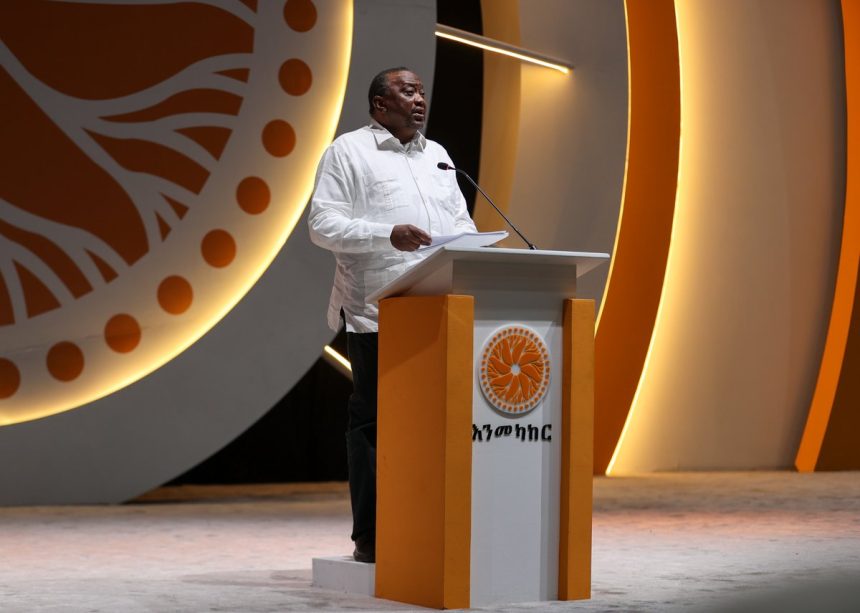
Former President Uhuru Kenyatta has hailed Ethiopia’s rich civilisation, diverse cultural heritage and indigenous systems of governance.
Uhuru, who graced the closing ceremony of the Ethiopian National Dialogue Conference in Addis Ababa, said Ethiopia’s history and cultural diversity offer valuable lessons on governance and national cohesion.

“I stand before you as a friend of Ethiopia, a country that has become to me a friend and a second home,” Uhuru said.
He said his travels across Ethiopia had given him an opportunity to appreciate the country’s diverse communities and traditions, particularly the indigenous systems that have shaped its society.
“Sometimes a friend has the privilege of looking at a country from outside and reminding its people of something extraordinary that they encounter so often that they do not see it-the riches of what they hold together,” he said.
Uhuru described Ethiopia as more than a nation, noting its significance as one of Africa’s ancient civilisations.
“Ethiopia is not just an African State, Ethiopia is an ancient African civilisation,” he said.
The former President also singled out the Gadaa system of the Oromo people, which he encountered during his travels through the Oromia region, describing it as a heritage deserving greater recognition.
“We move to the centre, Oromo heartland, vast landscape of Oromia and Oromo people, the Gadaa system,” he said.
The Ethiopian National Dialogue Conference, organised by the Ethiopian National Dialogue Commission, brought together nearly 4,000 delegates drawn from different parts of the country and diverse sections of society.
The conference officially commenced on July 15, 2026, with participants spending about 40 days deliberating on some of the most consequential issues facing Ethiopia.
The discussions were structured around eight fundamental national issues identified through nationwide public consultations.
They included state-building, identity and shared history; the structure of government, federalism and power-sharing; the status of federal cities such as Addis Ababa; religious and cultural affairs; institutional building, human rights and the rule of law.
The dialogue sought to provide a platform for Ethiopians to exchange views, address longstanding differences and build consensus on issues of national importance through peaceful political engagement.
The closing ceremony brought together religious leaders, former and serving presidents, senior government officials, national figures and invited guests.