
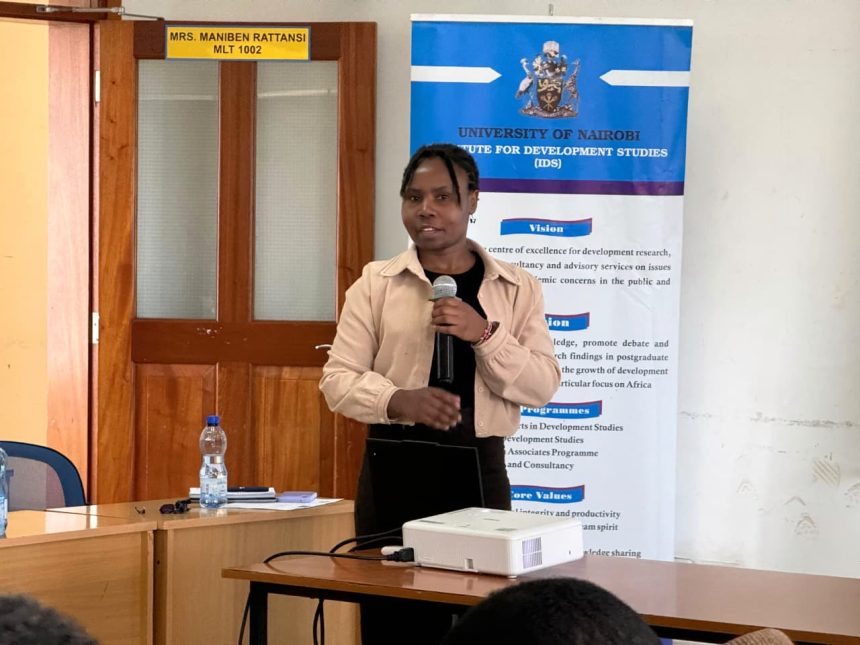
Established academic researchers and development policy specialists convening at the University of Nairobi’s Institute for Development Studies (IDS) have highlighted actionable strategies to boost Kenya’s industrial productivity, emphasizing that domestic value addition, the integration of Artificial Intelligence (AI), and synchronized state coordination offer practical avenues for economic advancement.
Speaking during an academic public seminar held under the theme “Debating Evidence on Growth: A Postgraduate Seminar on Kenya’s Economic Potential and Future,” the seminar evaluated growth data to outline how key economic sectors can scale up efficiently and capture high-value export markets.

Presenting during the discourse, development studies expert Abigael Kariuki emphasized that Kenya possesses strategic opportunities to transition from exporting unprocessed primary commodities into developing high-yield manufacturing capabilities. She pointed out that sustainable expansion requires driving productivity growth both within traditional agricultural activities and across modern industries like textiles.
She asserted the need for local processing, stating that “we have pockets of opportunities where Kenya can do the right thing. The most important objective we want is productivity growth within sectors and across sectors. Our core model must be to export value-added products and not raw products. We build lasting economic capability when we process our agricultural output locally before export.”
Adding depth to the conversation, renowned UoN Professor Karuti Kanyinga urged African scholars, innovators, and industry actors to proactively embrace modern technologies and artificial intelligence to multiply productivity per hour and align with evolving international trade standards. Prof. Kanyinga noted that modern global supply chains are increasingly tracking environmental sustainability, clean energy sources, and hourly efficiency benchmarks, making technological adoption an essential tool for competitive participation in international commerce.
Drawing on developmental benchmarks from across the continent, Prof. Kanyinga cited Morocco’s strategic transformation into a regional clean energy supplier and an automotive assembly hub for international manufacturers as an instructive example of what focused institutional coordination can achieve. He reflected that “when Portugal and Spain had a blackout, Morocco was able to supply them with power because they innovated and built surplus capacity. Today, Morocco is manufacturing vehicles for global brands and supplying European markets.”
Expanding on the operational aspects of economic development, Gatsby Africa’s Dr. Samuel Kareithi noted that transforming complex economic sectors requires patient, multi-decade capital rather than short-term project interventions. He demonstrated through regional trade analytics that addressing supply-side bottlenecks in livestock and aquaculture can enable local producers to satisfy rising domestic demand across Kenya.
The public seminar concluded with participants re-affirming the need for continued stakeholder engagements, noting that the dialogues hosted by the University of Nairobi and IDS would continue to generate evidence-based insights to inform Kenya’s industrial development path.