China and Kenya have pledged to enhance cooperation on global development and governance, with officials and policy experts from both nations calling for stronger multilateralism and greater influence for developing countries in international decision-making.
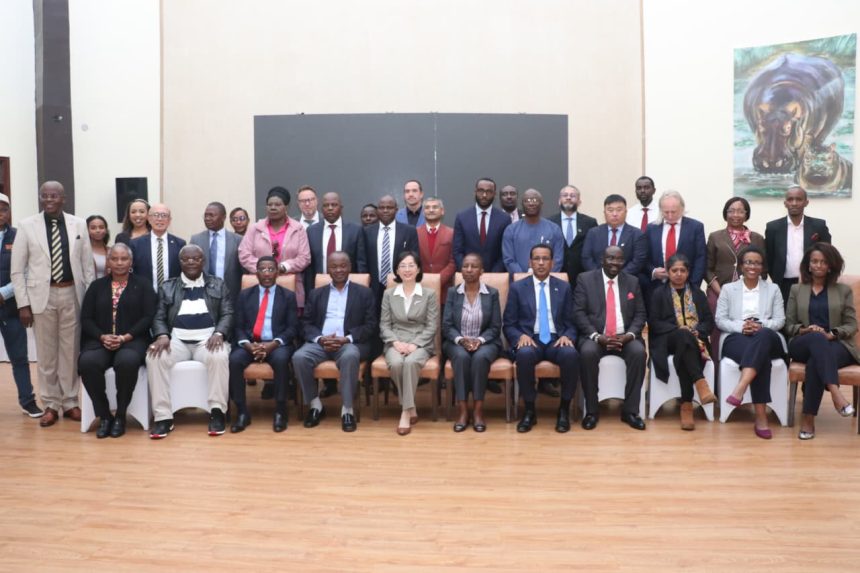
The commitment was made at a seminar held on Thursday in Naivasha, titled “Jointly Advance Global Development and Governance: China and Kenya Usher a New Chapter of a Shared Future.” The event was co-hosted by the Chinese Embassy in Kenya, Kenya’s Ministry of Foreign and Diaspora Affairs, and the Africa Policy Institute.

The forum gathered Chinese and Kenyan government officials, diplomats, United Nations representatives, think tanks, and other stakeholders. They convened to explore the practical implementation of China’s four Global Initiatives: the Global Development Initiative (GDI), Global Security Initiative, Global Civilization Initiative, and Global Governance Initiative (GGI).
Chinese Ambassador to Kenya, Guo Haiyan, stated that the four initiatives were designed to address interconnected global challenges in development, security, peace, and governance.
“The four global initiatives complement and reinforce one another, providing a clear strategic framework for promoting prosperity through development, maintaining stability through peace, enhancing mutual trust through exchanges among civilisations, and advancing equity through governance,” Ambassador Guo explained.
She noted that the Global Development Initiative, which celebrates its fifth anniversary this year, has moved beyond policy commitments to deliver tangible cooperation outcomes in developing countries.
Ambassador Guo highlighted the Standard Gauge Railway, Talanta Stadium, and Nairobi Expressway as examples of projects stemming from China-Kenya cooperation. She also pointed to collaboration in health, agriculture, education, and professional training as areas where the GDI has provided practical development support.
The envoy reported that, under the broader GDI framework, over 130 countries and international organisations have expressed support for or participated in cooperation.
She added that mechanisms such as the China-UN Peace and Development Fund and the Global Development and South-South Cooperation Fund have mobilised more than US$23 billion. This funding, according to Guo, has supported over 2,000 cooperation projects, trained more than 200,000 professionals, and benefited people in over 120 countries.
In Kenya, she disclosed that GDI-supported cooperation has included grants for health interventions, support for maternal and neonatal healthcare, scholarships and professional training, equipment for over 70 technical and vocational education and training institutions, and backing for national development priorities spanning infrastructure, agriculture, energy, water, manufacturing, and ICT.
Kenya’s Deputy Director General for Asia and the Pacific at the Ministry of Foreign and Diaspora Affairs, Jane Makori, said the cooperation reflects the depth of the strategic relationship between the two nations. Makori, representing Foreign Affairs Principal Secretary Korir Sing’oei at the seminar, said Kenya and China have maintained high-level exchanges and consultations that guide cooperation in areas of mutual interest.
“China is one of the most important strategic development partners of Kenya, being the leading bilateral lender. Kenya-China strategic partnership was elevated to all-weather in 2024 with a focus on Building a Closer Community with a Shared Future for the New Era,” she remarked.
She added that Kenya’s participation in the Belt and Road Initiative and the four Global Initiatives demonstrates the two countries’ commitment to South-South cooperation and shared development objectives.
Former African Union Commission Deputy Chairperson Erastus Mwencha said the next phase of cooperation should concentrate on ensuring development partnerships strengthen Africa’s productive capacity and participation in the global economy.
“It is not enough to build the railway or to open the market. We must load that railway with goods that Kenyan hands and Kenyan enterprises have added value to,” Mr Mwencha emphasised.
He also linked development cooperation to emerging global governance challenges, particularly climate change and artificial intelligence.
“GGI’s insistence on inclusive, multilateral governance applies as much to the algorithms shaping our future as to the climate protocols shaping our present. Both demand cooperation, not fragmentation, and a genuinely multipolar approach to writing the rules,” he stated.
Mwencha pointed out that the GGI is built upon five principles: sovereign equality, international rule of law, multilateralism, a people-centred approach, and real action. He stressed that the governance agenda should ensure Africa is involved in setting the rules governing emerging areas of the global economy, rather than merely adapting to decisions made elsewhere.
Practical areas through which Kenya and China could advance the Global Governance Initiative also shaped discussions, including proposals to strengthen cooperation through the United Nations and other multilateral institutions, increase the representation and voice of developing countries in global decision-making, reform international economic and financial institutions, expand development financing cooperation, and coordinate responses to transnational challenges such as climate change and artificial intelligence.
Ambassador Guo stated that China is ready to work with Kenya and other African countries, UN agencies, and think tanks to align the four Global Initiatives with the UN 2030 Agenda for Sustainable Development, the African Union Agenda 2063, and national development strategies.
“We are ready to work together to build an all-weather China-Africa community with a shared future for the new era, to help Africa achieve modernisation at an early date,” she said.