In the tense run-up to Kenya’s 2027 elections, almost nothing a politician does is without meaning. Symbols matter.
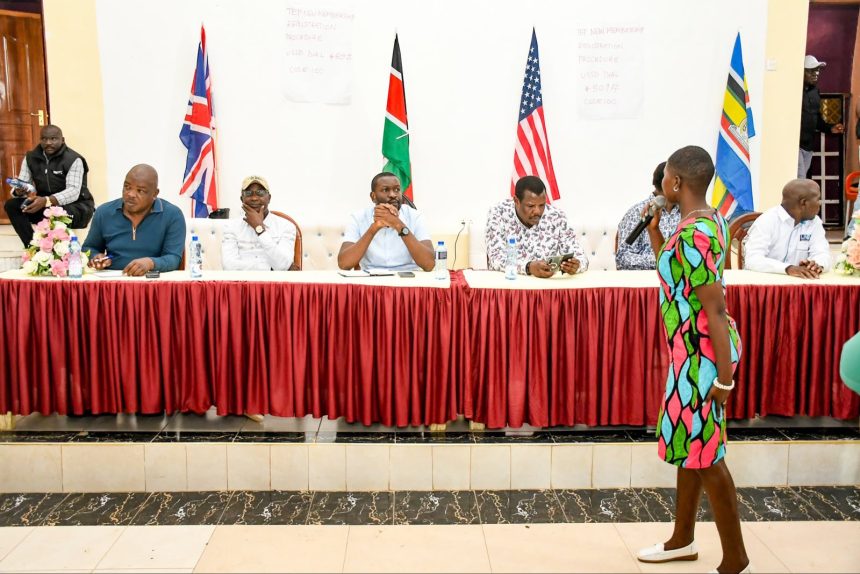
When Nairobi Senator Edwin Sifuna shared photos from his consultations with aspirants in Webuye under the Linda Mwananchi banner, people noticed something immediately. Behind him stood the flags of the United States and the United Kingdom. The online reaction was sharp and consistent, highlighting thoughts on the meaning and essence of it.

The image touched a raw nerve about legitimacy, identity, and what it means to lead in a country that still carries the memory of colonial rule.
Kenya’s flag was never just decoration. Black for the people, red for the blood that was shed, green for the land, white for peace, and the shield and spears for the defence of freedom. It was created after independence precisely to mark a break from the Union Jack that once flew over Government House and from the wider network of foreign symbols that had defined power for decades.
Placing the flags behind a man presenting himself as a champion of ordinary wananchi is more than poor judgment. It is an abuse of territorial integrity and sovereignty.
Sovereignty is not only written in the Constitution. It is performed every day in the choices leaders make about the spaces they occupy and the images they project. When foreign national flags dominate the backdrop of a domestic political meeting on Kenyan soil, the message is clear even if unspoken: external symbols are being given equal or greater visual weight than our own. That is not a small thing. It softens the boundary that independence was meant to harden.
No one is arguing that Kenyan politicians should avoid Western diplomats. Sifuna has met the U.S. Chargé d’Affaires and other envoys. Those conversations are normal and often necessary. But a private diplomatic meeting is not the same as a public campaign-style consultation with local aspirants.
In the first case, foreign flags belong in the room. In the second, they do not. A serious contender for national leadership has a responsibility to control the frame. What the public sees is not “Senator consulting people in Bungoma.” What they see is Western flags standing over a Kenyan political gathering.
African leaders who fought for independence understood this instinctively. Nkrumah, Nyerere, and Kenya’s own founding generation were careful about the visual field. They knew that liberation was incomplete if the symbols of the old order continued to occupy the centre of political life. Even those who later sought Western aid or security cooperation kept the national flag dominant in public settings.
Foreign emblems stayed in embassies and formal bilateral events. That discipline was not paranoia. It was an assertion of ownership over the country’s political stage.
The same standard should apply now. Foreign flags have their place at embassies, trade forums, and official state-to-state meetings. They do not belong as silent co-stars in grassroots political consultations. Sovereignty is not an abstract concept reserved for courtrooms and international conferences. It is practised in the ordinary decisions a leader makes about what stands behind him when he speaks to Kenyans.
In a country still negotiating the weight of external influence, these choices are not cosmetic. They signal where a politician’s primary imagination and allegiance lie. Sifuna and his team had the chance to affirm Kenyan symbols first. Instead, they allowed the flags of other nations to share the stage on Kenyan territory. That is not a minor aesthetic slip.
It is an unnecessary and avoidable abuse of the territorial integrity and sovereignty that generations of Kenyans struggled to establish.
The writer is a political analyst