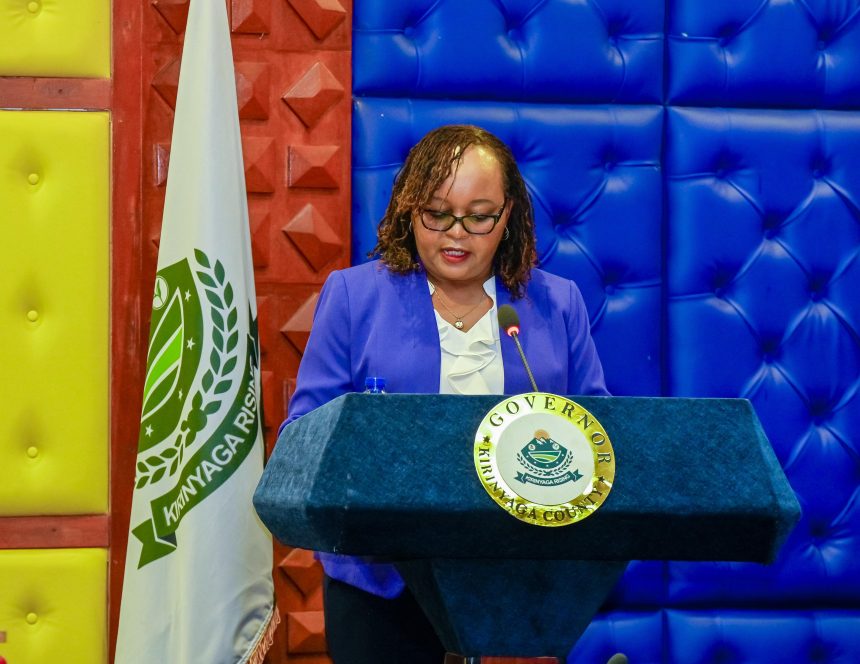
Kirinyaga Governor Anne Waiguru has declared that the development vision she set out for the county when she took office has largely become a reality with Gross County Product (GCP) growing by 66 per cent.
Waiguru said the GCP had risen from Ksh114.9 billion in 2017 to Ksh190.79 billion in 2025. The 8.7 percent economic growth rate in 2025, outperformed the national growth rate of approximately 6 per cent.

While delivering her final State-of-the-County Address before the County Assembly on Tuesday, Waiguru said the county had an impressive nine-year transformation record spanning all development sectors.
She highlighted the county’s own-source revenue improvement tripling from Ksh344.4 million in the 2017/18 financial year to Ksh1.11 billion in 2025/26, which she attributed digitization of revenue collection and management and the operationalisation of the Facility Improvement Fund, which have strengthened the county’s capacity to mobilize resources for development.
Waiguru presented an account of a county that has undergone far-reaching transformation through sustained investments in healthcare, agriculture, infrastructure, water, education, industrial development and social empowerment, translating long-held aspirations into tangible improvements in people’s lives.
The address was less a farewell than a powerful affirmation of a development journey that has seen Kirinyaga build stronger economic foundations, expand essential services, strengthen institutions and position itself as an emerging development and investment powerhouse.
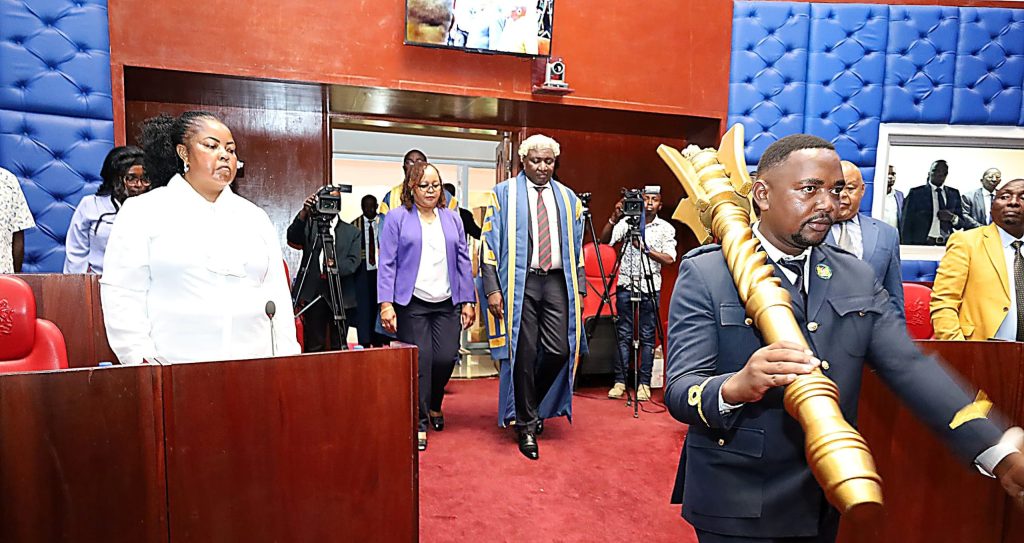 Waiguru ho has declared her bid for the Deputy President position, said her administration had spent nine years systematically translating its development promises into tangible projects, stronger institutions and measurable improvements in livelihoods.
“Today, we can proudly say that Kirinyaga has undergone remarkable transformation. Our economic foundation has strengthened, infrastructure has expanded, public services have improved, institutional capacity has grown, and our development outlook has become even more promising,” she said.
The outgoing Governor described the journey as a deliberate process of building a diversified economy beyond traditional agriculture and trade, with a stronger focus on industrialization, investment, value addition and modern urban development.
A defining feature of this ambition she said was the emerging Sagana Industrial City, one of the county’s most consequential investments and a major step towards positioning Kirinyaga as an industrial and investment destination.
Waiguru noted that for a county whose economy has traditionally depended heavily on agriculture, the project represents a significant shift towards processing, manufacturing and value addition. She said two investors targeting tomato and avocado processing have already delivered machinery in preparation for establishing operations.
The city’s Special Economic Zone has also been gazetted as a customs-controlled area, paving way for industrial plot leasing and investment incentives, while construction of 487 affordable housing units is progressing as part of the wider development.
The industrial city has already generated more than 2,650 jobs through the construction of its major components and is projected to create over 100,000 direct and indirect jobs when fully operational.
The governor said that the investment was designed to create an integrated economic ecosystem in which farmers would have reliable markets, local produce would be processed within the county and businesses would gain access to wider domestic and international markets.
Agriculture, which contributes approximately 42 per cent of Kirinyaga’s economy and supports 87 per cent of its population, has equally undergone significant transformation under the Wezesha Kirinyaga programme, which has supported more than 100,000 farming households across various value chains.
She said the programme had shifted the focus from fragmented smallholder production towards organised farming, commercial agriculture, cooperative financing, improved productivity and better market access.
Production across major agricultural value chains has recorded remarkable growth, with rice output increasing from 65,000 metric tonnes in 2017 to 210,000 metric tonnes annually, generating approximately Ksh16 billion for farmers. Tomato production has grown from 46,000 to 116,000 metric tonnes, with an estimated annual value of Ksh6.9 billion.
Coffee production has also risen from 28,000 to 49,100 metric tonnes, with sales reaching a record Ksh7.48 billion in the 2025/26 financial year. In the dairy sector, average milk production per cow has increased from 2.5 litres to approximately eight litres daily, translating into an estimated 86 million litres annually worth KSh3.1 billion.
In healthcare, Waiguru pointed to the construction of the Kerugoya County Referral Hospital Complex in 2023 as one of her administration’s landmark achievements, significantly expanding access to specialized medical services within the county.
She also highlighted the near-completion of the Kianyaga, Kimbimbi and Sagana hospital complexes, which will elevate the respective Level 3 facilities to Level 4 hospitals, alongside a network of dispensaries constructed and operationalised across the county.
Waiguru said the combined investments in health infrastructure and human resources had contributed to improved health indicators, with the county recording outcomes that surpass national targets.
Infrastructure development has been another major pillar of the transformation. Through the Nyorosha Barabara Mashinani programme, the county has strengthened connectivity across its rural and urban areas, reducing transport challenges and opening up previously inaccessible communities to economic opportunities.
Waiguru also cited improvements in the trading environment through the construction of about 30 markets and aggregation centres, town improvement programs, education and human capital development, as well as investments in social and economic empowerment programmes that have created opportunities for residents, particularly women and young people.
In water provision, more than 50,000 additional households have been connected to clean water, significantly expanding access to an essential service and improving the quality of life across communities.
The two-term Governor also acknowledged that development is a continuous process, with some flagship projects still at advanced stages of implementation. However, she assured residents that the remaining months of her tenure would be dedicated to completing ongoing investments, strengthening service delivery and consolidating the gains already made.
“I want to assure the people of Kirinyaga that although my constitutional term is drawing to a close, my administration remains fully committed to serving you until the very last day in office. We still have eight months ahead of us, and we shall continue working with the same energy, focus, and determination that have defined our service from the beginning. We will finish strong. We will complete ongoing projects, strengthen service delivery, and ensure that the gains we have made are firmly secured for future generations,” she said.
She also urged Kirinyaga residents to elect leaders who will safeguard and build upon the progress so far achieved, emphasizing that development is too important to be interrupted. .
“The roads we have built, the health facilities we have established, the water projects we have implemented, the industrial investments we have attracted, and the opportunities we have created for our people require leadership that understands the vision, values continuity, and is committed to taking Kirinyaga to the next level,” she said.
She described serving Kirinyaga for two terms as the greatest privilege of her public life, reaffirming her commitment to public service and to championing the interests of the county, Mt Kenya region and the country at a higher level.